Morning Thanks

Garrison Keillor once said we'd all be better off if we all started the day by giving thanks for just one thing. I'll try.

Monday, March 14, 2016

Ronnie and Nancy


In November of 1980, I was a graduate student in hallowed halls, where most of my colleagues and professors judged the end of the world was upon us. Ronald Reagan--remember that picture of him and the chimp?--had just been elected President of these United States, a former Hollywood movie star with unimpeachable. conservative credentials. Fire, pestilence and certain doom threatened all around. People talked of Canada.

We all lived through the next eight years and, in retrospect, did quite well. Some consider Reagan's two terms the finest years of the 20th century; then again, some aren't as worshipful. Iran-Contra was messy horror, and air traffic controllers found themselves out of work; but Reagan pulled off some wonders and made a hefty portion of America once more proud of being American.

If you liked Reagan, you probably liked Nancy too, always cow-eyed there beside him, the perfect helpmeet, who, as it turns out, did substantially more than pick out her husband's ties. Today, some call her the most powerful First Lady since Eleanor Roosevelt, more immediately influential than Hillary. Flaky?--well, maybe, consulting horror-scopes and other divines to determine the national course of action. But always there, maybe the most trusted adviser.

I met a woman from Tampico, Illinois, the birthplace of a the President, the man she insisted on calling "Ronnie," as if he was still in the swings in the city park. In the second floor apartment (above the bank) where Ronnie was born, there's something of museum today, nothing like the Reagan library, but something little Tampico is proud of.

And there, beneath a lamp on a table, stands a picture of Jane Wyman, Ronnie's first wife. His marriage to that Hollywood star is part of Ronnie's story, so that framed picture has a rightful place in Tampico's little museum. But locals claim that when Ronnie and Nancy toured the little upstairs apartment, Nancy made it very clear that she did not care for Wyman's picture. She hurried her husband out of there quickly--or so the story goes.

I'll have you know that Jane Wyman's starlet pic is still there on the table. Tampico doesn't have to listen to Nancy Reagan.

In 1992, the Reagans returned to Tampico, two years after he'd completed his second term. On the streets of town, the word is that Ronnie was clearly showing signs of senility--that was two years before his Alzheimer's was made public. Everyone knew, it is said, because Nancy commandeered the whole event, made all the decisions. Nancy was at the helm of the Reagan ship, Ronnie something akin to a smiling passenger.

If you wade through some of the memories, the stories, the reminiscences, it's not hard to forgo all the old politics. Nancy loved Tampico's Ronnie. She cared for him. Selflessly. 

That whole trip back to his boyhood home, I was told, was awkward in the way the presence of Alzheimer's creates discomfort, especially if it's not acknowledged. What may have looked bossy and pushy was behavior that arose from a heart full of love and respect, and a determination not to injure the President or his love for those he loved and who loved him in Tampico and all around this country.


That little upstairs Ronald Reagan museum has a copy of letter Ronnie himself wrote when, in 1994, he himself acknowledged what Tampico awkwardly witnessed but didn't mention two years earlier. 

I confess--for years I thought of Nancy as cloying. She made me sneer. 

But today I can't help think of how difficult it must have been for her to take care of Ronnie on a trip to his old hometown, to the upstairs apartment where he was born--how much she must have worried, how hard she had to work to try to make it all work smoothly. He was, after all, "Mr. President."

More than that, he was the man she loved.

It might not hurt to consider that an infirm President, even an unfit head of state, is not new. I'm with those who say Biden should withdraw, but it needs to be said that we've worked with such problems before.

Sunday, March 13, 2016

Sunday Morning Meds--That perfect storm


The waters saw you, O God, 
the waters saw you and writhed; 
the very depths were convulsed. 
The clouds poured down water, 
the skies resounded with thunder; 
your arrows flashed back and forth. 
Your thunder was heard in the whirlwind, 
your lightning lit up the world; 
the earth trembled and quaked.
Psalm 77

The days are thick and windless and unusually warm in the morning. Humidity veils the sun’s sparkle and casts the whole world in air that glows, as if somewhere down the road one could find a lake of hazy steam. Some days in early summer, every single afternoon sky telegraphs an evening storm; morning stillness threatens, as if dawn were only a cease-fire.

In the atmosphere, things build all day long until gray-green thunderheads mass like a mountain range mirage rising slowly in the west, rolling upward into huge raised fists. It’s just a matter of when and where and how violent.

The only way to live with tornadoes is to respect them from the moment they suggest they could be brewing somewhere far away in a swirl of angry clouds.

One night, years ago, in our old house, we rode out a storm in a cellar built years ago—six inches of cement for a ceiling. Plenty of rain had fallen that spring, and the water table inched up so high the hardware man joked there were only two kinds of people in town: the ones with water in their basements and liars.

In our storm cellar water stood a couple of inches deep, but there we sat—my wife with her robe rolled up above her knees, holding our daughter, her eyes wide as pocket watches in the dim glare of a naked forty-watt bulb set in the concrete wall. My pants legs were rolled up above my calves like peddle-pushers, and we sat barefooted, ankle deep in rain water while outside the wind swept over like a passover plague.

There was no tornado that night; we heard later that somewhere out on a farm a grain bin had been flattened. But even near-misses have ways of finding a place forever in wordless memories.

Here on the edge of the Plains, you just know when tornadoes might visit. You can feel it all day long, even when the sky is clear, the sun shining. Some kind of potent atmospheric mix sends shivers up the spine.

It’s not a tornado that Asaph coaxes from his memory in these verses, but what he’ll never forget—and what he wants to rehearse again and again—is the perfect storm, a potent cocktail of atmospheric events that must have shaken the Israelites to the bone. There they were, the only home they’d known left far behind, when suddenly this monster storm arises. They’re miles from cement ceilings, all alone on the plains.

Such storms scare people spitless. This one—the one Moses conjured himself—could not have been any different. Pharoah and his minions are out there charging, a monster storm is brewing. Moses stands up, arms raised, and just like that, the waters of the Red Sea part, creating a dry ground walkway.

Is it any wonder Asaph wants to bring that all back? In his anxious sleeplessness, his worry and guilt, he reminds himself to remember the story, that incredible story when God was there with them, miraculously, on the shore.

He wants to remember that absolutely perfect storm.

Remember that? How can we forget? 

Friday, March 11, 2016

A neighborhood


On one of the corners of Public School 21, Paterson, NJ, an old brassy sign stands proudly just off the sidewalk, a war memorial that lists the names of hundreds of men from the neighborhood who served their country during World War II. It's five feet high, maybe a yard across, soiled by the passage of time, weathered more than a little, but proud and still readable. 

The children playing out in the fenced-in yard were almost entirely kids of color, as were some of their teachers. Some of the men listed on that memorial may well be people of color too; one million African-Americans served the country in every branch of the military during WWII. But it's unlikely that many descendants of the vets listed on that old sign live in the neighborhood. When kids in PS #21 get into fifth grade maybe, and the teacher starts talking about WWII, chances are few have ever heard of it. Their stories--their great-grandparents' stories--are rooted elsewhere. 

It's a disconnect that's both inevitable and difficult, inevitable because most who live in the neighborhood don't have deep roots there, and difficult because it's hard to feel a part of a story you don't share. Most of the vets, I'm guessing, were white, and most white folks are gone. I hope I'm not being racist when I tell you that when I walked by that big sign this week, I couldn't help feeling that there's very little glory in the old memorial. 

If you're lily white, like I am, it's not hard to feel powerless in a neighborhood like the one around PS #21, and powerlessness a striking feeling because, if you're lily white, like I am, you really don't know what powerlessness is. It's new and it's strange and scary. 

I think I understand what many assume to be the power of Donald Trump's amazing appeal. White folks are angry that we've lost something, something, well, huge, in a land that once seemed so surely to be ours and promised so many dreams--and even, quite regularly, lived up to them. Today, it's getting uncomfortable to live in any neighborhood that was once ours. In airports and on planes this week, I heard a dozen foreign languages at least. 

I get it. I don't feel it, but I get it. Count me among those who believe Donald Trump threatens America like no other candidate. 

But I get it. I'm white. I get it. 

I was walking on the sidewalk just outside PS #21, Paterson, NJ, on Tuesday morning, walking to a place where a different story was being told, a story that brought people into each other's lives in a way that created a new story, our story. 

More on that soon. 

Thursday, March 10, 2016

Rush and the savior


Here's Rush's take. I heard him yesterday while I was driving back from Omaha, listened to his wisdom first hand on talk radio.

American evangelicals wake up one morning to find the house full of rats: dirty rotten liberals--you know, Obama and his ilk. The whole house, every square inch, wherever they look there are beady-eyed, buck-toothed rats who've long ago robbed us of our freedom. It's awful. You can't take a step without some pointy-headed rodent underfoot or drawing blood because they bite, too. Awful. They're everywhere, an infestation. There is no peace, no rest. Only war. So totally have the rodents taken over the house that the only things American evangelicals have time for is finding a way to get rid of them.

Listen, these evangelicals have prayed for deliverance. They've trusted in a sovereign God to rid themselves of the pestilence that's making life miserable in and out of their closets, but everywhere they look the still see rats and more rats. It's a plague of biblical proportions. 


Along comes an Orkin Man with yellow hair, a stuffed billfold, and fat little hands. He says he's got a concoction of poisons and old-fashioned potions ("Trust me," he says) that'll knock the shit out of them, all those stinking rats, and he'll use it when he becomes President. (BTW, that's his language--the way he explains things.)

Now the Orkin man has had three wives, including his latest, who's a real trophy. He's also foul-mouthed, and, Lord knows he'd have trouble getting through the eye of the needle. He's made his fortune in real estate and casinos, gambling halls, and not long ago was actually among the rats himself, a fat cat rat. But he's seen the error of his ways. He says he's a great Christian, even though he can't remember ever telling anyone he was sorry for anything. Sure, he's rough around the edges, but didn't Jesus hang out with tough guys?  Besides, he's repented of all of that. He's a convert. He only recently become an Orkin man.

And hey, when you're looking at a plague, what do you really care about a savior's personal life? What evangelicals know is that the house is full of rats--they're everywhere, and we need the Orkin man like none other to get the filthy, evil things out, to clean the place up, to make America great again.

That's how Rush sees it, just in case you missed it yesterday. 

Not since General Sherman torched Atlanta on his "March to the Sea" has America seen anything quite as devastating as the Donald's mad campaign for President. The guy has laid waste all kinds of heretofore sturdy traditions, broken just about every rule of campaigning, and totally confounded those who think they understand American politics, whether they see things from the left or from the right.  "I could shoot a man on Fifth Avenue and still be loved," he said right here at Dordt College. He's probably right. To Rush, he's the Orkin man.

Among American evangelicals he's created an identity crisis of cosmic proportions. They don't even know who they are. 

Right now, he's got us scrambling for a definition, something to describe ourselves. The only real competition left, the only fighter in the ring other than Trump is Ted Cruz, who built his campaign on winning "the evangelical vote." 

Guess what? A funny thing happened on the way to church. American evangelicals weren't buying. Instead, they've been going consistently for the Orkin man. Trump took out Cruz's strategy by snaring most of what people have considered "evangelicals," even though he says "Two Corinthians." 

There's never been anything like it. Ever. It's huge. 

But when you got rats coming out of your ears, Rush says, you don't ask whether the Orkin man reads the Bible. You hire him.

Thus saith Rush, who's been fighting vermin for decades, and admires Donald Trump, who promises, among other things, to save us from the rats.

Millions of evangelicals believe him. 

Me? Count me among the lost. I think the Orkin man is a con. I prefer the rats. 

I guess that means I'm no evangelical.
_____________________________

Even the New York Times is asking evangelicals what it means to be evangelical. Read through some responses here. 

Wednesday, March 09, 2016

Missionary Heroes and Villains (end)

Bishop Whipple at Ft. Snelling with the Dakota Captives
It is not impossible to argue that no single cultural force was as intensely destructive of the Dakota way of life as the work of Christian missionaries. Confessing Jesus Christ as savior changed most everything about the Dakota, exactly as its best missionaries wished and promised it would. Belief in Christ altered passions and behavior, and prompted those who did convert to renounce behaviors they often simply deplored and equated with a Dakota culture they tried to set behind them. Rev. Riggs, like his fellow missionaries to the Native people, wished more than anything to bring all God’s children home to his love. But that soul-change was impossibly tangled up with changes that were undeniably destructive to native cultures.

And it’s instructive to remember that by 1862, there were already hundreds of Christian Dakota, some of them—maybe many of them—the children of mixed-race marriages, “mixed-bloods.” Christian believers frequently distinguished themselves by wearing the white man’s clothes, cutting their hair, and becoming “farmer Indians.” Those Dakota who hadn’t converted often hated “farmer Indians” and mixed-bloods just as deeply as they did the white people who’d taken their land.

Still, we all know that in August of 1862, more than a few “Christian Dakota” became as angry as any, as if their conversions had amounted to nothing more than a haircut. Little Crow himself, a reluctant general, had attended Sunday worship on the Sabbath before the war commence.

 Stephen and Mary Riggs don’t appear to have been brutal or bigoted. They were simply a 19th-century American evangelical mission family couple, subject to all the prejudices we might expect; but there can be little doubt he loved the people he served.

No single moment in his own retelling of the 1862 story more fully documents his 19th century Christian enthusiasms than his reaction to what he considered the remarkable occurrences of spiritual renewal and conversion among the suffering Dakota men and women, first at Mankato and then at Ft. Snelling. When the attacks had begun at the Lower Sioux Agency back in August, Riggs admitted, in his memoir, that he’d thought about that day he simply couldn't help but wonder whether all of that work had been in vain.

But when he ministered to those who were imprisoned that winter, he was shocked by how many Native people were suddenly voraciously hungry to hear about this man Jesus Christ:

Some of these men, in their younger days, had heard Mr. Ponds [another missionary pastor] talk of the white man's religion. They were desirous now, in their trouble, to hear from their old friends, whose counsel they had so long rejected. To this request, Mr. G. H. Pond responded, and spent some days in the prison assisting Dr. Williamson. Rev. Mr. Hicks, pastor of the Presbyterian Church in Mankato, was also taken into their counsels and gave them aid. For several weeks previous, many men had been wishing to be baptized, and thus recognized as believers in the Lord Jesus Christ. This number increased from day to day, until about three hundred—just how many could not afterward be ascertained—stood up and were baptized into the name of the Father, of the Son and of the Holy Ghost. The circumstances were peculiar, the whole movement was marvelous, it was like a “nation born in a day.” The brethren desired to be divinely guided; and after many years of testing have elapsed, we all say that was a genuine work of God's Holy Spirit.

That phenomenal procession to grace was, to Riggs, an answer to prayer—and the answer to the riddle so many of us face so often in life—why so great our suffering if a loving God is in control of our world?

(#33—quote) This first communion in the prison made a deep impression upon myself. It began to throw light upon the perplexing questions that had started in my own mind, as to the moral meaning of the outbreak. God’s thought of it was not my thought. As the heavens were higher than the earth, so his thoughts were higher than mine. I accepted the present interpretation of the events, and thanked God and took courage. The Indians had not meant it so. In their thought and determination, the outbreak was the culmination of their hatred of Christianity. But God, who sits on the throne, had made it result in their submission to him. This was marvelous in our eyes.

In some ways, his reaction to this chapter of this frightful story is completely understandable to his mind and his soul. It was the best way he had himself of making some kind of a sense of the horror that Minnesota (and Iowa—Spirit Lake) can’t and perhaps shouldn’t forget, even though it happened, now, more than 150 years ago.

But that assessment, to those who don’t share his religious view, makes God into a monster who perpetuated the horror of what had gone on in August of 1862 in order to bring some Indians to a saving knowledge of Jesus Christ, an argument that may well be analogous to our saying that God created Auschwitz and Buchenwald, not to mention World War II, in order to save those who found the Lord within in the deprivation of the camps, as some certainly did.

It’s just not an argument many Christians are willing to make with such unbridled enthusiasm.

As a Christian myself, I’m not so sure as Riggs is of God’s specific plan—for the Dakota or the settlers—although it is impossible to doubt the confessions of those, like the thief on the cross, who truly sought the Lord in such god-awful extremes. Riggs was a fine man, a courageous Christian, someone who didn’t abandon the Dakota, when every other white person did. His need for comfort and grace had to be immense amid all the suffering he’d witnessed—on both sides.

But Stephen and Mary Riggs were nothing more or less than who they were—neither angels from heaven or demons from hell. There were beasts on both sides during that war—beasts who perpetuated the slow death of the Dakota people, and beasts who murdered the defenseless in a fashion many of their own didn’t and wouldn’t condone.

But between those extremes some were not, and at least some of those were missionaries, and a portion of them were really on a mission of the gospel of peace.

End


Tuesday, March 08, 2016

Missionary heroes and villains (v)


When the war was over, the governor appointed Stephen Riggs to be the Military Chaplain to Indian prisoners. In general, historians have come to describe his role in the trials that took place at Camp Release as a one-man grand jury. Often relying on the testimonies of those who had no joined the armed struggle, as well as the Christian Indians who opposed it, Riggs, in essence, created the charges against those who he determined required punishment for their acts. No single human being was probably more responsible for creating guilty verdicts against more than 300 Dakota, verdicts which almost inevitably led to a sentence of death by hanging. 

What everyone knows is that the testimonies he took often lasted no more than a few minutes so that it’s difficult to assume that officials of the government could have rendered, in many cases, anything but snap judgments. To say that justice was done at Camp Release in those few days of a blood-soaked frontier hearing is almost impossible. Those who consider what happened there as a cruel, kangaroo court have good reason. And the Reverend Stephen R. Riggs, missionary of the gospel of Jesus, was both the mind and the heart of that injustice.

Stephen Riggs seemingly never second-guessed the individual or collective results of his own conclusions of testimonies given at Camp Release. He played major roles in establishing the cases against almost 400 individuals; of that number, only fifty were released and twenty sentenced to imprisonment. The remainder, over three hundred Dakota, by way of indictments he brought forward, were condemned to hang. “The greater part of these,” he admits in his autobiography, “were condemned on general principles, without any specific charges proved, such as under less exciting and excited conditions of society, would have been demanded” (181).

What he meant by “excited conditions of society” can only refer to the bloody hate generated throughout the territory by the massacres perpetuated by the hungry Dakota. During the deliberations, the mail was full of hate, “letters from all parts of Minnesota,--a wail and a howl,--in many cases demanding the execution coming into our hands,” he wrote in his memoir. Newspapers in St. Paul burned with hate.

Those “excited conditions of society” had a palatable effect on him and the proceedings. Many of those quickly-drawn indictments, he admits, “had no good foundation.” His faith was that those convictions would be “reviewed by a more disinterested authority.” They were, by President Lincoln himself. Riggs himself tries to give cause for what injustice was done: “the condemnations were demanded by the people of Minnesota.”

At Mankato, Rev. Riggs acted as an agent of the state by translating for the condemned as well as letting the prisoners know what was going to happen. His old colleague Rev. John Williamson, ministered to their spiritual and physical needs. In his retelling of the story, many of those 32 who were subsequently hung turned to the gospel of Jesus for comfort and hope. For their work, both Riggs and Williamson were roundly condemned by white people, who had lost 500 of their neighbors to the Little Crow’s warriors, some of whom they knew and even considered friends before the blood had begun to flow.

After the mass hanging at Mankato, Williamson and Riggs continued to minister the hundreds of prisoners held in squalid conditions at Ft. Snelling, a place some call a death camp. Of the 300 or so Dakota men who were not hung—reprieved by President Lincoln—120 died in the next three years, some of them while imprisoned at Camp McClellan, in Iowa. Of the 1,600 Dakota men, women, and children locked up at Ft. Snelling, many guilty of no crime, 300 were dead in just a few months.

And it’s important to remember that hate was as poisonous as it was overwhelming. When contrary voices were heard—the voices of clergymen who publically deplored the horrid prison conditions in which the Dakota were suffering—they were brutally criticized. Preachers were physically attacked by white citizens simply for ministering to the imprisoned Indians. Riggs and Williamson and Whipple, who had intervened personally with President Lincoln, regularly kept religious services with the Dakota, and were scorched by newspaper editorials. “Holiest rites of the church given to red-handed murderers,” one journalist wrote. “God was mocked.”

The war had created such venomous hate that the white settlers of Minnesota wanted nothing less than to be rid of all its first residents—all Native people, including Ojibwa, who’d played no part in the war.

Hundreds of Dakota were crammed aboard steamboats for a long trip down the Mississippi to St. Louis, then brought across the state to St. Joseph to be jammed into yet another boat that took them up the Missouri to Crow Creek, in the Dakota Territory. Rev. Williamson protested: “When 1,300 Indians were crowded on the boiler and hurricane decks of a single boat, and fed on musty hardtack and briny pork, which had not half a chance to cook, diseases were bred which made fearful havoc.”

When they finally reached the Crow Creek Reservation, they were so weakened by starvation and disease that 150 died in just a few weeks, 300 by the end of the summer.

"That’s justice," many white folks said. "The only solution," said others. For what those Dakota did, vengeance maintained, hundreds had to die. And they did. An eye for an eye, a life for a life.

Through it all, Rev. Stephen Riggs stayed beside them, even though, by his own admission, his wife Mary was herself a victim of the war. “Mary’s health,” he wrote, “always tenacious but never vigorous, had received a severe shock by the outbreak and what followed.” In five years, his wife, and the mother of their eight children, died in Beloit, Wisconsin, and was thereby delivered “to the flowergarden of God,” he wrote.


What I want to establish is telling the Riggs’ story is the fact that this man’s life among the Dakota was complex—he is neither a hero, nor a villain. In fact, I think it may well be important to say that he was neither hero nor villain because, quite clearly, at times he was both.

He was a man who believed in his calling, loved those who he served, tried to balance justice and mercy, and never stopped ministering to those he’d come to serve. His commitment was total, lifelong. But there were moments in time—and not just a few—when his work was intractably related to larger causes and movements that imperiled and destroyed the lives and fortunes, the hearts and souls, of the very people he came to serve and eventually, I think, to love.

When his daughter tried to explain in a mission magazine what had happened during the brief but bloody Dakota War, she ended her story with attitudes that are strikingly clear:

The Indians have not been without excuse for their evil deeds. Our own people have given them intoxicating drinks, taught them to swear, violated the rights of womanhood among them, robbed them of their dues, and insulted them! What more would be necessary to cause one nation to rise against another? What more, I ask. And yet there are many who curse this people, and cry, ‘Exterminate the fiends.’ Dare we, as a nation, thus bring a curse upon ourselves and on future generations?

Monday, March 07, 2016

Missionary Heroes and Villains (iv)


Little Crow

As were all the white folks in the Minnesota Valley, Riggs and his family were forced out of their home at Hazelwood Mission when Little Crow and the Dakota went to war with white settlers in 1862; but it’s important, I think, to do the math here—by 1862, Stephen and Mary Riggs had been with the Dakota people in several mission stations for almost a quarter century.They were not newcomers; they had roots and experience, and they were well-known among the Dakota people.

And while the story of their evacuation, aided throughout by Native people, is not as bloody or tragic as many; their story is rife with suffering that left its imprint for a lifetime on those who were with them during their escape, including Mary Riggs.

On Monday night, when word of the attacks reached the mission compound, a Christian Native man named Paul Mazakutimani came to Riggs and his wife and begged for blue cloth because he knew that only if he took off his white man’s clothes and returned to a breechcloth could he escape death at the hands of his own people. Such a request must have been mystifying to the Riggs—and very scary.

That evening, Mary put her children to bed; but as more and more refugees, some of them hurt, came into the mission compound and told their stories, as more and more of the Christian Dakota people let Riggs know that what was happening was not just some spat, he knew they had to act.

First, Riggs led his people in prayer and sang hymns.Then, after midnight, they left the compound, unarmed, bound for an island in the river, where they hoped they might escape the ugliness. But when Riggs himself heard the latest reports of death the next morning, he knew they had to leave.

When they did, they met other men and women and children—some deeply traumatized, in shock. Rain began to fall hard that afternoon and didn’t quit until the next day. “The first night we were out, some of smaller children called for home,” Riggs wrote of that time. “The next night some of the older children would have cried had it been any use.”

By Thursday morning, they were out of food. They gathered wood from a grove, killed one of their cows, and roasted it over the fire. They had no utensils or pots and pans. And at that moment, a photographer escaping with them took this picture, one of very few photographs from the 1862 Dakota war.


All along the way, afraid for their lives, they had discovered burning homes, dead and burned and mutilated corpses. On Friday, they made their way to Ft. Ridgely, but when one of their number approached close enough, he saw burning buildings and more frantic homesteaders.What was supposed to be refuge offered no comfort.

On the Sabbath, they came to a crossroads, where many other white people were congregated. For the first time, they felt somewhat safe.

The Dakota War has far more horrible stories than that of the Riggs’ party’s escape, but none of those who traveled with them to safety likely ever forgot.

Just a week or two before the war began, Little Crow himself had been in church. The profound sadness the pastor must have felt surpasses anything I can imagine.

Sunday, March 06, 2016

Sunday Morning Meds--Interstate miracles


“You are the God who performs miracles; 
you display your power among the peoples.” Psalm 77:14

My daily commute back then was a good 45 minutes, mostly interstate, from the very heart of the small town where we lived, to the urban center of Milwaukee, where I taught and went to school. I enjoyed that daily trip. Forty-five minutes of morning news is a good way to start the day, and the traffic never really picked up until the last fifteen. , when I got to the city.

I don’t know how to describe the climactic conditions that particular morning, other than to say that, exactly where the suburban traffic thickened, I hit something akin to black ice, hardly visible but startlingly evident beneath the tires.

Without warning, my car did the sweetest little 360 you can imagine. Not fast, but in an almost delightful slow motion. Had I not been in the middle of a three-lane freeway, I might well have enjoyed it. When I remember it now, in fact, that complete turnabout seems almost elegant.

Miraculously, my car ended up going south, the direction I was traveling anyway. I’d accomplished an almost perfect two-ton pirouette. Me and the station wagon simply decided to stop for a moment and take a turn on the interstate dance floor. From above, it was a thing of beauty, I’m sure.

I remember being shocked, not so much at having lost control—that was too scary to allow me to imagine anything. Things had gone completely out of my control, and I shook so hard I had all I could do to hold the wheel. But it was flat-out unbelievable that I just kept on going down my merry way as if nothing had happened at all, that pirouette spun out of nowhere, almost whimsically.

Twenty minutes later I was in my office, my hands still shaking far too much to write or type. Both accidents and near-misses leave me trembling. I didn’t put a scratch on the car that morning, but I was shaking enough to have totaled it—I swear.

The janitor on my office floor was an odd character right out of a Flannery O’Connor story—a big talker missing an arm, wearing instead a prosthesis with a hook, his good arm heavily tattooed, roughhewn, an oddity amid university offices.

It was early—maybe 7:15, and I had an 8:00 class. I had to tell someone, so I told Robert the janitor, who stood there with a wastebasket under his good arm as I spun my fingers in the air, replaying the mad highway dance. “And I ended up right back there in the right lane of traffic, my snoot going south—it was amazing,” I told him.

He waited a moment, eyes flashing. “Get on your knees, man,” he told me. “You’d better thank Saint Christopher.”
Honestly, I’d never even thought of what had happened as a miracle choreographed by St. Christopher or God almighty. It had not dawned on me to thank my lucky stars for the fact that I’d been able to pull out of traffic alive that morning.

When he said it, I felt cuffed by the crazy janitor’s faith.

Or my lack of it.

That one-armed janitor was right—I should have been on my knees. I believe in miracles—spectacular and otherwise. I do. I believe in stupendous supernatural happenings that make no sense. God occasionally steps into our lives to pull a fast one. Sometimes bullets get snagged by pocket-sized Bibles. Sure.

I should have thanked my lucky stars, my God the holy choreographer.

As Asaph says, “You are the God who performs miracles; you display your power” right there on the everyday paths of our lives.


Friday, March 04, 2016

Missionary Heroes and Villains (iii)


Rev. Stephen R. Riggs felt called to the Dakota people by the burden and blessing of his Lord’s last wish to spread the gospel and to help others, those somehow disadvantaged. There is inherent paternalism in that assessment and, no doubt, all too often the road to hell is paved by well-meaning intentions.  But helping others isn’t morally repugnant in any culture. Among Lakota, band leaders achieved and held their community status on the basis of their helping their own disadvantaged, in traditional giveaways, for example.

Still, irrefutably, mission work among the Dakota in the early decades of the 19th century was not something any Dakota asked for. No one begged Riggs or any of the Presbyterians to come into their camps along the Minnesota River, and that fact cannot be repeated often enough.

What Stephen Riggs discovered quickly was that nothing could be accomplished among the Dakota without his learning their language. He and Mary spent most of their first year trying to learn the Dakota language, and when Stephen and his superior, Rev. John P. Williamson, determined that Riggs had a particular gift for language, Riggs stayed with language study and translated several books of the bible. He wrote the first Dakota grammar, still available on Amazon. 

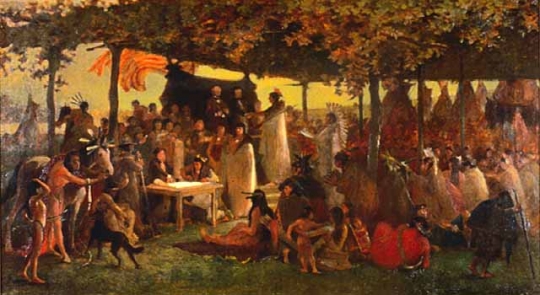
There is no question, however, that Rev. Stephen Riggs acted in the interest of white colonialism when he was assigned to be translator for the 1851 Treaty signed at Traverse des Sioux. Signing the treaty, some thought, was not in the interest of the bands of the Upper Dakota; others, older members, determined that Native people had few choices—they’d seen what happened to Black Hawk and his people. When pen was put to paper, the older members had won—Washington paid the Dakota an annuity the equivalent of 3 cents an acre for 24 million acres of land and charged settlers $1.25 an acre. The government set aside two reservations for the Sioux along the Minnesota River, each about 20 miles wide and 70 miles long, which later were made temporary. Like every treaty the white man created, the responsibilities assigned to the white people were eventually violated by those who had begged the Dakota to sign. 

1851 Treaty of Traverse des Sioux
The Reverend Stephen Riggs was well-suited to be a translator in that process because, like few others, he was blessedly bi-lingual. But if I were Dakota, and I grew to despise the bill of goods I was sold at Traverse des Sioux, I’d find it very difficult to separate the efforts of the white missionary from the government agents who lied and cheated.

Any assessment of the causes of the Dakota War of 1862 has to make reference to the 1853 Treaty establishing Dakota reservations and Stephen Riggs central role in it. 
White Christians today have to understand that. 

Riggs' Hazelwood Mission

The Riggs stayed with Dakota missions despite difficult conditions in the Native community and lack of support and commitment among those who paid their bills. Often finances were wanting, especially when mission efforts weren’t as successful at saving souls as supporters back east expected them to be. The Riggs’ family never returned out east. After the Dakota War, Stephen spent some time in Minneapolis and Mary lived in Beloit, Wisconsin. Stephen eventually returned to the Dakota people, as did he and Mary’s missionary sons and daughters.  What's evident is that the Riggs were not carpet-baggers in any sense of the word, moral or repugnant.

Nineteenth-century missionaries weren't of one mind when it came methodology. Some argued that any attempt at “preaching the Word” to the Dakota—and other tribes—could only follow attempts at altering--which is to say, destroying--Native culture. Riggs, and others, argued that the Word of the Lord itself changed minds and souls. It was an argument he stuck with in during theological battles and his own ministry among the Dakota. “That uncivilized heathen nations should first be civi­lized, and then Christianized, is a sentiment of the past,” he declared. “Now it is coming more and more to be acknowledged, that the Bible is the great civilizer of the nations.”

He tried to understand Dakota ways, even recorded their stories and legends to better understand their language, thereby preserving aspects of Dakota culture. He and the mission itself rarely saw seeing the significant results churchmen back east expected. His place, Hazelwood Mission, often struggled for years without converts. “We have sown our seeds in toil and in tears,” he once told his wife, “but where is the fruit?”

Stephen and Mary Riggs didn’t profit materially from their lifelong commitment to mission, but by their own testimony they seemingly didn’t profit “spiritually” either. By their own standards, they were not as successful among the people as they had determined or fantasized they would be. From the letters she wrote, it seems that after the 1862 war she never really prospered in any way.

The Riggs’ story is multi-dimensional, as is our assessment of Christian mission enterprise among America’s first nations is similarly complex and multi-faceted.

Of course, the Dakota War altered everyone's life--whether you preached the gospel, sat on rough-hewn benches and listened, or stayed outside the chapel all together. Everyone suffered.

Thursday, March 03, 2016

Missionary Heroes and Villains (ii)


Mary Riggs, the schoolteacher who married the Reverend Steven Riggs, was a thoughtful and devoted wife and mother who described her life in a series of letters to her family that have thankfully survived.

What the letters document is an obvious change in her perceptions. She began her mission work with childlike naiveté, a young woman who’d never been west and knew nothing about Native people. She was convinced that what she would touch would bear the imprint of the very hand of God. “Today, for the first time, if memory has not proved treacherous,” she wrote, “I have seen some of the dark sons of the forest, from the Seneca Nation, a peaked, oppressed people.” I wonder whether the word oppressed doesn't come from her abolitionist soul.

When she and her husband reach Minnesota, she quickly forms a strong opinion about the military, who are, after all, the only other white inhabitants of the Minnesota River valley. 
You remember I used to cherish some partiality for the military but I confess the last vestige of it has departed. I am not now thinking of it with regard to the peace question, but with that of moral reform. Once in my childish simplicity I regarded the army and its discipline as a school for gentlemanly manners, but now it seems a sink of iniquity, a school of vice. And oh, how lamentable is the influence which we wish to exert. And yet we are all from the same country.
Simply stated, the mission work of Mary Riggs, her husband Stephen, and of white, Christian missionaries—Roman Catholic or Protestant—is a moral mixed bag. If we understand that the selfsame motivation to free the slaves was at work in those who chose to minister to Native American tribes, it becomes more difficult to simply dismiss them out of hand as agents of colonial aggression or scouts for aggression of the Seventh Cavalry.

In her years at the Dakota mission, Mary Riggs's attitudes changed as her perception of the Dakota downgraded from “noble savage” to simply “savage.” Three years after the Riggs arrived in Minnesota, she wrote this to her mother: “We have scarcely anything to write except exhibitions of the folly and superstition—and the wickedness of this heathen people.”

She changed for other reasons as well: she laments her lack of letters; she became homesick; the hard work required as a young mother in frontier life kept her from the mission work she dreamed she would be doing; her husband’s dedication seemed to make him less considerate of hers. It wasn't an easy life.


But while her attitude toward the Dakota she and her husband served changed, she still campaigned stubbornly for the rights and the honor and dignity of Dakota women. At one time, a Native woman asked her, innocently, why she did not unloosen the Reverend Riggs’ boots when he came home. Mary replied that she simply never had done anything like that, that she in fact didn’t know how. The woman told her she could teach her how to do it and then continued:
The Dakota women always do thus & so when their husbands return from hunting. One of the wives goes out to meet & help him, taking his pack, whether game or furs, she carries it home. The she loosens his moccasins & taking them off, & also his leggings, washes his feet & anoints them with a mixture of oil & paint.
Mary, the missionary wife, gets more than a little snarky. “Is this being a ‘help-meet’ or a servant?” she asks her mother in a letter.


“You are aware,” she tells a friend in a subsequent letter, “that Indian women are too much slaves of their husbands & brothers; they seem peculiarly so among this tribe.”

Here’s a bit of moral conundrum one enters when making too hasty conclusions about the nature of mission work among this nation’s aboriginal people. If we see the missionaries only as point men for white culture—which, undoubtedly, they were—we fail to note some of the blessings those missionaries offered, in this case, Mary Riggs’ attempts to change women's roles among the Dakota.

On the other hand, what possible business was it of hers to assume a wife’s removal of her husband’s moccasins and some tender loving care for his feet when he returned from hunting amounted to slavery, a word I’m sure she didn’t use glibly? Is her attitude simply cultural chauvinism, and a deliberate subversion the unique culture of Dakota people?


Christian missionaries were often the very first white people Native Americans met as their land disappeared beneath the wave of Europeans. Here in the Upper Midwest, missionaries of the gospel—both Roman Catholic and Protestant—followed fur trappers, often preceded homesteaders. They were often, as were the Riggs, among the earliest white settlers in the woods and on the prairies.

It is painfully understandable to me how this country’s First Nations found it hard to determine the difference between missionaries, military forces, frontiersmen, and the early homesteaders, from all the other white people flowing endlessly into this region and taking up residence as if the Native people were invisible, eventually destroying a way of life that gave them life.

Christian missionaries began treating disease and injuries with their own medicine, but when they did, the change was at the expense of traditional medicines. Christian missionaries wanted Native people out of blankets and into white man’s coats and dresses and hats. Christian missionaries wanted an end to bloody, intertribal warfare—Dakota vs. Ojibwe. But ending violence destroyed traditional measures of character and manhood. Christian missionaries learned Native languages, but, in boarding school situations, forced Native children to use English, making precious mother tongues undesirable. Christian missionaries, Protestants especially, wanted red men and women to be white men and women.

Assessing the importance of Christian missionaries among Native peoples is difficult, complex, and even risky. Native folks who recognize the importance of traditional values understandably judge Christian mission outreach to be an enemy. White Christians who don’t understand that simply do not understand history.

On the other hand, Native people who perceive Christian missionary efforts among their people—yesterday, today, and tomorrow—as a means to cultural genocide fail to understand what Christian mission efforts have done to that benefit them.

That seeming paradox is both painfully and beautifully illustrated in the life of the Rev. Steven Riggs. More about that tomorrow.

Wednesday, March 02, 2016

Missionary heroes and villains (i)


Mary Longely’s father served his country in the War of 1812; her grandfather, Col. Edmund Longley, served under George Washington in this nation’s War of Independence. Mary herself was a proud child of this nation’s first white settlers, “true and worthy representative of New England,” her husband, the Reverend Steven R. Riggs says in the first few pages of Mary and I: Forty Years with the Sioux, his record of their long service among the Dakota in Minnesota.

Neither ever said much at all about their love for each other, but then their Puritan ways likely forbade such silliness. In some ways, their marriage was arranged. Riggs was the son of an Ohio blacksmith, born with a far more ordinary working class, 19th century history than Mary Longely. His father pressed him into service in the shop, to work that obviously didn’t please him much; so he went off to apprentice at a harness maker—less smoke and soot, he suggests.


But Riggs says the Lord God appeared to him “in a wonderful manner” and altered the course of his life, “making discoveries of himself to my spiritual apprehension.” Riggs says very little more about this clear spiritual vision, but what happened wasn’t all that strange. Most of the nation was enlivened by similar visitations in what historians call “the Second Great Awakening.” To Riggs, God’s call was life-changing, “so from that time onward my path lie in the preparation for such service as He should call me into.”

Riggs became a Reverend, and it was in that capacity that he and Mary met and were married. Mary was a schoolmarm with enough adventuring spirit to head west; she accepted a teaching position in Bethlehem, Indiana, and immediately began to search for a means to get there.

Rev. Dyer Burgess
Because many Midwestern church men happened to be, just then, out East, she found a traveling protector in Rev. Dyer Burgess, of West Union, Ohio, who had previously asked the young Stephen R. Riggs to live with his family while he was gone out East. Mary came with him now that Burgess was journeying back to Ohio.

Who cares about all of this missionary bingo? Here’s the point: Riggs characterizes his mentor and their cupid, the Reverend Dyer Burgess, as a “rabid abolitionist.” That he was, is of interest to our understanding Rev. Stephen and Mary Riggs and their place in the lives of the Dakota people and the Dakota War. They were--as Burgess was--abolitionists.

 Just how “rabid” Mary Longely was about the cause of abolition—the end of slavery as an institution in America—is unclear. That her pastor husband was unalterably opposed to slavery is clear, however. Riggs claims Burgess hired him on as a ministerial understudy because, Riggs says, Burgess had perceived that Riggs was “of the same craft.” That characterization suggests strongly that Riggs too was a strong abolitionist, maybe even “rabid.”

All of this church genealogy is helpful because it's very simple today to create caricature and even villainy from 19th century missionaries to America's Indiginous, ever since Plymouth Rock, in fact. That Stephen and Mary Riggs were products of their time and place is indisputable. On their shoulders they carried heavily what was then called "the white man's burden." The colonialist arrogance that has, without a doubt, created no end of horrors all across this nation is evident in his memoirs: “. . .we were already in the land of the Dakotas, and passing by the teepees and the villages of the Red man, for whose enlightenment and elevation we had left friends and home.” Riggs is a creature of his time.

But when I say these Christian missionaries were both abolitionists, it's important to note how contrary that sentence feels. In secular society, a missionary is a bigot, but an abolitionist is a hero. 

Well, mostly. The truth is, we still don’t know quite what to do with the most heralded of our “rabid” abolitionists, John Brown, a man so devoted to ending slavery that he led a suicidal revolt at Harpers Ferry, Virginia. 

But less “rabid" abolitionists, those who charted and ran the underground railroad are, today, and deserve to be, American heroes, at least to those of us who live above Mason/Dixon. In fact, the Dyer Burgess house was just one stop on an Underground Railroad. He was, like the Riggs, an abolitionist.


Home of Rev. Dyer Burgess, West Union, Adams County, Ohio (2012).
The Dyer Burgess House, West Union, Ohio
The Second Great Awakening did more than enthuse a nation spiritually; it also trumpeted causes that altered the way white America perceived its own moral character and its duty. In spirit and principle, Riggs would have certainly argued that teaching Native people to read the gospel of Jesus, like freeing the slaves, arises from a similar biblical impulse: "He has told you, O man, what is good; and what does the LORD require of you but to do justice, and to love kindness, and to walk humbly with your God?" Micah 6:8.

What’s more, one has to remember something of the times in which the Riggs worked. When, decades later, Richard Henry Pratt created the Carlyle Indian School with the express purpose of “assimilation through immersion,” his was the argument of white liberals, the progressives. The conservative alternative to "the Indian problem" was simple: extermination, genocide. As horrifying as that may sound, white missionaries, who undoubtedly did much to further colonization and its attendant horrors among Native America, were the enlightened alternative to mass murder. 

I'm not making this up.

Not long ago, in my own denominational archives I found a note written by a highly respected early country preacher named Bode, who asserted that the denomination should never undertake mission activity among Native people because, he wrote, such savages simply could not be saved.
  
My denomination’s first missionary, Rev. Tomme Vanden Bosch, went to the Rosebud Reservation in the late 1880s, where he preached the gospel to Brule Sioux and, by his report, had little success, so little, in fact, that he left just two years later, convinced, as Bode was, that mission work among so foul a people was impossible. 

In the next few days, I want to tell the story of Rev. Steven and Mary Riggs because we err in two distinct ways if we make 19th century missionaries like them into adoring saints on one hand, or vile colonialists on the other. The truth, as it always does, lies somewhere in the spacious ground between. 

Were missionaries heroes? Yes and no. 

Were missionaries villains? Yes and no.

That's the difficult and complex story I'd like to tell by way of the lives of Rev. Stephen and Mary Riggs.

Tuesday, March 01, 2016

Rehoboth, the CRCNA, and the Doctrine of Discovery


“We cannot spread the guilt. And we cannot seek to justify our actions,” the report states. “The CRC was wrong to establish and run a boarding school named Rehoboth; the land the missionaries sought to conquer was not theirs to flourish in; it was wrong to punish students for speaking their language; our denomination was wrong to take children from their homes. The CRC Board of Heathen Missions initiated a lot of pain through its dehumanizing view of Native Americans.”
That's how The Banner, the official magazine of Christian Reformed Church in North America (CRCNA), the denomination I remain a part of, summarizes a report coming before the Synod of the CRCNA this summer, a report from the Doctrine of Discovery Task Force.

What is the "Doctrine of Discovery"? It was--and still is--a papal bull issued by Pope Nicholas V in 1452 to condemn "Saracens [which is to say Muslims] and pagans and any other unbelievers" to slavery.
“We weighing all and singular the premises with due meditation, and noting that since we had formerly by other letters of ours granted among other things free and ample faculty to the aforesaid King Alfonso -- to invade, search out, capture, vanquish, and subdue all Saracens and pagans whatsoever, and other enemies of Christ wheresoever placed, and the kingdoms, dukedoms, principalities, dominions, possessions, and all movable and immovable goods whatsoever held and possessed by them and to reduce their persons to perpetual slavery, and to apply and appropriate to himself and his successors the kingdoms, dukedoms, counties, principalities, dominions, possessions, and goods, and to convert them to his and their use and profit -- by having secured the said faculty, the said King Alfonso, or, by his authority, the aforesaid infante, justly and lawfully has acquired and possessed, and doth possess, these islands, lands, harbors, and seas, and they do of right belong and pertain to the said King Alfonso and his successors”.
What has a 15th century Roman Catholic ruling have to do with 21st century affairs? The Doctrine of Discovery has links to us and our history and our culture today because it was used, especially throughout the 19th century, to deny Native peoples their very identity. It was used to perpetuate the horrifying notion that they had no rights to the land they lived on, land they often even considered sacred. The Doctrine of Discovery was a forerunner of Manifest Destiny, the doctrine that all of the new land belonged to the conquerors, who were somehow blessed by God. 

The Doctrine of Discovery Synodical Report claims, not wrongly, that the CRC's desire to do mission work in New Mexico at the end of the 19th century developed out of a view created by European culture's adherence to the Doctrine of Discovery. For that reason, the report says the CRCNA "was wrong to establish and run a boarding school named Rehoboth."

I have great sympathy for the argument. The history of this nation's abhorrent treatment of its aboriginal people is not of particular interest to most of this country's (white) culture. When, on national television, a Hollywood star the magnitude of Leonardo di Caprio takes a moment to dedicate his awards to Native people, we raise an eyebrow, at least until the next award category looms.

What is indisputable is that if you're of European stock, you're an immigrant, and, by Native standards at least, illegal. 

But I have significant problems with a report that so baldly states the CRCNA was wrong to do the kind of mission work it did--and still does--in McKinley County, New Mexico. What the report doesn't say is that up on top the hill south of Gallup there stands an impressive health care campus called Rehoboth McKinley County Christian Health Care Services, a facility created when St. Mary's Hospital merged with Rehoboth Hospital, which was the first significant health care facility in the entire region and another outgrowth of CRCNA missionary activity.


In my estimation, the report is not wrong, but short-sighted. That the CRCNA's mission efforts in New Mexico developed out of racist attitudes is undeniable. That we may have uncritically adopted commonly accepted educational theory with respect to our First Nations is obvious. That we preached but rarely listened is impossible to deny. That we were a significant part of a national policy of cultural genocide, difficult as it is to admit and, more importantly, confess, goes without question. 

But there's a hospital in Gallup today that bears the name of an institution that throughout its history did incredible work where there was nothing quite like it. And there's a Christian high school just down the road in Rehoboth that professional evaluators claim is one of the very finest in the country, the only one like it in New Mexico.

For the next several days--just as I have for the last several--I'd like to tell another long story, this one, like the one I've been telling, set here in the rural Midwest, not in the American Southwest. I would like to explore the role of mission enterprise by way of a specific series of stories and human beings who were part of the Dakota War of 1862. I'm not interested in establishing heroes or villains, but instead telling a story that is, at once, complex and difficult, a bloody story in which there are no heroes, only humans, in need of grace.

As we all are and were and will be. There lies the tale. 

Monday, February 29, 2016

Old River Bend Church--(vi)


What a couple dozen Santee families took home from the Ft. Laramie Treaty was not anger that grew from resolve never to give in to the white man. The Native leaders we honor--Sitting Bull, Crazy Horse--after the Fort Laramie tend to be those who, in the spirit of New Hampshire, "Live free or die."

In the Great Plains, Ian Frazier worships Crazy Horse, the Lakota warrior who wouldn't be photographed, wouldn't become an "agency Indian," wouldn't do anything white people wanted or demanded him to. We honor Crazy Horse with good reason. He was a fighter, wanted nothing less than justice for his people. He wasn't interested in conquering the hoardes of white folks streaming west and homesteading all over Sioux land. He wanted no more or less than to live as his ancestors had. 

But in On the Rez, Frazier says he's walking some things back from the honors he gave Crazy Horse. In On the Rez, Frazier claims Red Cloud should stand as high Crazy Horse in our esteem, even higher perhaps because Red Cloud came to understand when making war creating little more than more death among his people.   

The Santees who left their Nebraska reservation in early spring of 1869, determined there had to better way of life than what they would experience on their newly created reservation. So they walked to a place forty miles north from what became Sioux Falls, South Dakota, at just about this time of year. The weather here can change in an hour. Saturday morning it felt like spring. Sunday morning it was winter. Walking 150 miles was not unusual for them, but when a blizzard came, their numbers were decreased by one--a woman died. More left Nebraska later that year; more again the next.

They were leaving behind the guarantee of annuities, the reparations the government promised if the Sioux people pledged never again to take arms against the flood of white folks moving west. 

In lieu of all sums of money or other annuities provided to be paid to the Indians herein named under any treaty or treaties heretofore made, the United States agrees to deliver at the agency house on the reservation herein named, on or before the first day of August of each year, for thirty years, the following articles, to wit:
For each male person over 14 years of age, a suit of good substantial woollen clothing, consisting of coat, pantaloons, flannel shirt, hat, and a pair of home-made socks.
For each female over 12 years of age, a flannel shirt, or the goods necessary to make it, a pair of woollen hose, 12 yards of calico, and 12 yards of cotton domestics.
For the boys and girls under the ages named, such flannel and cotton goods as may be needed to make each a suit as aforesaid, together with a pair of woollen hose for each.

The Treaty mandated much more, of course, including the promise of individual land ownership within the reservations. But when the Santees left their Nebraska reservation and started walking north, they had determined not to be wards of the government.

Why risk leaving? Why turn down what the government promised? 
The germs of this movement are to be found in the resolves for a new life made by these men when in prison. They were all nominally, and the greater number of them really, converted to Christ. All of them, in some sense, experience a conversion of thought and purpose. 
That's how Reverend Stephen R. Riggs explains their motivation to leave in his mission memoir Mary and I: Forty Years with the Sioux. To be sure, he has good reason to assess their leaving the way he does--he is undoubtedly determined to register successes among those to whom he ministered. He wants to believe his lifetime of mission work bore fruit. 

But what if he's right? What if the desire for freedom in those Santee families grew from a growing unease with a way of life that they perceived might well become a endless circle of dependency? What if their Christianity helped them determine that they wanted to live free, as citizens of the nation? Then isn't it worth our time to know that when we pass the old church on the hill just outside of Flandreau, South Dakota?--a church and a community established by Indians, not by white men,

Here's how Rev. John Williamson saw it:
Many wonder why the Flandreau Indians ever left the agency with free rations and gray suits. If one could see into their hearts, he would find that it was the same longing to "be one's own," or for freedom, as we say, which led the Puritans to Plymouth Rock.
Once upon a time, the novelist Frederick Manfred told me where his interest in regional history began. His father and the boys had just finished milking, he said, so he sat down on the cement steps outside their farm house near Doon, Iowa, and looked out on the broad land before him, miles of it. He said he couldn't help asking himself what stories were there in and on that land, stories he knew nothing of. There had to be more than he knew, he told himself.

That's where the stories began.

Sometime soon, sit on the step and wonder for yourself. I'll have you know that the River Bend Church isn't all that far from here, just a ways north. Worth the trip. Oldest Continuously Used Church in South Dakota. Read the sign for yourself someday. 

It's not that far from home.