Morning Thanks

Garrison Keillor once said we'd all be better off if we all started the day by giving thanks for just one thing. I'll try.

Monday, March 23, 2015

"Bully pulpits and closet prayers"


In 1640, Boston had more educated people, per capita, than London, because Protestantism, Calvinism to be more exact, was all the rage. Hard to imagine, I know, but it's true. Puritanism wrote the mission statement for Harvard College. Jonathan Edwards, the most famous Calvinist preacher in American history, was once president of Yale. 

Protestantism built schools all over the world.  In Africa even today, differences between countries where England and France colonized still exist because the predominately Protestant Brits pushed universal education. Early American Protestant missionaries to this country's indigenous peoples were almost always responsible for the preservation of Native languages, not because those missionaries were anthropologists, but because they wanted, above all, to teach Native people to read the Bible. If the Reformation was about anything, it was about democratizing the Holy Scriptures, taking the Word out of the hands of the priests and placing it lovingly in the open hands of the laity. Sola Scriptura.

All of that is noble, a history I'm proud of, but it has its dark side.

Just for a moment, imagine you know Christianity in the way the Christian faith can be known in America even without participation. You love the Christmas season, and you know the Pope is rare because he gets headlines for saying things that no other pope has. You get that.

You also know that in some places three or four different churches stand inside just a couple of city blocks, that the internet has a million religious sites, and that any hour of the day or night you can find two or three TV preacher saying woe and woe and woe. Christian billboards are as ubiquitous as bumper stickers. Kids wear t-shirts with Bible verses--so do their moms and dads. And, oh yeah, someone down south somewhere is building an some big fat ark. What's that about?

So one day you ask the really nice woman you work with--she's got a bible verse on her coffee mug--that you don't get this whole Christian thing. That comment lights her up like nothing at work has in a long time, and she brings you a Bible. "Read this," she says.

So you go home, put your feet up, and open about halfway through--I mean, what do you know?--and find the book of Hosea. You start reading.

Good luck.

Hosea has a story, but that story--honestly?--is bizarre, half real and half parable. It's about a man who is ordered by God to marry a whore. He does, a spike-heeled street-walker named Gomer. She continues to make a living the hard way, but he buys her back. Seriously? Is that what happens? Anyway, the guy, Hosea, has kids by some wife--the tramp?--and gives them really bizarre names.  

That's it. All of this happens in three chapters, and what follows are eleven more of sermons from Pat Robertson on steroids. Mostly the same, too, playing on a film loop.

Say, what? 

Teaching the world to read was a noble effort, just as putting the Bible into the hands of everyone was a blessed event that, in its own way, gave birth to democracy.  

But it also created a gadzillion readings, from Martin Luther to Martin Luther King, from Joseph Smith to David Koresh, from you and me and the weird guy down the street who's in sackcloth and ashes beneath that bizarre sandwich board. Isn't freedom a riot? Yes, it is.

Our little Bible study "did" Hosea this month, and I for one found this minor prophet a mystery, a scrapbook of sermons that no one took the time to edit. It rips up the Jews of the northern kingdom, but promises love anyway in a fashion that any believer--including this one--simply calls grace. I get that.

But it wouldn't work well on a flannelgraph. It requires interpretation, as does every last verse of the Bible. Listen, "Thou shalt not kill." Very true, except for police, of course, and Navy Seals and  U.S. Marines. It's a raw and difficult rule, but it seems to me to be true that you can't just believe every word the Bible says.  

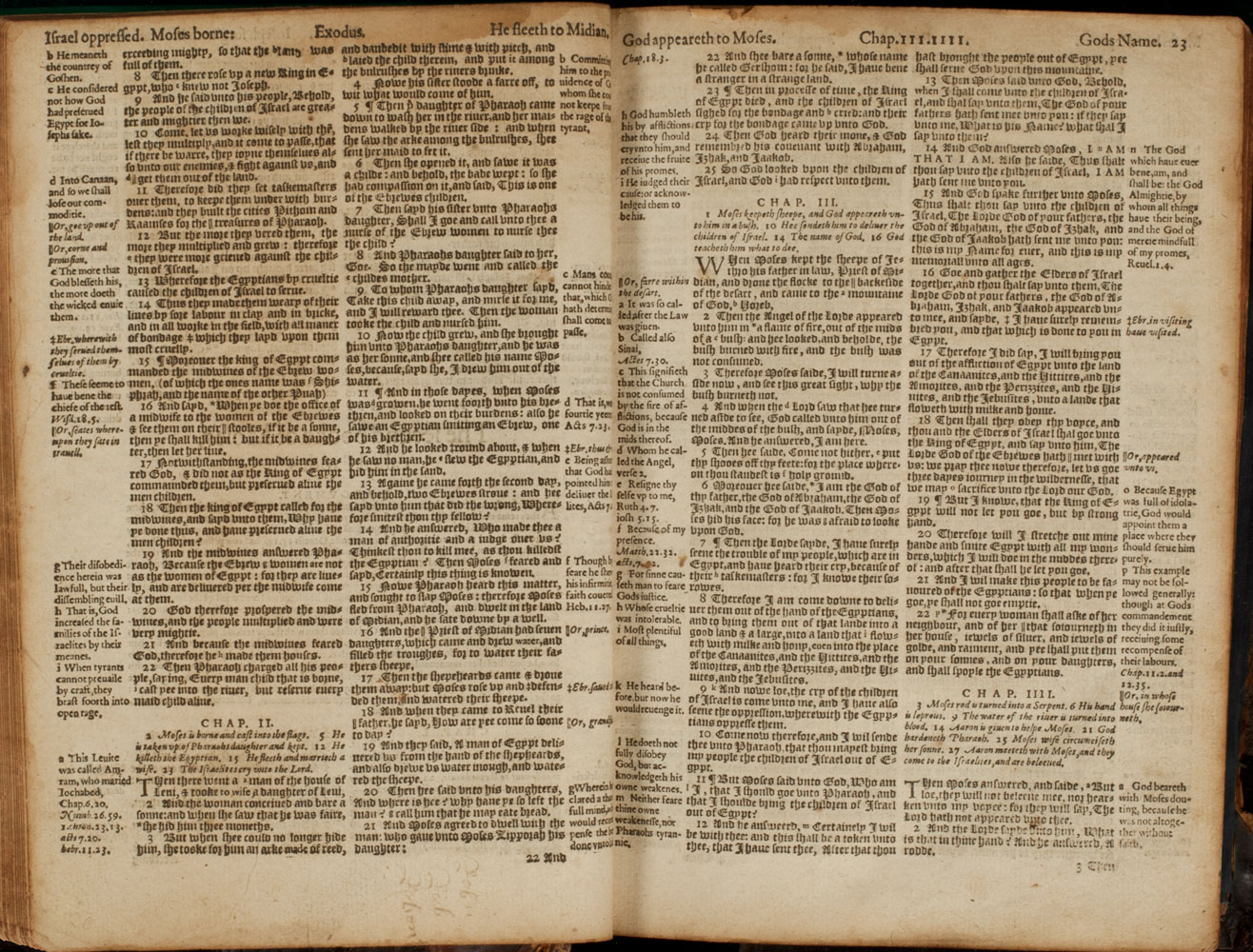
Those first Calvinists knew it. That's the  Geneva Bible at the top of the page, first Bible "of the people, for the people, and by the people" you might say. Have a look at the running commentary on the sides. That's there to teach you and me how to read because you can't just "read the Bible."

If it's the Word of God--and I believe it is--then, well, "it's complicated." David Koresh had a faith that was vastly deeper and stronger than mine, but he was also out so significantly out of his tree that he believed every woman on the compound was soon to be yet another Mary mother of God by his divine insemination. 

I like what Samuel Mahaffy says in a recent post:  "It is time to put religion back in the closet where it belongs. With fewer bully pulpits and more closet prayers, we may yet find our way back to the sacred." 

He's not just talking about just Christians either. He's talking about Sikhs and Muslims and Mormons and Roman Catholics and Evangelicals and fundamentalists of all persuasions. It's time to pay attention to these words of Jesus: "But when you pray, go into your room, close the door and pray to your Father, who is unseen."

Mahaffy says we need fewer bully pulpits and more closet prayers, and he's right.

Thursday, March 19, 2015

Deception Pass -- a story (i)


Just yesterday, I was reminded of a story I wrote ten years ago already, maybe more, when a magazine wanted me to write stories with themes that connected to how we worship. It had been a while since I'd thought about that story--and a ton of others thusly conceived--so I thought I'd run this one for a couple of days. This particular issue was to be devoted to how we do baptism, and in my theological world baptism is an infant thing. So, there's the assignment: write a story that has something to do with the sacrament of baptism. 

Here 'tis, from a magazine titled Reformed Worship, a story about baptism that happens to be set in the Pacific Northwest.
___________________

What is unique about Reverend Gordon Martins--and his whole congregation at Snowhomish Church recognizes it--is his penchant for doing meaningful baptisms.

Often it means a children’s sermon with all kinds of visual aids--a goldfish, a baby hamster, a meat cleaver (of all things!), five hundred-dollar bills, and the one no one would ever forget, his own wife in a bathing cap. Each baptism had its own, special music: Amy Grant done by kids, teenagers, and even in duet, one time, by a mom and dad; the three-year-olds singing “Jesus Loves Me”; and “Feed My Lambs,” that Natalie Sleeth pastoral, with flute accompaniment by the baptized child’s sixth-grade sister.

What no one at Snowhomish Church knows, however, and what few anywhere understand is why Pastor Gordon has this thing for baptism. There is, after all, a reason.

Pastor Gordon’s father was a firebrand preacher, a man driven to purity in doctrine and life, a dissenter in the denomination into which he was born, and like the pilgrims who settled Plymouth, Massachusetts, finally a separatist who left his childhood denomination to beget a new and more rigorous assembly.

His mother was the exact kind of woman his father required: she slid along in his sometimes turbulent wake without once second-guessing the surf her husband was creating. Both of them were small, hunched in appearance, stern-faced but full of the spirit; their eyes seemed to match, dark and foreboding and wary after all those years of battle.

Gordon was the oldest of four children--three boys and a girl. His brother Autrey sold carpets and taught ninth-grade Sunday School in Eugene, Oregon; while Rebecca, their sister, like her mother, had set her sights on motherhood, married a man who became a professor at a Christian college, and the father of their four children.

Then there was Jeremy, the prodigal.

*

It is August, 1985. The Martins family is camping at a park in Whidby Island, Washington, together for the first time since the death of their father two years earlier, when the children decided they should get together more often, not just wait for the next funeral.

The place is called Deception Pass, more than an hour from Snowhomish Church, a place Gordon picked for its beauty, where each day billions of gallons of tidal water from the sound rush through a thin, deeply cut crevice in the earth, back and forth, to fill and then empty the basins of the island.

Jeremy and Alexandria, his second wife, arrive in a beat-up Volvo, a pair of bikes on a rack on the trunk. The rest of the family knows that the first time he was in church for years was the funeral of his father. Alex is his wife now, but she wasn’t when their baby, Aaron, was born, just two months after the funeral--and believe me, that’s another story.

Jeremy and Alexandria are the first of the children to arrive, after Gordon, of course, who with Donna, his wife, has set everything up. And perhaps because they are alone--Gordon, the preachers, and his brother Jeremy, the prodigal--Jeremy asks Gordon a question Gordon hasn’t really anticipated.

It’s asked in a flourish of hope, Gordon thinks, when the two of them are standing alone outside the cabin where Alex is nursing the baby. Jeremy is lifting the trail bike off its hooks, when he looks at his brother, smiles, and says, “We want you to baptize Aaron--here, now, with the family.” Then he puts the bike on the gravel, lifts the front end off the ground and spins the front tire, as if to see if the long trip from Minnesota did any harm. “We think it’d be nice, with all the family around. It’s something we’ve thought a lot about,” Jeremy says. “We’d like you to do it.”

Gordon’s first reaction is his father’s: a family is not a church. But although he is a preacher, Gordon is by no means his father’s clone.

“I mean, when everybody’s here,” Jeremy says, taking hold of the second bike, the one with the baby seat.

So much within Gordon wanted to rush into a wonderful baptism in the same headlong fashion by which tidal waters pour through the steep gorge on the coast. Baptism was a step after all, a baby step, even, toward faith for his brother Jeremy, who the whole family had prayed for endlessly through what?--fifteen years of rebellion and personal problems.

“It just seems right to us,” Jeremy says. “It’s not just for Dad’s sake either, it’s for us--for Aaron.”

It was a mark of how far Jeremy had wandered from the path of his father that he would even ask such a thing--so sure Gordon was of what would have been his father’s immediate response.

“Wouldn’t it be great for Mother?” Jeremy says.

Gordon helps his brother lift the suitcases out of the trunk. What he knows, of course, is that he can give no answer so quickly, so he offers his brother the only response he can think of right off hand. “I’ll have to think about it,” he says. “It’s not just something one does, Jeremy-like nursing the baby.”

Something dies, just that fast, in his brother’s eyes, and Jeremy turns away, carrying a pair of suitcases up the worn board stairway and into the cabin. Behind him, the screen door slams, slapped shut by a long spring. Just as quickly, Jeremy reappears. “You’re so dogmatic, Gord,” he says from the doorstep. “Just like Dad, there’s no humanity in you.”

“I haven’t said no,” Gord tells him.

“But you’re thinking about it,” Jeremy says.
______________________________

Tomorrow: conclusion

Wednesday, March 18, 2015

Morning Thanks--Dawn's own grace


I am, for better or for worse, among those who lay claim to the the theological legacy of John Calvin, not that I care to fight about it. Count me among those who believe---gulp!--in predestination. 

There I said it. I'm out of the closet. Now let me say it again: I think Calvin was right about the inscrutable sovereignty of God. 

But before we lay bare our fists, let me say that the truth of that much maligned doctrine can be forsworn only in a rear view mirror. That God chooses us makes sense only after the fact, not before, and certainly not about you or that gent down the street or the woman he married or didn't. That God does the heavy lifting in mission work doesn't mean we don't.

I have beloved Christian friends who think I'm stark raving mad to admit that, sweet saints who've been brought up to believe that what I've just said are fightin' words. 

I get that. One of my all-time favorite wise men, a thoughtful scamp named Rev. Leonard Verduin, used to say that salvation will forever be one of God's great mysteries. To say we have no free will like the predestinators do is to deny our own functioning humanity; but to say that our free will trumps God's will is the rant of idiots. Verduin told me he liked to think of grace as an escalator (think airports) constantly going up to the next floor, always in operation (heavenly escalators here, not the ones in O'Hare), always moving, always accessible, always lugging human being into grace.

But you got to get on the dumb thing. An escalator won't grab your bag or load you. You got to take a step yourself.  

I like that.

See the picture up top?--that's yesterday's dawn.

I sat down here correcting papers until seven, got up from the chair, wandered over to the picture window right here to my right, looked out, and saw--I'm practiced at dawns--that this Greenland-sized gray cloud was aimed like a battleship at the spot where the horizon was burning and that therefore what was going on outside my window was going to turn into something that was going to knock your socks off.  

All mornings are masterpieces--don't get me wrong. Dawn is always so much more than dawn. If you don't believe me, open Walden to its back pages sometime and listen to Thoreau.

But this one, I knew was going to be special, as they say, the colors not to be believed.


I was right. I got a pair of shoes on, threw on too light of a jacket, grabbed my camera, and drove like a banshee to a place where the horizon was open to the sky, where there was enough of a silo to create some frontispiece. Then, suddenly, and only momentarily, I was in a cartoon world.

I came back home, unloaded the goods and dropped four of them on Facebook. Not once in my years on FB did I get as many "likes." More than one hundred.  These shots are show-stoppers not because I painted the heavens but because yesterday's dawn, for which I'm thankful by the way, was one of those once-a-year specials. Grace was written in the heavens.

I got a digital remembrance or two because I was there. I saw it with my own camera. But that's it. I didn't do it. I didn't spring that battleship of a cloud, I didn't paint its underbelly scarlet, didn't do a darn thing. I was just there looking through a lens.

That dawn you see there belongs to the Lord.

That's the kind of Calvinist I am. See this?  That's what he done yesterday, just outside my window. 

That's grace, or at least something like it.


Tuesday, March 17, 2015

Siouxland 101


No tests. No quizzes. No essays. No grades.

But some required reading.


Ought to be fun.

Monday, March 16, 2015

Please be disturbed


There I sat in a room crowded with science profs, Christians, all of them talking about evolution. Like Republican politicians these days, I don't know much all about the subject. I can read and I can think (I think), but my inclinations don't take me deeply into the nature of nature. Just don't. "We can choose what we write," Flannery O'Connor once said, "but we can't choose what we write well" (don't ask me for chapter and verse).

For the most part, the discussion had to do with teaching approaches in a Christian college where lab tables full of students probably believe the world would be better off if Darwin had chosen to be a butcher or baker or candlestick maker. To many evangelicals, "evolution" is just another word for "revolution" against the Almighty.

I won't try to quote anyone, but it was clear--and no one should be shocked about this--that the profs (from two different Christian colleges by the way) considered themselves more open-minded about such things than at least some their students and a goodly number of parents.

A kind of consensus formed mid-stream that nothing could be finer than a student's willingness to listen, maybe even carry a dollop of doubt. "What we want to see in students is a questioning mind, a little confusion," someone said, which might translate this way: in some situations we want kids with doubt.

I understand that.

I was not a participant in all of this, just a facilitator. I didn't have to talk, and I didn't say much at all; but as I was sitting there, I couldn't helping thinking that neither college would be using a line like that on its web page any time soon. "We want only open minds"--put that on a banner up above the student union on a Friday visit day.

In an article in Tablet, Todd Gitlin says some documentary-maker came to his campus recently to show a film that featured the unspeakable violence going on in Syria. Before the presentation started, the director said, "We want to haunt your imagination. Please be disturbed."

Please be disturbed. That's not going on a poster or a t-shirt anytime soon either.

Todd Gitlin says, "Universities are not fallout shelters."

Neither are Christian colleges, nor should they be.

Which doesn't mean there are no rules. The only time I exercised censorship in my classroom was decades ago when, from a retiring colleague, I inherited a course in contemporary novels. My predecessor's curriculum looked like a good place for me to start, so I followed his leads, including the novel Clockwork Orange, by Anthony Burgess, a novel that featured frighteningly violent scenes in order to question behavioral sciences then in their heyday (think B. F. Skinner), a kind of uber-disturbing 1984 or Brave New World.

I assigned Clockwork Orange until a couple of female students told me, politely I might add, that they simply weren't going to read it. These students were not excessively prudish; their spokesperson is, today, a celebrated university prof herself. They were deeply offended by the rape scenes especially, by what the novel itself called the "ultra-violence" of the street toughs.

I quit the novel right there. It's probably important to point out that I never was taken with Clockwork Orange; as far as I was concerned, it took two steps back into barbarism in order to take one step forward into enlightenment. It's a novel with a point, with an argument, a thesis--not my cup of tea. As it turns out, it's an asterisk today, a novel (and a movie) known more for its innovation than its moral character, a story with really flashy accessories but a sermon whose time has basically come and gone.

No matter. I quit.

Did I do the right thing? I think so. I think I felt a gender block here, the sense that the novel was much easier for me to read than it was for the young women in my class. In this case, the strength and wisdom of Clockwork Orange didn't earn the difficulty the students had negotiating its brutality.

But that doesn't mean I don't think Todd Gitlin is right. "Universities are not fallout shelters."

I think "Please, be disturbed," should be a recruiting tool. But mostly I'm sure what you'll hear is, "You'll love it here."

But if education doesn't bruise something sometime, I don't know if anything is really learned.

Sunday, March 15, 2015

Saturday Morning Catch--Monarchial


Their table manners are atrocious, their cuisine obscene. 


In a group, they're more bullies than birds, and their singing is anything but. 


No matter. Our bald eagles are royalty, 
and no matter where they roam--
on land, in trees, or in the skies, 
their pure majesty makes you want to bow.


Friday, March 13, 2015

Man bites dog


It won't make the news really. It's not the kind of thing everyone talks about, and it's really just an arts thing, after all; it's not going to change the world or redo whatever it is we call "the status quo." Still, it's something.

It's a tale of two cities, although they're both really just towns. It's a tale of two cities that exist somewhat less than a good cup of coffee apart, two cities who've existed in relentless competition for at least 125 years, despite the fact that most of the citizenry are, well, kin. True story.

Here's the latest. These two little burgs--hard-working, vigilant, aggressive, and, to some, oppressively Republican--are actually going to work together. I'm not making this up.

No, not on a new hospital--they've each stuck millions into their own already.  And no, not on a college--they've each had one of those too for a long time. For years, there's been talk of a shared airport, but no one is holding his or her breath because these two villages, overwhelmingly Dutch-American, are often state champions of their own independence.

Enter The Nutcracker. That's right, the greatly beloved traditional Christmas ballet. You know?--the world's largest tree and a stage overflowing with gymnastic Cossacks and tiny mice and sugar plum fairies all tripping the light fantastic. It was The Nutcracker that did it because it doesn't just take a village to mount The Nutcracker--it takes two. That's right.

So they're doing it together. It's true, and it's going to happen this Christmas, and it's going to change the course of Sioux County history.

Well, that may be more than a little hyperbolic.

Besides, when the news gets out, the skeptics will grouse. What? they'll say. Who let that happen? After all, it's competition that's kept us lively. It's the American way. One of us imports a humongous playground system and the other buys up an open space a half block long to build one of their own. One gets a Holiday Inn, the other gets an Embassy Suites. One gets a Wal-mart and the other weeps. Yes, but you have to remember that only one has the courthouse--so there! 

It must be noted that both do exceptionally well despite being planted in America's demographic graveyard, the upper Midwest, where small towns don't have to go to die because they're already here. Some barely.  People have been leaving for a century.
These two towns, loyalists say, do well because they don't work together, because they're fiercely competitive, because they each keep one eye open over their shoulders to see what the other is doing.

I say, let the fundamentalists grouse. After all, some of them thought indoor plumbing was a foul idea. 

I say it's epoch-making. Get this: Sioux Center and Orange City are going to work together. You read that right. The two of them, in tandem, working together, are going to stage The Nutcracker come yuletide, and the stage at Unity Christian High will be overflowing with sugar plum kids--all of them ours.

That's cool. And its news. It's big-time news.

Thursday, March 12, 2015

Sioux County History--Pious scullduggery


To be sure, the place was not well-made but slapped together, the boards on it sides scratched with the letter R to signal ownership--Mr. Roelse, a Civil War veteran who fought with Grant at Vicksburg. Roelse came to northwest Iowa, put up what was thought of as a beautiful home along the Floyd River, west and just a bit north of Hospers, but also slapped together a flimsy shack on another chunk of good Iowa land, as per the conditions of the law.  As a Civil War vet, he was entitled to free land, but he had to stay there.

So he did, sort of.

Every once in a while, Charley Dyke says in the History of Sioux County, Roelse and a friend or two or four would meet out there and yak, talk about Vicksburg and trout fishing along the Floyd and maybe last Sunday's sermon from Dominie Bolks. Oddly enough, Roelse sold a little Johnny Barleycorn in that shack, liquor-by-the drink, by the cupful, so much so that occasionally late night singing was heard floating loftily over the prairie grass for miles around. You wouldn't call the place a tavern, wouldn't think of it as a house really; it was little more than something slapped together to meet the letter of the law. 

On the vast and beautiful prairie back then, wood was at a premium; the only cut lumber had to be hauled up north from LeMars and purchased with provender most pioneers didn't have. 

So one day that makeshift slapped-up shack simply disappeared. It was gone--Dyke doesn't say much about the barrel of hooch. Remember, 'twasn't a house really; it was little more than a lean-to. Someone had hauled off with the lumber. Wood was valuable.

Roelse the veteran did a little detective work and discovered that a man who lived closer to Orange City--think Newkirk-ish--had made off with Roelse's own man-cave in the middle of the night, his oxen pulling the load of stolen goods back past the sod house of yet another pioneer neighbor. Late night processionals were rare back then, and that neighbor, up with a colicky child, had cause to investigate.

Roelse got word, visited the thief, acted kindly, greeting the family warmly. Over a cup of coffee, they talked for awhile about the new northwest Iowa world they were in, about the war now successfully behind them, and about the sterling nature of Dominie Bolks's sermons. Mr. Van Berkenbosch, Dyke calls him (then tells the reader he's creating a name to protect the innocent) was quite the pious sort, a man "good at religion," you might say.

But Roelse had the goods on him right there in his hand, a board scratched with his initial, a smoking gun. When he made the accusation, Van Berkenbosch was smart enough not to further sup with the Devil. Immediately, Van B's wife launched into a tearful outburst of "I told you so." Van B begged for grace, supplicated for forgiveness. Roelse told him no harm would come if this little shack of his got back to its government-appointed place by sundown the next day--and it did.

Now that would be a Sunday School lesson if it were the end of the story. But Dyke says Van B's penchant for piety was topped only by his taste for nice things--and who could blame him, after all? The story is rooted in the very earliest of pioneer Sioux County days; the Yankton Sioux still wander around. It's the era of sod houses after all, open fires, snakes in the roofs, puddles on mud floors. Van B wanted some stability. Van B wanted wood.

What he wanted got the best of him. He grabbed what he thought he needed from the LeMars lumber yard one night, started the long trip back to Newkirk, and never got there because the sheriff caught him and stuck him in the clink, where he stayed for a week or so, missing church the next Sunday. Dyke doesn't say what his wife said, but if you want to imagine her in that sod house when the news came of her husband's crime, you can assume more wet floors.

Dominie Bolks minced no words, Dyke says. It was a communion Sunday too, and those days of blessed sacrament didn't come often back then. "It is with a feeling of great shame and sorrow that I have to announce to you," Bolks said before the entire congregation, "that one of the brethren who intended to sit with us at the table has disgraced himself, his family and his church, and is now behind the bars at LeMars for stealing lumber. God be merciful to him, and let it be a lesson to us. He who means to stand, see to it that he does not fall."

And there, blessedly, Charlie Dyke ends the story, still a touch of Sunday School.

Wednesday, March 11, 2015

Family album


It's a darn shame Barbara's eyes are closed because you can't see how perfectly robin's-egg they are. Big smiles always appear to catch her in a blink, so we have lots of pics where she looks just like this, which still, her husband says, isn't half bad.

But we aren't the feature in this shot. This image wouldn't be stuck away in our old slides if there weren't a baby in her mother's hands, our first, a tiny little girl who just two days ago celebrated a birthday. The year is 1976, America's Bicentennial, and we're on the Vander Ark's porch in Phoenix, Arizona--that much I know, that much I remember. We're already starting to pack I'm sure, because we're moving to Iowa, "back home," I would have said, all three of us. Soon enough, those two will fly, and I'll take the VW and the cat.

More than that I don't know, More than that seems so far behind me that it's hard to believe the three of us have a 2015 manifestation at all, hard to believe any of us was ever that young.

It's not a good picture of little Andrea Jane, and Lord knows I took tons that are better, so I'd better drop one of those in to ward off the inevitable criticism. Here's one. 


Because it was her birthday, I scrambled through dozens of them a couple days ago, trying to find a good one for Facebook. When I did I couldn't help but think how ridiculously innocent we were. Andrea, of course, has an excuse--she was a month or two old. But her parents were pushing 30, and getting pregnant hadn't been all that easy as a matter of fact. We were thrilled. We were blessed. But my goodness, we were pitifully young.

What did we know? The hospital was downtown. We lived on 35th Avenue and Thunderbird Road. I remember watching the clock beside the bed, timing Barb's contractions. Finally, we left, drove all the way into the heart of the city, checked in, only to have the doctor tell us we might as well go home because Andrea wasn't ready to make her debut. 

So we did. A couple hours later, we got back in the car. By this time it was rush hour, and I remember actually standing still on the freeway, Barb in what certainly seemed to me to be real labor. When we got back to the hospital, this time our little Andrea didn't dawdle.

What did we know about having a child? Really, nothing. I look at these pictures and I can't help but shake my head.

Or this one.

It's shamelessly out of focus, but it was a lot easier to mess up in the olden days. Here's Barbara and Andrea near Slide Rock, somewhere in the vicinity of Sedona, Arizona. I remember thinking it would be good for everyone to get out of the house for a while; and that's probably what I told Barbara, even though I was using the editorial we to cover the real truth: I was the one who wanted to get out. 

So this was the first time we went away with our new daughter. I remember thinking vaguely that things had changed. We're in Sedona, but I got the sense that we could just as well be at Grand Canyon or Carmel by the Sea, Diamond Head, or Las Vegas. Didn't really matter to either of them. 

Look for yourself. I got a glance in this picture, half a smile from a distance, because my young wife is blessedly preoccupied with that darling baby. This is "mother-and-child," a relationship every male on earth has to struggle to understand. This old shot is sadly out of focus. But then. so was I.

There was so much I didn't know, so much in front of both us we couldn't begin to imagine.

Last night, just a floor above me, she lay on a couch beside her grandson, a five-year-old, who had mentioned as she spread out his bed that he missed his mom and dad on this little sleepover at grandma's house. For two hours, she laid there beside him, trying to coax him into sleep. Two hours.

We're older now, but some things haven't changed.

She probably won't like me saying that, but last night's sleepover is already there somehow in the Sedona picture. 

It's just that I couldn't have known and still can't. 

That old Sedona picture is out of focus some, but it's still a beautiful portrait.

Tuesday, March 10, 2015

Brooks's "moral direction"


I've simply come to expect that David Brooks will write things that no one else in his league is writing and only a few other widely respected cultural commentators are saying. He's a classical conservative who is not always politically conservative. 

This morning's NY Times op-ed piece, "The Cost of Relativism," contains a paragraph that is somewhat more self-reflective than most of the content of his essays, and it goes like this:  
People sometimes wonder why I’ve taken this column in a spiritual and moral direction of late. It’s in part because we won’t have social repair unless we are more morally articulate, unless we have clearer definitions of how we should be behaving at all levels.
I am too much a Calvinist not to agree with him, as I most often do. In this morning's piece he looks at our world and sees a scary landscape attributable to an insufferable loss at the moral core of the nation. We're in sad shape, he says. [He's just read Robert Putnam's new book, Our Kids. You can read or listen to an NPR interview with Putnam here.]

Think of Brooks as a minor prophet--well, okay, maybe a major one. We're in bad shape, he says, and we'd better get better. His is the rhetoric of the religious right, even though he doesn't mention abortion or gay marriage.

He claims moral revival isn't impossible, then claims the U. S. of A. went through one in the 1930s. That's a perfectly typical Brooks argument because most of his conservative friends would probably disagree. If the 1930s are known for anything, Republicans might argue, it's for FDR's America becoming "the welfare state."

What Brooks means, I think (and Putnam would surely agree), is that these days we must learn to care for each other, not just ourselves. The title of Putnam's book is telling: Our Kids. We need to hold each other to clearly known moral standards, especially when it comes to raising our children. As Hillary once wrote, It Takes a Village.

And just exactly how do we do that? How do we hold each other to the test? Aye, there's the rub.

A couple of weeks ago, I visited a high school as a guest writer. Before I got there, I assigned the kids to read an old story of mine, something I wrote almost 40 years ago, assigned it because it happens to be set right where the kids live. The story features a father who can't forgive her daughter for getting pregnant before wedlock, a father who tells the preacher that his daughter has to confess her sin before the whole church.

I'm old enough to remember such rituals, but the high school kids I was talking to were horrified. They thought such an event was medieval torture, which it may well have been. In fact, they couldn't believe a church would do that, even though consistory minutes tucked away in their own churches' safes I'm sure include any number of similar stories.

The reason for a church's public handling of its public sinners was its belief in open confession and mutual forgiveness, in a public morality. Too often, however, public sins were simply the occasion for public shaming. But then, for the most part, public shaming probably worked.

But was it right?

It's never all that difficult to look at the world and claim that grace has departed. I don't doubt for a moment that those high school kids wouldn't believe that upstanding white Christians beat up African-Americans on a bridge just outside of Selma, Alabama, fifty years ago this week, just because they wanted to vote.  I'm sure Selma's white people that day also thought the nation was losing its moral core.

Still, I like David Brooks because he's made me think this morning, make me wonder, make me reevaluate. He's right--his own columns have taken on a "spiritual and moral tone," and we're better off for his moving in that direction.

Monday, March 09, 2015

Paying Respects at Harrison


My mother-in-law, who knew Charley Dyke, author of the History of Sioux County, used to say, wryly, that you couldn't really believe everything the man said, which is to say that the journalist/historian was more than occasionally a fiction writer.

But Charley Dyke is on the money on this one. In his story about the very first Christian Reformed minister in Orange City, Iowa, Dyke claims that the Reverend John Stadt, who was somewhat summarily dismissed from service here after a couple of years, then banished to LeMars to do mission work among the Dutch immigrants then stepping off the train in goodly numbers, that Rev. John Stadt eventually left the area for Harrison, SD, where he died, and where, Dyke says, he's buried in the Harrison Cemetery. 

You can read the story here.

At the end of that post, I said I thought I'd go look and pay my respects. 

I'm not always a man of my word, but I did just that last week; and sure enough if I didn't find him. Well, that's stretching the truth, after all he was nowhere to be seen. But I did find his gravestone, which was considerably less readable than his wife's, who, someone thought, needed to be known as a juffvrouw helpmeet, or so her gravestone insists.


I found them both, no small task, then said hello, paid my respects, gave them my best and offered greetings from all my friends at Orange City First CRC. 

Here's the shocker. Just behind the stone, there's an inset stone, a marble brick with the word Vader printed on it.  Here 'tis.


Okay, you may think I've gone batty, but have a look for yourself. It seems to me that this little additional adornment is newly cleaned up, the grasses and refuse brushed away fastidiously as if someone there at the site wanted to make sure things were in order for a drop-in visit from someone from northwest Iowa. Look for yourself--it looks nicely kept. 

I'm thinking someone sent Dominie Stadt or his loving juffvrouw that little story I wrote about him, who then took me at my word, and didn't want the place looking, well, unkempt. Someone, I swear, tidied up in good Dutch Calvinist fashion. 

I like that idea.  

And some people wonder where on earth I got the idea for my last book of short stories. 


Friday, March 06, 2015

Country school


Poor things haven't seen a kid in years. They don't look as depressed as they are simply desolated, where they still exist at all. Sure, some people live in them these days, having turned them into homes; but most are long gone--the old one-room schools. Here one stands out in the country, empty of kids, empty of soul. 


I feel a little guilty snapping a picture, having caught the old place so out of sorts. It's like coming up on a dead body along the road. There's a face here somehow, or am I dreaming? It seems an act of mercy to take the color out. I don't know why, but black and white bestows at least some vagrant dignity. 

Once they were ubiquitous, hard as that it to believe. Here's the Carmel, Iowa, area, circa 1908. Ye olde Atlas claims six of these schools existed in what amounts to six square miles. Look for yourself.


Once they were greatly welcoming, I'm sure. Farms were much smaller; families were much bigger. Many more kids meant more rural schools. All six of these are long gone now, but then so are most of the kids.


My mother taught in one of these places long, long ago, mid-thirties or so, when she was a young thing just out of normal school, too young at times to handle big farm boys who walked through doors like this only occasionally, when they weren't cultivating or helping out with spring planting. I remember Mom telling me that some of the boys she had in Lakeview country school were almost her age and somewhat fearfully bigger than she was. She remembered letting one of them drive her car, some fellow named LeRoy Fritsch, long dead, I imagine. She used to shake her head in disbelief when she remembered letting him do that. I'm sure she was taken with him somehow. I've been a teacher myself.


And once upon a time, in a school just like Hoff District 80 my mother said she was having a good day, mid-winter, when in the middle of a lesson to one grade or another, something started rolling up the hardwood floor from the back, making the kind of hollow noise that edged itself into distraction. She didn't remember what she was teaching, but she remembered hearing the empty noise then seeing a marble, one of those big ones--didn't people used to call them "shooters"?--big as a chestnut.

Like I was saying, a place like this, just such a place.


She was busy with some of the others--a school like this included all eight grades--and I know she was deeply invested in whatever it was she was doing. People say she was a great teacher, and I believe it. Anyway, there she was, mid-winter, in the middle of school a half mile from Lake Michigan with a bunch of tough farm kids when a big marble came rolling up on the wooden floor. I've always thought it was LeRoy Fritsch who did it.

Without thinking, book in hand, she reached down and picked it up. It was, she said, so shockingly red hot that it seared her fingers because it had been heated on the potbelly stove. My mother rarely used bad language, but that moment could well have been one of those times when refraining was out of the question. 

Whatever she said or did at that moment, the pain and shock and disrespect never really left. Nor did it leave her son, who heard the story when he was just a little boy who loved his mom. 

I think I hated LeRoy Fritsch for most of my life, even though I never met him. Old childhood hate that keeps the name alive after all these years and both of their deaths.

You can't help thinking about it when you stand out there beside what few of these still exist--that once upon a time a place like this was full of stories, full of life.

Thursday, January 01, 2015

Old Years/New Years


For the record, this is where those winter scenes at the end of Dances With Wolves was shot, that sweet Kevin Costner paean to the beauty of the Great Plains and its aboriginal people. Now that factoid would be of little consequence to me if it weren't for the fact that Costner knew what most historians of the region know--that the Sioux loved the Black Hills because canyons like this one offered something of a respite from winter, sheltered as they are in the dark green pines that give the whole region its name.

What I'm saying is that where we were yesterday, where we are today, is traditionally a place of peace, even when the temps dip to obscene levels, as they did when we got here. The Black Hills--and Spearfish Canyon itself--was, you might even say, something of a vacation spot for a hundred bands of Lakota--and others too I suppose. As it was, and still is, for us.

The truth is, sane retired people tend to go places, mid-winter, where the temps are seventy degrees or so warmer than they are here in Spearfish Canyon. But my wife's husband has always loved the Black Hills, and we'd just bought ourselves two pairs of snowshoes we'd used outside our back door but never in exotic country like this, where the smoke from those Sioux winter campfires still seems to linger between steep canyon walls.

When I googled "Black Hills snowshoeing," I'd decided on this place, a place where I'd been before, because whatever on-line veteran I was reading claimed one of the best showshoeing trails in the Hills was the trail on the way to Roughneck Falls, where Dances with Wolves was shot.

Done. We got ourselves a room--Speakfish Canyon Lodge. So, yesterday, we got the new Redfeather snowshoes out of the back of the Pilot, pushed our still warm feet in, and started out. That's Barbara, looking almost Minnesotan, don't you think?


What they told us at the Lodge desk was that the trail was all of a mile, only slightly uphill, and greatly doable by rookies. They didn't say anything about our age or relative physical condition, but told us, smilingly, that it was as beautiful a hike as anyone on line could have described because what's there at the end is simply gorgeous this time of  year.

On the way up, we ran into some women coming down in showshoes, who claimed--I swear--that she thought we were looking like real veterans.  They're nice people, snowshoers, I mean. You got to be when it's this cold, right?

Anyway, we made it.  Here we are, Roughneck Falls behind us, looking all happy.


The truth is, on the way back we just about died. Even though, back home, we walk two miles daily or work out at the gym when the weather's too ugly, even though the people at the desk claimed this sweet trail was a piece of cake, getting all the way back again in those clumsy things nearly turned us into the Donner Party, well inside at least. I'd have taken some sort of selfie upon our return, but I couldn't raise my elbows to eye level.

So our New Years Eve was spent in bed--well, on a bed, trying not to move a single aching muscle. So much for Times Square.

But I'm up and alive this a.m. I'm not so sure about Barbara. We'll see soon, I'm sure.  

New Years Resolution #1:  Next year, when we try Tucson, we'll leave the snowshoes at home. Besides, some great movies were shot out on the Arizona desert.

Anyway, Happy New Year from us and Spearfish Canyon. 

Tuesday, September 03, 2013

The little cemetery at St. Mary's


This is St. Mary's Episcopal Church, Santee, Nebraska.  If you come into the Santee Reservation from the south, on gravel, you'll slowly descend the big shouldered hills that loll beautifully all along the South Dakota's branch of the Missouri River.  Between Yankton and Pickstown the Missouri is "braided," the river's flow separated into channels that pass through so many islands that the river looks like just another Nebraska emerald farm field. If you'd like to know what Lewis and Clark navigated when they went up the Missouri in hopes of charting the new Louisiana Purchase, your best bet is to visit this leg of the river.  It's an amazing view.

The Santee Reservation sits right there, on the river.  At the end of the street where you'll find "our" church, as the woman in the museum called it, a landing gives boaters access to a river bed that stretches close to a mile wide, all the way across to sandstone bluffs gleaming as if the white cliffs of Dover were magically transported to rural South Dakota.  And there in the heart of things, at the eastern edge of town, sits St. Mary's, built in 1889. 

What I knew about the Santees was that they have descended from the Minnesota Dakota, who went to war in 1862 in a conflict whose very name is, 150 years later, still controversial.  For years, it was "the Sioux Uprising," but the word uprising suggests that they were almost slavish and not a free people, which is, of course, somewhat true, given their handling by white folks.  

These days, it's somewhat officially called "The Dakota War of 1862," because, especially to Native people, it was a war, not an uprising.  In that war, the Santee Dakota were both its perpetrators and its victims.  It's a long story, told often and well and agonizingly because there are few silver linings in a story that horrendous.  

When the river of blood stopped flowing, the Santees were marched to Mankato, where 38 would hang.  Hundreds were spared for years of suffering until at least some of those few who remained were given a strip of land here, on the Nebraska side of the river, where home looked more like the Minnesota River valley where they'd lived when the war began than it did the far more arid plains of northern South Dakota, where the government wanted them. 

St. Mary's has cemetery with but a few graves, several of them flagged to remember the veterans.  The yard is clean and well-kept, but not well-used, most of the stones are 19th century.


One of them marks the grave of Mary Hinman, who died here in March of 1876, just a couple of months before Custer and the Seventh Cavalry lost the Battle at Greasy Grass, or Little Big Horn, to Crazy Horse and Sitting Bull and a thousand Sioux and Cheyenne.  


The first time I was here, in June, I had absolutely no idea who this Mary Hinman was.  But I loved the inscription.  Here it is in close-up.  


Goes like this:  "A token of the Affectionate Remebrance of the Santee Women of Mary E. Hinman wife of Rev. S. D. Hinman--Born April 30, 1842 Died March 1, 1876."  She was the preacher's wife, but I didn't know much about the preacher either.

The church, built in 1889, is named, by the way, in her honor.

I had never been to the Santee Reservation before.  I wanted to look around because of the bloody legacy of the place, the Santees all ex-patriots of the state of Minnesota, whose white folks, enraged and horrified into pure hate, wanted their new state entirely purged of its Native populations after the bloody war of 1862.  

Inside their new tribal museum all of those warriors who went to war with their new, white neighbors are honored, probably this year especially, just a year after the 150th anniversary of the Dakota War. If the historical documents are true--and there are some who claim they are not--then it takes an act of real loyalty to put a warrior like Cut Nose up on a wall and call him a hero.  

But the Japanese politely refuse to acknowledge their own history, just as we white folks politely refuse to pay much attention to the fact that we are, like it or not, 300 million illegal immigrants.  Wars make heroes of horrors, and the Santee's own little museum honors the memory of all kinds of warriors, even though some were vastly more honorable than others. 

Here's Cut Nose, a man who murdered women and children remorselessly during the Minnesota River blood bath in August, 1862.  He was hung at Mankato, but his memory is honored at Santee Museum.  In the eyes of some good people, he was a freedom fighter.  


But it was Mary Hinman stuck me because I've been interested for a long time in white Christian missionaries among Native populations in America, perhaps because members of my own family, my ancestors, were among those who felt called and those who supervised the men and women who went.  The tribute the Santee women gave to Mary Hinman upon her death is wonderful (she never fully recovered from injuries she sustained when a tornado came through the reservation and destroyed the church where her husband was the priest).  Why was so she so greatly beloved? Who was she?

In his memoir Lights and Shadows of a Long Episcopate (1902), Henry Benjamin Whipple,  Bishop of Minnesota, mentions a Pastor Samuel Hinman.  Whipple says Pastor Hinman was beaten into unconsciousness when white thugs in St. Paul grabbed him on his return from ministering to the suffering Santee Dakotas at Ft. Snelling.  It was not only assault; it was a hate crime.  He was beaten for loving Indians.

The Hinmans spent their lives with Native people, the Sioux. 

I went back to the picture.  Mary Hinman was Samuel's wife, his first wife, the mother of their five sons.  The tribute is to her, not him, but at least I know something about the couple who created the Episcopal Mission on the Santee Reservation, just two hours or so from where I live. 

And this white man is wondering whether or not Samuel and Mary Hinman will someday have a place in the new Santee Reservation Museum, whether they continue to merit "affectionate remembrance" for their own lives among the Santees in a day when Christianity is often seen as having been a formidable force in cultural genocide, which it was.

Maybe they will be someday.  Then again, maybe not.

And I've also discovered there's more to the story, as there always is; there's much more to the sometimes scandalized Christian ministry of Rev. S. A. Hinman.  

On Sunday morning I heard a rather conventional sermon about forgiveness.  It was a good one, the pastor lively and interesting; and it's major point was this never-to-be-forgotten miracle:  when we are forgiven, the past is simply erased.  It's gone.  It's not there. Glory be. From that moment on, we're newborns.

Forgiveness is a gift of grace like nothing else.  I'm a believer.

But the marker is there on the Santee Reservation, and the past is not gone. 

Oh, that it were.