Morning Thanks

Garrison Keillor once said we'd all be better off if we all started the day by giving thanks for just one thing. I'll try.

Sunday, March 04, 2018

Sunday Morning Meds--Heavenly Preaching


“The heavens declare the glory of God. . ." Psalm 8

In a sense, you could set your clock to the sun. I’m not sure who determines such things, but if you’d like to know exactly when dawn will arrive eight years from Thursday, you can check any of a dozen readily accessible sources. Count on it.

What you can’t know is what it will look like. A dawn is a dawn—the sun nudges itself up from the eastern horizon and spreads its glorious gold over the world. But no two dawns are exactly the same.

For years, I’ve been a chaser of the dawn. I leave home in the darkness, camera in hand, to hunt dawn’s early light the way some folks hunt deer. I chase down empty country roads, gravel cracking up in my wheel wells, trying to get to the best possible place at the best possible time for the best possible shot. Dawn is, after all, fleeting. 


More often than I care to admit, I come home empty-handed. Last Saturday, rain fell about an hour before dawn. When I stood outside and looked up at the sky, it was perfectly clear above me and all the way to the west; so I loaded up the cameras, made some coffee, jumped in the Tracker, and took off west to where the land rolls like a bunched up carpet and the landscape’s yawning breadth is huge.

But the clouds that had dropped the rain kept up a thick curtain, so when I stood out there in an open field I had nothing to shoot at. I got back in the car and headed home, slowly, thinking maybe something worth shooting would appear, as it often does.

Some mornings, even out here, miles from open water, mists lounge in low spots like gossamer, like satin left behind. Fog make the sun look as perfectly cut as a communion wafer rising like something offered mysteriously from the night. 


On windy mornings when the skies are clear, the sweeping light of dawn can be overpowering. The moment sun rises, it washes everything out as if it were midday. The only place to shoot is west, where shadows run long and deep.

The most beautiful dawns are not perfectly clear because what turns the sky into a palate is clouds. They break the intensity or create immense crowns of shimmering rays leaping up to heaven. They take what the sun offers in innumerably different ways, to offer a light show that’s new every morning. Dawn is the most incredible show anyone will ever see, and it happens every day on a limitless theater screen just outside our door. 


Dawn is God speaking—or so says the psalmist here. “The heavens declare the glory of God,” he says, which is to say, the sky is a preacher whose sermons are never derivative nor stultifying. What the heavens tell us is big and glorious, ever-changing, and always new, even though themes never change.

What the dawn says is that God is God. When we acknowledge him to be the Supreme Architect, the creator of the very fabric of the universe, says Calvin, then we can’t help but be ravished with wonder.

I’ve been a church-goer for most of my life. I feel guilty if I don’t go. I wonder why I don’t feel the same about dawn. The heavens declare his glory, after all. Just outside my window, God himself, a noted clergyman, is on the pulpit. His sermon is the sky.


Friday, March 02, 2018

"Abandoned Farmhouse"--Ted Kooser


He was a big man, says the size of his shoes
on a pile of broken dishes by the house;
a tall man too, says the length of the bed
in an upstairs room; and a good, God-fearing man,
says the Bible with a broken back
on the floor below the window, dusty with sun;
but not a man for farming, say the fields
cluttered with boulders and the leaky barn.


A woman lived with him, says the bedroom wall
papered with lilacs and the kitchen shelves
covered with oilcloth, and they had a child,
says the sandbox made from a tractor tire.
Money was scarce, say the jars of plum preserves
and canned tomatoes sealed in the cellar hole.
And the winters cold, say the rags in the window frames.
It was lonely here, says the narrow country road.


Something went wrong, says the empty house
in the weed-choked yard. Stones in the fields
say he was not a farmer; the still-sealed jars
in the cellar say she left in a nervous haste.
And the child? Its toys are strewn in the yard
like branches after a storm—a rubber cow,
a rusty tractor with a broken plow,
a doll in overalls. Something went wrong, they say.

Thursday, March 01, 2018

Great is Thy Faithfulness

Related image

On Sunday, with Dad, we attend worship services in the Home. 

All the residents are in wheelchairs. One at a time, they're ushered in by the weekend help to take their places behind long tables set on angles before a pulpit and a couple of lighted stained glass windows built into the meeting room especially for Sundays. 

The hymnal, bound by a red plastic hinge, is printed with its own economy--no more than three verses from any selection because you can only get so much on the page with all that over-sized lettering. No notes, no music, nothing obscure, only the favorites too. Every week we sing, "Great is Thy Faithfulness." If one of the residents don't choose it, the visitors do.

Some residents sing. Some can, some can't, some are tuned elsewhere, if they're tuned at all. Some slump, several sleep.

Dad can't read the hymnal's words, but he turns to the right numbers. Besides, there's remnants of the old standbys in his memory, enough so that mostly he stays with the program. A really active mike might pick up a word or two if you held it up close, but I'm thrilled just to see his lips move at all on "Amazing Grace."

An old man who spent the war in England, he told me, developing pictures created by Allied bombers over Germany, comes with his wife every Sunday. He pushes her into the room himself, and they sit up front. He sings, not well. He turns his wife's hymnal to the right page for her, then shoves it at her, as if by force he can prompt her to sing. She seems oblivious, rubs her fingers over her forehead as if her worries have left her voiceless. Eventually, he gives up.

The woman front-and-center has been in a wheelchair for most of her life. Once she was a teacher. Once she was married. All of that ended with a withering diagnoses already decades ago. She appears to know all the words, and she smiles when she sings, her face uplifted as if what's up there above is all that she needs to see. 

Years ago, a friend and colleague told me how his senile mother, a woman who long ago stopped speaking altogether, would speak only in song, in the hymns she'd learned as a child. Otherwise, her condition seemed to have left her mute. "It's as if  'Jesus Loves Me' was all that was in her in those last years," he told us.

I never forgot that story. To believe that each of us has a battery that never runs out of childhood inspiration, even when the now is a blur or nothing at all, is a blessing, whether or not it's true. 

Did I mention? He's here, too, that very friend who told me about his mother's singing. Forty years after she surprised him by singing along when he'd visit her, he's here too. Sometimes. When he is, he's strapped in his chair, always bent over. If he sings at all, I don't know.

There's a distance in the faces of the residents that might make you think their singing is a chore. It may be for some--I don't know; but when I sit there among them, I think not. 

Last Sunday, the visiting church group brought some children along, and one of them, a four-year-old darling, stood up front and sang "Jesus Loves Me." In the Home, children are just about the best medicine a doctor could prescribe. Where there are so many years, few years are a blessed miracle. Her mother, holding the mike, stooped beside her to help.

She knew nothing of the second verse, but then "Jesus Loves Me" was a favorite when her grandmother was a girl. Today, every Sunday there are new songs. Little tyke stood up front mouthing words that didn't match, just like the whole room of patients who were, just then, joining her in making wordless music all the same. Blessed harmony from all that mumbling.

And me?--I was no help. I was trying to hold myself together. What those voices raised in the meeting room with the stained glass wasn't much really. But I never doubted for a moment that we were--all of us, even in our mumbling--making music.

Great is thy faithfulness.

Wednesday, February 28, 2018

Book Review--Fred Manfred's Golden Bowl


Image result for Manfred The Golden Bowl

In what now seems another entire lifetime, I assigned students (lots of them, too) The Golden Bowl, the  very first novel of Frederick Manfred, a living, regional writer I wanted them to read, not because I loved the novel, but because I wanted them to know the writer and to like him. I wanted them to understand literature as something very much alive, not a classroom exercise, the ramblings of dead white men. I didn't want them to think of American literature as the rarified province of schoolmarmish English teachers who loved speculating about vague, underlying themes. I wanted them to see what they were reading as a record created by ordinary people of the life they--and all of us--live. 

I wanted them to experience what I had when I discovered Manfred, a yarn-spinner who told stories not all that different from the ones you could hear in a barber chair.

Forty years, something of a lifetime--it had been that long since I read The Golden Bowl.

Back then, I knew more about Fred Manfred than what I'd picked up from the novel. His Green Earth was just out, a sprawling chronicle of Siouxland life as he'd experienced it in the early  years of the 20th century, as shocking in its realism as it was teeming with life. I knew he'd once crawled through the open prairie for hours in order to know what Hugh Glass had felt dragging his broken body a hundred miles back to a settlement. More than a decade had passed since I'd been seduced by The Secret Place, a sad Siouxland saga of love and loss. I knew Frederick Manfred more by reputation--"he writes dirty books"--than I did by the novels themselves. 

The margin's scribbling was proof I'd read The Golden Bowl before, but I didn't remember my reactions of the story. Manfred's first novel is less deliberately autobiographical than some of the later Siouxland tales. Maury Grant hales from Oklahoma, not Siouxland. He's a pilgrim, he says, looking for work, as he has been for four long years since leaving his family's dusty disasters on the Southern plains. 

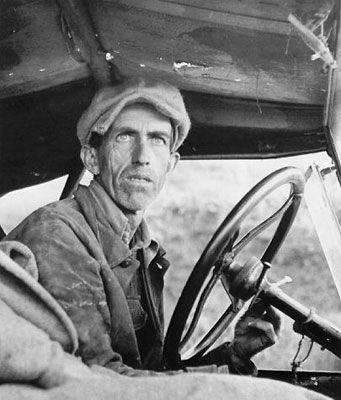
He's heard there's work in the Black Hills' mines, so he's on his way through West River country in South Dakota, a "bindlestiff," he calls himself, a tramp living off whatever odd jobs he can pick up for food and fare, when he discovers the Thor family--or they discover him. He's lean and gaunt, but so are they--so is everyone. Think Dorthea Lange. 
Image result for Dorothea Lange photographs

The land has not been kind. Abandoned places litter the northern plains. The brutal beauty of the Badlands now rises from most of South Dakota west of the Missouri. Maury can't help but admire Pa Thor's shiny-eyed idealism, his absolute trust things will get better; he's attracted by hope he considers misguided, and he enjoys their well-meant offer of a place, even their daughter Kristin's affection--if what happens between them can be called that. 

Forty years ago I knew what was happening in The Golden Bowl. I knew that in the Thor family, the pilgrim Maury was slowly discovering something he'd lost; just as they looked at the stranger within their gates as the son they'd lost to misery all around. Soon enough, Grant calls the old man "Pa," who calls him "son." I knew that. The notes in the margins say it clearly.

What they don't say is that I had clue of the cosmic character of Maury's quest, or of the young Fred Manfred's determination this novel needed to be read in the company of sources that had given him life, sources in Shakespeare and the Bible and what not else. 

I wanted my students, back then, to be introduced to a regional writer who grew up just down the road from the classroom. I didn't understand that a young novelist, writing in a sanitarium in 1942, had a different agenda, that the massive black roller in the final chapter of the novel isn't just a horrifying dust storm. Pardon the English teacher: that black day is what obscures us even when we return to hope, however seemingly futile, and love, whoever human.

Fred Manfred, just a kid when he wrote this his first novel, was deadly serious about Maury Grant. I didn't realize that, but I was just a kid myself. 

There are more scribbles in 1976 University of New Mexico Press edition, scribbles my son carved on the page with a pen. It looks like I let him take a shot at the novel too. Back then, he was, at most, two years old. When I picked up the novel last week and found them again, I remembered him beside me, pen in hand. 

I don't expect anyone to believe me, but this particular copy of Manfred's Golden Bowl is just another version of the panel in the broom closet where my mother periodically traced in her son's height when she knew he was growing. 

I'm far too young to remember the Great Depression. I never choked on dust that blew in massively from Kansas or New Mexico, never had to shoot cattle or hogs whose very existence made my life or that of my family only more precarious. I didn't hitchhike through the Dakota version of the Dust Bowl, didn't look for work in the Black Hills, didn't find solace with a hardscrabble farm family whose only wealth was hope.

Forty years ago, when I made my students read The Golden Bowl, I liked the thought of assigning novel by a writer from just up the road. All those years later, reading it again was a different experience, because all those years later, I just loved the novel.  

Tuesday, February 27, 2018

Small Wonder(s)--Catharine Boa Henderson

Caroline and Will Henderson, Eva, Oklahoma

She and her husband went to the revival because the church was their church too, sort of. She and her husband hadn't been shy about telling their neighbors that they liked the United Brethren fellowship but weren't all that hot on the doctrine, all that thrilled, for instance, about hell.


"Hell, What it is. Where it is. Who Goes There." Maybe they should have known not to go in the door that last night.

Here's the way she described what happened. 

Even if I  could write every word, I could scarcely suggest the unloving tone and manner of presentation, the vulgarity and crude materialism of the whole thing. The geological location, the names of people now there, the vile denunciation of others, the stickiness of melted brimstone, the red flames of burning sulphur--it was all but intolerable. 

Then, the test. In "a large, challenging voice," the preacher asked "whether there was anyone before them who did not believe in hell." 

Caroline Boa Henderson, who with her husband, Will, worked a plot of grassland that would nearly blow away in the Dust Bowl a few years later, did not believe in hell and weren't particularly shaken by some fire-breathing evangelist flinging brimstone all over the church.

Caroline Henderson raised her hand. Those around her were not shocked, but surprised.

The pastor marched right up the aisle, took a match from his vest, told Caroline to hold out her hand, lit the match, held it beneath her skin. "You don't think your body can burn?" he asked, holding that match there. 

Caroline said it wasn't fire she doubted, it was the place he delighted to call hell.

Her hand blistered, or so she told her readers when she described the revival; but what really burned her up was how the fire-breather told her neighbors it was unbelievers such as they'd just seen who were going to burn in hell.

That was it. The Hendersons never darkened the church door again, the only congregation within miles of the windswept grassland where they lived, the land so many abandoned when it dried up into powder that swept into the lungs of man and beast. The Hendersons grew more and more alone.

People in Eva, Oklahoma, thought of prickly Caroline Henderson as hard to get along with. True believers sometimes are, and Caroline Boa Henderson certainly was. She may not have believed in some other world of fire, but she was champion of faith in this one.

Caroline Henderson believed a man or woman who had a love for the land he or she worked created a harvest of virtue, plenitude, and grace. If you loved, truly, the ground you worked, she believed you would be blessed.

Today, the idea sounds cockamamie, even here in Siouxland, where the abundance of our good land keeps us here. But Mrs. Henderson's faith had roots in Thomas Jefferson, who liked to believe--and did--that "those who labor in the earth are the chosen people of God." That's what she believed.

But she lived in No Man's Land on the Oklahoma Panhandle, where between 1933 and 1938 she and Will suffered through 301 dust storms, many of which lasted for as long as four days. Think John Steinbeck or a buggy-like truck with dining-room chairs spilling off of a pile of junk sputtering along anywhere west.

Not Caroline. She and Will weren't about to give up the faith that had taken root in her soul. They didn't turn their backs on Thomas Jefferson, even when blinding dust drifted endlessly into the house her husband, an ex-cowboy, had built with his own hands. She never stopped writing, never stopped singing.

"Those who labor in the earth are the chosen people of God." Where did that faith come from? Carrie Boa was born in Wisconsin in 1877, but moved here, with her family, to Plymouth County, to a Union township farm between Remsen and Kingsley, a farm her father managed and ran successfully, working northwest Iowa ground, the kind of place Jefferson claimed made promises to those who did.

She left Siouxland for Mt. Holyoke College in 1897, at a time when very few farm girls even went to high school, much less a college out east. She must not have been shy about her dreams because the 1901 Mt. Holyoke class prophecy boldly declares that Carrie Boa, class of 1901, will soon be living "somewhere on a western ranch."


In her commencement gown and mortarboard, her soft cheeks make her look girlish, her seriousness something of a sham. There's innocence in her endearing eyes, but no fear. It's a face that will win by grace, by sweetness you might well expect of an Iowa farm girl in 1901.

Soon enough, she would know hard times. She moved to Eva, Oklahoma, because she wanted to be a pioneer, as her parents had been, part of the epic western movement. 

But life was no bowl of cherries. Sometimes the three of them--they had a daughter--lived hand-to-mouth, years when there were no cattle in the gates, no fruit on the vine, nothing.

She may well have given up on hell because she'd seen enough on earth. But she never stopped believing in the land, even though it neither promised nor delivered rose gardens. 

Caroline Henderson wrote about her life in No Man's Land in a series of letters and essays in the Atlantic Monthly, depictions that do as fine a job as there is of documenting life in the epicenter of most significant agricultural disaster of the century. Letters from the Dust Bowl tells her story. And part of ours too.

It wasn't easy. Often enough, she and Will were alone, as they were when they walked out of that revival. But unlike others, Caroline Boa Henderson, who grew up just down the road, never stopped believing in the land she loved.

Monday, February 26, 2018

The Great Pumpkin


What you can be sure of is that people will have their opinions and they'll let them fly. Downtown Des Moines is about to get a new--and permanent--resident, this goofy monstrosity, a giant pumpkin. Won't be long and pumpkin growers across the state will be trying their best to create a clone, but on Tuesday this one--a nicely proportioned five-footer (eight foot tall on its pedastal)--will take up residence at the John and Mary Poppajohn Sculpture Park.

Cute is an unlikely word for a fat old pumpkin, but this one, somehow, is. Maybe it's polka-dot clown hat that sits jauntily up top. The thing doesn't look old really, but its saggy bottom suggests a sweet disposition, the kind of a pumpkin someone might hope to be a friend.

On the other hand, the vertical stripes of its spots give the thing a bit of a high-rise look, don't you think? This is a pumpkin that'll fit better in downtown Des Moines than downtown Doon. It's an urban pumpkin, as Doon residents will be happy to point out.

The Poppajohns, whose finances are central to the place, have some choice in what sculptures reside in the park, more than I do anyway or George and Jenny Des Moines. The Poppajohns like it, they say, in part because it's the work of a master sculptor. While you might gather that it's goofiness has to be the vision of some kid, you're wrong. The sculptor claims pumpkins are a source of great comfort to her, as they were when she was a child in pre-war Japan. You read that right--this great pumpkin is the work of an 88-year-old woman who has, for decades, held a secure place among the world's foremost sculptors.

Don't believe that? Think on some rainy afternoon your granddaughter could have done this? 

That's okay. That's just fine. Think what you'd like. 

A century ago, some muck-a-mucks in Woodbury County, Iowa, presented a building plan for a brand new courthouse. The commissioners weren't taken. After all, where were the pillars? This was going to be a courthouse, after all, didn't it have to look classical? Slack-jawed, they stared down at a building that looked like nothing else they'd ever seen--and they didn't like it. 

Not at all. And they let it be known. This "prairie-style" courthouse was a monstrosity that looking nothing like the glory that was Greece or the grandeur that was Rome. It looked like a stack of flat bread. What would people say?


From the outside, it seemed nothing special at all, just lines up and down with thin repetitive windows. 


The Woodbury County Board of Supervisors said no, until a single powerful member talked them out of it and into the building that will, this year, celebrate its hundredth birthday, a magnificent structure that would likely be far better known if it were somewhere other than fly-over country. 

Art can be tricky. Who would have guessed American Gothic would ever become American Gothic? You own a art shop in downtown Chicago, and some skinny man comes in with a portrait of two hicks, two skittish farm people, one of them wielding a pitchfork. They're standing in front of a boxy little house somewhere in the middle of nowhere. That painting is going to sell? you say. Sure.

Art only toys with reason. It's serious about mystery and rather likes being misunderstood because it really treasures ideas, even strange ones, even some ideas you haven't thought of.

Who knows? A hundred years from now that great Des Moines pumpkin may be little more than a loo for starlings. On the other hand, the city may slowly wake up to a new nice guy downtown, a portly old friend right there on the street, the very first one to pull on the slouchy polka dot toque that everyone's wearing. 

Sunday, February 25, 2018

Sunday Morning Meds--Sheer lunacy

“Who has set thy glory above the heavens?” Psalm 8:2

“This is nuts.” 

That’s not what David says, of course, but it’s where Psalm 8 begins.  "This is plain crazy.  Trying to praise God Almighty is a task that requires something light years beyond us. After all, 'You have set your glory above the heavens'—that high, that far beyond reach. Who can begin to describe it?  Where are the adjectives, the metaphors?  They don’t exist.  Oh, what the sam," he says—"let me sing your praises, even though it’s ludicrous to try."

It’s possible—although no one will ever prove it convincingly—that this song of David is the very first musical stomp.  The preface addresses the psalm this way:  “To the Director of Music according to gitteth.”  No scholar claims to know for sure what this word gitteth means, but I really like the claim that a gitteth is a musical instrument used to lead singing when folks were in the process of making wine, specifically that step of the process when the grapes were stomped.

And I like it because a sort of drunken celebration booms out of the song.  Filled with the triumph of a successful harvest, grape mashers, accompanied by a musician on whatever this gitteth was, shout out impossible praise, roaring as they stomp. The madness of the opening lines of Psalm 8 make me think of someone who’s high, not on wine (there’s nothing fermented at the stomping), but on the exaltation of finishing up a humdinger harvest, luscious juice squeezing up from between their toes.

There is something dreadfully yet gloriously human in the exercise, something that speaks of David’s character. He confesses, at the outset, that what he’s going to do here is fail. He can’t begin to describe Jehovah, the great I AM; but he doesn’t let impossibility stop him. He can’t help himself.  He takes his best shot, knowing he’ll never get there anyway. The whole pattern is so recklessly human.

Of course, he fails. He can’t do what he’s promised he’s going to. The only truth he reaches is the one he confesses—that it’s impossible.
           
But we’ve got Psalm 8, don’t we? He may have failed at finding divine language, but he hasn’t failed at all in the only language we’ve got. What he created has echoed through the ages, is quoted by apostles and, incredibly, by Jesus Christ, the Son of God. His failure has created a song as close to timeless as any human reach can ever come.

Psalm 8 is a miniature of all of our striving. Whether we work to create a song of praise or a novel or a poem; whether our striving results in a log home, a soccer championship, a corporate buyout, a clean kitchen, or a better-behaved kid, nothing we will ever do has any permanence, nothing is really eternal. We all know that, but our knowing that’s true doesn’t—and will never—end our typing, our building, our trying. 

Our best may well be little more than filthy rags, but that doesn’t stop us giving it our best shot.

Flannery O’Conner once said that people without hope don’t write novels. I believe she’s right, but I also believe that people without hope don’t do much at all.
 
Jehovah God is eternally beyond our reach, but that won’t stop us from trying to serve him in every way we can. Shout it out.

At the stomping, I wonder if He isn’t the one playing the gitteth.  

Thursday, February 22, 2018

Shooting in the Ice Age


Well, all right--let me be a bit sacrilegious. Global warning got you up a tree? Consider another Ice Age. 


Got to be an idiot to go out in weather like this, although, lots farther north, thousands do it to try to pull a squirming walleye out of a hole in a thousand frozen lakes. Make that ten.


I didn't come home with supper. I didn't take a fishing rod and was nowhere near a lake, although once upon a time more than one prairie ancient called this world an ocean. 


I've got more gorgeous pictures of this scrubby thing along a mud road that's not maintained. There's something in the way it stands in the pitch of this broad land that's just plain attractive, I guess. although I'll admit that maybe I'm the only one who sees it. 

The problem with taking pictures out here in the world where I live that there's honestly nothing to shoot. The Black Hills?--sure. The Badlands?--no kidding. But empty northwest Iowa fields freezing in mid-winter?--nobody calls this world beautiful. 

But then, I tell myself, someone certainly does. Someone in upper case. 


I consider it my office to see. It's not particularly hard work, but sometimes, like right now, it's freezing. 


I'll admit it--there's nothing show-stopping in these shots, nothing to make me or anyone else stop in their tracks. 

No matter. I'm here to say that if your can keep your fingers warm--even out here, even mid-winter--there's always something to see, always some joy, even in the cold.


You just got to dress warm, like he does.

Wednesday, February 21, 2018

Memorial*


I suppose even moments of great triumph or indescribable loss make no visible impression in or on the places they occur. They leave shadows in our own personal memories, shadows that never really disappear. 

We're all touched by such events in one way or another. At least, in this case, I was.  After all, in this case, the victims--and it hurts to call them that but they were--were colleagues, neighbors, friends, and actual relatives.  They lived just down at the end of our block, and I know there's nothing here to commemorate the story.

When they lost their son, the entire community shook--their oldest, so talented, seemed so clearly destined to continue his father's significant legacy that only God himself could have created such clear design.  But then, if God did it, where on earth was He when their son was killed?  A job interview had been set, the kid was bright, creative, all things were in order, the music of the spheres was in the air, planets in a row.

And then an accident in traffic. Death.

That immense loss simply stopped the joy that music had always given our neighbor, both in performance and composition.  Inspiration was snuffed when his son's life was. I'm not sure how people walk to work again, much less how they dream or create anything after such unthinkable loss. For the man at the end of the block, composition ceased.  After all, what is composition, really, but this great human desire to create order, to make sense of things?  "People without hope don't write novels," Flannery O'Connor once wrote. People without hope don't write music either. Artists take snippets of our lives and theirs, sometimes jagged and horrifying, and somehow create a tapestry.

In the wake of his son's death, our neighbor's composition stopped, his creativity vanished.  The death of a child, like no other event, I'm told, kills the spirit. It reverses the order we know by instinct, programmed as we are to believe that someday we'll bury our parents. No parent ever dreams she'll bury a daughter or son.


So this musician, our neighbor and friend and cousin, froze in grief from the moment someone called to say their son was dying half a continent away, their son the musician. But it wasn't just the loss of his life that ushered in darkness.  His death--like the death of children everywhere--shutters vision because, especially in this story, everything had been in place, perfectly designed and set that when he was killed, his death destroyed order itself, leaving only chaos.  In the madness, our neighbor lost strength and faith and vision and the sheer will to make order, to make music he had been making his entire life.

Here's what happened. I know the story. His wife finally told her husband to leave, to go to his office at school and write.  She wanted him to write. He had to write, had to create, she said.  He had to say what it was that he felt in his heart, had to say it in his language, the language of music.  So he left, walked out of the house just down the block.

Didn't return for lunch, didn't return for dinner.  And when, that night, he finally walked home, he stepped in the door and laid the composition on the table in front of his wife, as if to say, "There--I did it."

What he'd written, some say, has become the best of his work-- "A Song of Triumph," the musical story of his grief and his consolation, an anthem whose richness is created, like the psalms of David, by equal portions of dissonance and harmony, despair and faith.

All of that was 35 years ago.  Thirty-five years.  Today, that son of theirs, had he taken the teaching job that seemed inevitable, had he moved into an office in his father's own music department, would be 62 years old. 

Our neighbors are gone now, with God's blessing to a place we all would like to believe music abounds.

I had their grandson in class my last semester teaching, and I liked him.  He seemed interested, but he didn't know exactly where his grandparents had lived when they lived here in town, didn't know the house, didn't know the back door his grandpa must have walked in one night years ago, holding "A Song of Triumph" in hand to show his wife, the woman who threw him out and told him he had to tell the story, in music.  

When I heard that part of their story for the first time, when I heard a musicologist explain exactly why the richness of that anthem exceeds most anything else our neighbor had ever written and how that piece is still being sung by thousands of voices, I couldn't help but think that it's a shame so much of the story is no longer here in the neighborhood.  Today, who knows anymore?--who remembers?  Shouldn't there be a plaque on the lawn?  Shouldn't we at least try to stop time's relentless march?  Do our great moments of joy and grief and sorrow simply disappear like sunlight?  

Thank goodness for songs of triumph.  Thank goodness she told him not to return until he'd written something, anything.  Thank goodness, once upon a time a father, struck to the heart with grief, sat down in his office and emptied his soul in notation, in a richly human attempt to make harmony out of dissonance, create order out of chaos.

In the neighborhood where we once lived, no one knows that story.

Thank God there's the music, a song of triumph.  What a song. What a triumph. Just three doors down it happened. Someone should know.

Listen for yourself. Here it is. 


_______________________ 
*first published here February 1, 2012

Tuesday, February 20, 2018

Joy, Mike, and Diet


Defining God is tricky business. Think not? Read a few pages of human history. 

Few of our forbearers or our contemporaries, clothed as they may be in animal furs or beaver hats or Superman shirts, didn't or don't have an opinion on who God (or god) is or was or forever shalt be. Classic atheists exist, to be sure, but not in significant numbers. Most of us have dreams we align with a theology of some type--and a revelation, whether it's of the Bible or the Koran or some midnight moment alive with bewonderment--or some weighty hybrid thereof. 

So I think Vice President Mike Pence had reason to be aggrieved by what Joy Behar claimed was a joke. She apologized, claimed herself a Christian ("I give my money to a church"-- apparently a substantial part of her definition). For the record, what Behar called a joke was a bit more than a tease: she said that if Pence actually thinks he hears from God, he's crazy (or something to that effect).

Which had Fox News and every conservative on the face of the earth bare-fisting both Ms. Behar and The View, the show she's part of. 

What's more Behar's snarky quip came from the report of a woman generally thought somewhat loony herself, Omarosa Manigault, who has made it to the top so successfully that, like Oprah or The Donald, she is recognizable only by her first name. Omaraosa, who worked for Trump in some as yet unknown capacity, claimed that of the two national leaders--the Pres and the VP--the really crazy one was Mike Pence, because Pence believes that God (in this case, upper case) speaks to him. That's the opening salvo.

Talk about an old fight! Here's the question:  "What is revelation?" Talk among yourselves.

My roots are in a pious culture in which people speak of the Almighty (if I use almighty, I'm defining my theology; if I capitalize it, I'm even more specific), as if he (if I use the masculine pronoun, I'm revealing my theology too) were a good buddy. I know very well how that goes. I'm a part of that world. In a way, it's the language of Mike Pence and millions of evangelicals. 

The intimacy inherent in being able to say, for instance, that "God told me to write this book," is comforting, but, as Omarosa claims (and Behar reiterated), it can also be, well, scary. Think Harold Camping, for instance. Think David Koresh. Think Warren Jeffs. Think about a thousand men and women--Ralph Waldo Emerson, for pity sake--who claimed their own individually-wrapped revelations from God or god or whatever name you'd prefer.

I listened, last week, to a recitation I'd heard innumerable times before, but not often in the last decade or so. On You Tube, I heard Diet Eman tell a story, her story, of life in occupied Holland during World War II. 

One of her favorite episodes--and one of the most memorable descriptions--occurs when her resistance group gets together to talk about what they can do. They have an immediate and huge problem, one they hadn't anticipated when they began to relocate citified Jewish people throughout the Protestant countryside: they need ration cards. Food was scarce anyway, but if a family took in two or three Jewish people--they thought the war would be over in a few months--keeping people fed became a matter of life and death.

What they decided--those good Christians, following what they believed to be God's own will in rescuing Jews--was that they had to willfully break a commandment, "Thou shalt not steal." They had to break into government offices to get more ration cards to save more Jewish people, and Allied pilots, and others in hiding from the Nazis.

When she tells the tale, the words she uses are both interesting and defining. She says the whole group went down on their knees to ask God for help, not just in doing the robberies, but in outlining for them what their calling was to be in these horrific times.

Her story about the desperate need for ration cards starts at about 17:05. Her explanation of the answer to prayer is about 17:35. Listen to how she tells it.


And "it came to us," she says when she describes what happened. She says it twice: "and it came to us" that we had to do robberies. She could have said, "God told us to do robberies," but instead she stays somehow cautious and deliberately uses a passive construction--"it came to us," she says. That too is a definition. She doesn't say, "God spoke to us" or "God told us to do robberies." She's less sure about their actions than she is about God's love.

Joy Behar wasn't all wrong. She says be wary when people say that God told them to do this or that or that the other thing. There's good reason.

But neither was Vice President Pence wrong. Every believer thinks God speaks to him or her in some way or another.  I do too.

But I must admit I like Diet Eman's choice of words. I like the hesitant way she described what she and the resistance fighters heard when on their knees during those nights they planned robberies in the name of their God.

I think she knows God is always, always, bigger than we are. 

Monday, February 19, 2018

Kids nowadays!


Hard as it is for me to believe, it's been 46 years. We'd just arrived in Phoenix, newlyweds, and, at the appointed time, we showed up at the little school where Barbara would be teaching, where we got a look at the place and at the room which was hers. At least part of the tour and the introduction was given by a sweet old veteran (read old, here, as somewhat relative), who'd been teaching kindergarten at the school for years. 

"Yeah, well, it won't be long and they'll be here, you know," she said, or something to that effect. "But it's fun. I'm kind of anxious." Honestly, I think of her as a kind of angel--most kindergarten teachers have to be. "But it's different, too," she said. 

"Different?" I said.

"Kids, I mean."

"How so?"

She scrunched her shoulders as if a little shy about complaining. "Used to be when they'd come into my room I had to work for a week to get them to open up, they were so scared," she said. "Nowadays, they come bustin' in, swaggering, and sayin', 'Who's in charge here?'"

It wasn't an indictment. She wasn't thinking the end of the world as we know it was near. It was just an observation about how kids had changed. Five-year-olds, she claimed, were far more brash and bold. That was almost a half-century ago.

I've been reminded of that moment when I hear the Florida kids talk about what happened last week at Marjorie Stoneman Douglas High School, especially their brassy bashing of the President of these United States. When Trump tweeted that the FBI should have been tracking the kid that did the shooting instead of investigating Russia, a torrent of kids' voices stuck fingers in his face:


That's cheeky stuff.

And it's just a few. You don't have to look far to find a thousand others, just as belligerent, just as "in your face." 

They don't seem to know their place. An old friend of mine who's almost 100 years old, told me that when, in occupied Holland, the Nazis would be around, the Dutch would jam their hands in their pockets because they'd always been taught it was disrespectful to stick your hands in your pockets.

We've come a long way. 

It wouldn't be difficult, on the basis of those students' barefaced sauciness to wonder about the state of the world, might even be easy to think the end is near, if it weren't for the fact that those kids learn impudence from the Master Bully himself, the Shah of Shamelessness, who cranked out own cheeky insolence all weekend long and clearly doesn't know his place either.

If you don't like the way those kids slam the President, consider how he talks to us just about every day. They're just good students. 

For the record, all of that doesn't mean the end isn't near. 

Sunday, February 18, 2018

Sunday Morning Meds--Factory Second


“How long, O men, will you turn my glory into shame?” Psalm 4:2

Were I a writing teacher (which I am) and were I to be asked to grade Psalm 4—(which I’ve not been) I’d have to admit (maybe I shouldn’t) that in my estimation this song isn’t one of David’s greatest hits.

I like the fact that it follows Psalm 3, a psalm traditionally called “a morning Psalm.”  Psalm 4 has been just as traditionally called “an evening psalm,” as we shall see.  Creates a nice pattern.  It’s somehow fits where it is.

But, just for a moment, let me make a case for what I see as its problems.  The song begins with a demand (“Answer me”) that softens rather quickly into the heartfelt request of every human being who knows he or she has sinned (“be merciful to me’).  Despite its in-your-face first line, it’s difficult to imagine that verse one could be written in any position other than on one’s knees.  Read it again, if you think I’m wrong.

Suddenly, and without notice, the supplicant of verse one turns his attention totally on those who have no faith in Almighty God, seems drawn to his knees out of concern for what the KJV used to call “sons of men,” a term of respect.
  
Verse three uses a whole different voice.  You should know, he says to those “sons of men,” that the Lord has chosen his own and, quite frankly, I’m one of them.  Furthermore, he says, chin jutting, he’ll answer my prayers.  Odd sentiment for a supplicant who wasn’t so sure about anything just a moment ago.

In verse 4 and 5, those pointy-fingered accusations about his enemies’ sins have melted away into a priestly blessing.  Listen, he says, his tone lightening up, look into a mirror sometime.  Once you’ve seen what’s really there (verse 5), offer good sacrifices to the Lord.
 
His enemies have disappeared altogether by verse 6, and verse 7 exudes joy at what seems to be the blessing he was demanding of the Lord at the outset.  Sweetly, the psalm ends with a pledge and a testimony.
 
Really, the emotional life—what writers call “tone”—of Psalm 4 is all over the map.  In this poem, David seems almost manic-depressive, like his predecessor, Saul.  There is little continuity here, almost no unity.  The major players in the drama—David and his vain enemies—are multi-faceted, and even God shifts in focus.
 
Ask yourself this:  how many people do you know who list Psalm 4 as among their favorites?
 
So who reserved a place for it in the canon?  Why is it in the anthology?

I’ll hazard an answer.  Because, in the words of a retail chain, Psalm 4-are-us.
 
Who hasn’t, in times of dire distress, panted prayers that were as disheveled as this, as madcap in structure and form?  Who hasn’t stuttered?  Whose most deeply felt  prayers honestly achieve beauty and grace?

Psalm 4, like so many other songs in this book, testifies of God’s love.  Its emotions are out of control, its rhetoric all over the map.  It’s the testimony of a man at wit’s end, a man who’s spent far too many nights tossing and turning.  Psalm 4 is David’s way, really, of falling, graciously, to sleep.

Because it’s here, because it made the collection, because it does what we do, it’s very much ours.  

Friday, February 16, 2018

Me and guns and Joni Ernst


I once shot a goose from the back of a motor scooter. Seriously, I did. I wasn't trying to show off, never guessed I'd hit it. We were riding along the Lake Michigan shoreline, putt-puttin' on the wet sand, late October probably, when a lone goose came by. My double-barrel, 16-gauge was loaded, so I aimed--sort of--let loose, and down came the goose. 

I'm not making this up.

We hunted crows with a phonograph. This old friend of mine had a record with nothing on it but a gaggle of crows gaggling. All that racket from the turntable would haul in crows from hither and yon, we thought, and we'd shoot 'em. That was the plan. Didn't happen, but we had fun. 

I hunted pheasants and deer and once upon a time got woefully lost in a Kettle Moraine forest hunting ruffed grouse I never once laid eyes on.

A day or two after JFK was killed in Dallas, a friend and I walked in a woods just outside of town, lugging our shotguns, supposedly hunting rabbits. Didn't come home with a bunny, but the two of us, not yet 16, had a memorable conversation about state of the union, as did the whole country.

In my Wisconsin childhood, I spent more time with guns than I did eating cheese. I learned to love the lakeshore woods by following an neighbor who walked as carefully through those pines and hardwoods as some Kickapoo might have a hundred years before. He taught me to love trilliums and buttercups and jack-in-the-pulpits. I watched him shoot a possum that stumbled into his trap, the first time I'd ever seen an animal die.

I've got my own treasured past with guns. I understand the attachment. I do.

On Wednesday night, a commentator on Fox News told the host that when he was a boy, he had a .22; but he never, ever entertained thoughts of shooting anyone. He was as dismayed as the rest of us, as perplexed about a problem that worsens with every passing month--18 school shootings already this year, eight inside the walls. In Florida, thousands are mourning 17 students and teachers who are dead.

I know what that guy was talking about. I shot a goose from the back of a Cushman motor scooter, but it never entered my mind to turn that 16-gauge on anyone else. Never. 

But then, I never carried an AR-15 either. Couldn't have. Wouldn't have thought of it. 

If the President can blame Democrats for the deaths of people killed by undocumented immigrants, shouldn't he also tag Second Amendment Republicans for the deaths of seventeen people this week in Parkland, Florida?

And shouldn't Joni Ernst, the hog farmer from Iowa, return the three million dollars+ her campaign blissfully received from the NRA? Shouldn't John McCain give back the seven million? Shouldn't the President himself fork over the $21,000,000 he got from a group who idiotically argue that Nicolas Cruz, a broken, parent-less, misfit 19-year-old, should have the perfect right to own a combat weapon as much like my 16-gauge as that Cushman scooter was to a Sherman tank?

What is wrong with us?