Morning Thanks
Garrison Keillor once said we'd all be better off if we all started the day by giving thanks for just one thing. I'll try.
Showing posts with label biography. Show all posts
Tuesday, March 27, 2018
1968--Becoming politicized
"LBJ quit!!"
He stands on the riser,
begging.
Like old Viking lords,
their faces shining with sweat,
the dancers thrust up their Millers
in ecstatic defiance.
Others, huddled together,
like clusters of mushrooms,
slowly unfold,
tightened fists raised as they stand,
ritual smoke rising gently above them.
The beach sings with the cheer
and the band plays
"In-a-gadda-da-vida."
We are politicized.
Great poetry, it's not.
I'm more than a little embarrassed to drop it in here. Someone announced the news-- that I remember. We were on a beach at Daytona with a ton of college kids gone south for spring break, and someone attuned to national politics, stopped the music and announced what had just happened--"LBJ quit."
March 25, 1968, is a half-century ago. I was twenty years old when this guy, a kid himself, begged for our attention. "LBJ quit!" he yelled. More than once. Yelled it until it became a chant.
The next stanza's simile doesn't work--there were no "old Viking lords" on that beach. We were all terrifyingly young, and we knew very well that being there was a blessing because on the other side of the world guys we knew were dying by the dozens in Vietnam rice paddies. There's some derision in that stanza of this old poem. I don't know exactly what to feel.
Those mushroom cloisters--another weak simile--are kids smoking weed. Marijuana was the drug of choice for 20-year-olds, but dope was something none of us Dordt students really understood. Seeing all those other kids passing joints was startling, but then much was startling to a kid whose spent most all of his life in a sturdy Dutch Reformed pew.
The begging worked--that I remember. "The beach sings with the cheer."
None of us heard LBJ's speech, but we all heard the guy begging up front. President Lyndon Baines Johnson, a tall, tough guy from Texas, told the world that night, a Sunday night, that he was ordering the cessation of bombing in some parts of Southeast Asia to attempt to start peace talks.
And then the bombshell. "With our hopes and the world's hopes for peace in the balance every day, I do not believe that I should devote an hour or day of my time to any personal partisan causes or to any duties other than the awesome duties of this office, the presidency of your country." Elsewhere across the nation, people looked up, startled, wondering what he meant to say. At Daytona that night, we were dancing.
And then he said it: "Accordingly, I shall not seek and I will not accept the nomination of my party for another term as your president."
"LBJ QUIT!" Some guy yelled, begging our attention. More than once.
and the band plays
"In-a-gadda-da-vida."
You have to be old to recognize that title, to bring back the blasting reckless rhythms. I don't know whether the band that night actually played that or something else, maybe something from the Doors; but I dropped that rock tune into my memory of that night because the hard-driving beat of "In-a-gadda-da-vida" suggested the kind of paganism I couldn't help feeling right then, right there.
I knew Eugene McCarthy, a scant-known senator from Minnesota, had made life miserable for LBJ with a message that was anti-war. I knew President Johnson's approval ratings fell into the thirties, his handling of the war even lower. I knew Senator Eugene McCarthy, the poet and liberal, almost beat him in the New Hampshire primary, when hundreds of college kids hit the street to campaign for him. I knew Robert Kennedy saw the blood in the water and threw himself into the race too.
I didn't know Johnson wasn't in good health, hadn't been for a long time. Very few knew what he was going to say that night, few of his cabinet members, a couple members of his family. The next day, his approval ratings went from 57 percent disapproval to 57 percent approval. He made millions happy when he bowed out.
"We are politicized."
I wrote that poem on the other side of forty years ago, but I know very well what I meant that last sentence to suggest. It's derisive. A couple hundred kids thrusting their Millers or passing the joints--we're politicized?
I wasn't sure of who I was just then, a Dutch Calvinist kid from a Dutch Calvinist college at a Sunday night dance on a Florida beach with hundreds of kids drinking and smoking up and celebrating the demise of President, while guys I knew were fighting Viet Cong terror.
I can't speak for anyone else around me the night LBJ quit, and I won't try. And even though that last line is meant derisively, critically, I know it's not totally untrue.
By 1968, I'd become more than a little iffy about Southeast Asia. Even though I meant that last line to be derisive, a half-century later, it was also something of a confession because without a doubt I was, at that moment, becoming greatly more politicized.
Monday, July 24, 2017
Vale of Tears

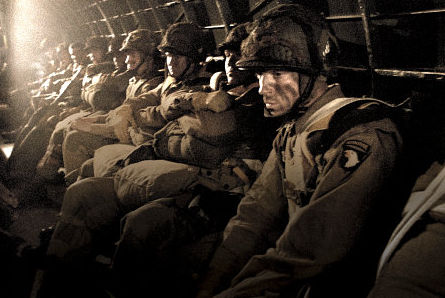
There they sit, packed into what seems little more than a toothpaste tube, two long rows of GIs, helmets festooned with brush, faces blackened, each so loaded with equipment it would seem the jumps they were all about to take would be their last even if there were no machine gun fire. Band of Brothers does its best to put viewers there with those paratroopers, high up over Normandy, the night skies full of flack, all around them other C-47s getting hit, some going down.
It's June 6, 1944. Beneath them, the Normandy beach assault had begun. But up above, almost 7000 paratroopers aboard 432 C-47s sat, one beside the other, waiting for the signal to jump into hell. Here and there, one or two may have been thirty years old; but for the most part, they were kids who knew that night might well be their last on earth.
The farther we get from war, the more difficult it becomes to imagine, especially mammoth events like Operation Overlord, the Allied invasion at Normandy. Once in a while a movie comes along that helps us all imagine what it could have been like for our own kin to be there. By 1944 almost forty men from First Christian Reformed Church, Orange City, Iowa, my father-in-law among them, were either overseas or on their way, the contribution of one church in one small town.
Dad wasn't with the 101st or 82nd Airborne, but he crossed the English channel some time later with his own band of brothers, the motor pool, gear heads commissioned to trail the front wherever it led and keep its tanks and jeeps and troop trucks running. While he never came under fire, he was always close enough to the ravages of war to know the world he was in was unlike anything he'd ever see again or wish to in rural Iowa.
It seemed very strange last night to watch Band of Brothers, having sat at his side for most of the day after he'd suffered another spell of infections--they come frequently these days--put what life is still within him at significant risk. Things are going down now, as they have been for a long time for Second World War vets. Once upon a time we drove him and his wife to a motor pool reunion in Toledo, Ohio, where a bunch of a old men laughed and told old insider jokes when they weren't remembering the toll of buddies who went down in just the last year. That Toledo reunion was, they'd determined, the last; and it was twenty-some years ago.
Dad went to the hospital because the nurse at the home asked us if we'd take him, then called again a few moments later to let us know they'd called the ambulance because they'd determined our getting him out of his room would be pretty much impossible. So we went straight to the hospital, got there before the ambulance, and sat with him--he really wasn't aware we were there or even that he was--while the nurses and doctors had a look.
I was introduced to a new word yesterday--septik. Five years ago we were told that out here at the edge of town we couldn't connect to a sewer system; we'd need a septik tank and field. I've always been a townboy. Definitions were needed.
As they were yesterday. What that little vial of blood the nurse drew from Dad's arm indicated was that he was "septik." And what that meant was that a certain regimen of treatment--water and antibiotics--would be given by IV to fight bacteria that this time had seeped into his bloodstream and would have eventually taken him, if nothing had been done.
By the end of the day his color was back, he'd regained partial consciousness, and he could talk a bit with us. But yesterday's hospital experience was new for us and him, even though he doesn't understand it himself. It was new because for the first time we understood that, whether we like it or not, we have a weapon in our hands, a weapon we are likely to have to use, a decision that will have to be made eventually: whether to let him live or die.
By giving permission to bring him to the hospital, we were signalling we wanted him to go through at least one more fight, one more battle. What the doctors told us--and there were two--was that we needed to know that from here on in that decision would be ours alone.
At the end of the second episode of Band of Brothers, after a prolonged firefight, hard to watch, Maj. Richard D. Winters steps out alone into the night, a roster of Allied troops behind him, endless combat ahead of him; and he tells himself that someday--I wish I had memorized the line--he's going to get himself a place somewhere outside of town and live the rest of his life in peace.
I heard my father-in-law's own dreams in that line, a man who followed the front all the way to Berlin and lost a brother in World War II. I even heard something his wife, now deceased, a woman who lost a fiance that June 6, 1944, and, three years later, married an ex-GI who always wanted to farm.
Yesterday, I had quite enough of this vale of tears, of life and death, as did my wife, I'm sure, Dad's only daughter and only child.
And as did he, or so he's told us. He'd like to go where he knows there is peace. He's ready.
Friday, February 10, 2017
from the museum--It won't be long
[Another old post, but I've been sick, still am. Last night I listened to Kevin Kling say that his prayers have changed through the years--from supplication (as a kid), to desperation (as a rebellious guy), to thanks (as a grown-up). All of that resonates, and reminds me that, once upon a time, this blog started a thanksgiving journal. This post, from eight years ago, sounds right to me. Thanks!]
On the way to Hudson last night for a burger and a beer, we crossed the Big Sioux, where a big herd of deer were standing on the frozen river bed. It was deepening twilight just then, but up against the snow they were unmistakable--it was no vision--just standing there, barely mindful of a Buick that slowed unnaturally as we tried to count them, at least a couple dozen, probably more.
There are more deer in the neighborhood than there were when Siouxland was nothing but an ocean of grass. The prairie is all corn and beans these days, of course, and, for most of any year, food, generally, is no problem. It's not unusual for us spot them were they stood last night, but only occasionally do we see that many. Maybe fifty. Maybe more.
"Where do they sleep?" my wife said, and I couldn't help but wonder myself. The snow this year is remarkable. It's all over, several feet deep on open field and in that strap of woods along the Big Sioux, even over the ice that blankets the river. At the end of our alley, there's a pile that's taller than I am.
A dozen times at least I've walked through woods and tall prairie grass and come on rounded bedding grounds, but I don't know that I could find such things this year, bare spots of ground where they might, for a few hours at least, escape the snow. I didn't have an answer.
And what would they be eating now--saplings, maybe, stripping bark? Maybe that quiet herd on the river were as stupefied as they seemed, unsure of how or where they'd spend the night or feed their yearlings. Maybe they herded up because they'd come to realize their only hope for staying warm was being together somewhere, sharing each other's body heat.
I don't repent for braying about the winter of aught-nine, as I have. We've had more snow and cold, without respite, than I can remember; and I've lived here now for more than forty years. I don't even put away the shovels I fight it with anymore. They're stabbed in piles of snow in convenient places for a job that seems and is unending. Just Thursday the temps rose to 26 or so, and I chopped the ice off the front sidewalk for the first time since mid-December, looked back at what I'd done, even took a picture because that patch of dark cement felt like some kind of harbinger of spring. I'm not overstating. It's been a long winter, and next week's forecast promises no particular respite.
But those deer and their sleeping arrangements prompted a verse of scripture to arise in me, part of the legacy of faith, I suppose, something about fox having their holes and homes when the son-of-man has no place to lay his head.
But this winter, I'm not so sure about the critters as Jesus was, over there in warm Palestine. Where do the deer lay their heads, really? How do they endure the cold that seemingly has no end? I'd have liked to slide a microphone up to one of those big bucks along the river and ask him where on earth they found a bed. I wonder. Would he have trembled like an anxious father, his answer a kind of prayer for spring? How are the critters doing this February? I honestly don't know. Are the pheasants finding something, somewhere?
Crows do fine, I guess. I just walked outside to check the sky, and somewhere, maybe a block or two away, their ridiculous cacophony was already raising a ruckus in the pitch dark of early morning. They come into town and pick a tree together somewhere and swarm. All that noise didn't seem fearful, just loud. I guess they're okay.
It won't be long now, and I'll go back upstairs and crawl back into a bed. Our electric blanket is kicking up a fuss lately, flashing FF, whatever that means, and shutting itself off by early morning, as if it really can't or won't keep up the pace.
No matter. Even without it, we could warm a bed, my wife and I. It's a burden she tells me she must endure--my coming back to bed to wake her. I crawl in beside her to beg the most blessed warmth any one of us can ever share.
All of which reminds me that long ago, when I started this blog, I'd determined to try to bring thanks every morning--for something, anything. We'd all be better off, Garrison Keillor once said, if each of us would take a pledge to be thankful, daily, for something at least.
So this morning it's not that goofy electric blanket for which I'm thankful, it's that warm bed, a place to lay my head and ward off the cold, and the fact that I know my wife will have me.
Last night, for the first time since November, the skies were light enough to see the deer on our way to Hudson. For the first time, we didn't cross the river in darkness.
No matter how high that pile at the end of our alley gets this winter, daylight's lingering now, and it won't be long. It won't be long. It won't be long. Maybe those deer understand that too. I hope they do.
That too is reason for heartfelt thanks. You just know--even though you have to remind yourself--that spring will come. And it won't be long. It won't be long. It won't be long.
Wednesday, January 25, 2017
Morning Thanks--Tumultuous privacy
This morning, even in the dark, we're aboard a ship on a sea of white. A mini-storm roared through earlier this winter, but something of a little big one is here with us now, turning the whole world outside our windows into a great white quilt. It's beautiful, really. But then, I don't have to clear a path to the barn, nor even clean a sidewalk. I've got a grain scoop I never use anymore. This blizzard won't bother me a bit.
Schools were called already last night. A huge banner headline greets you when you visit the web page of the school our grandkids' attend. What's outside throws a fit for thousands of parents, I'm sure, who have to determine what to do with children sentenced suddenly to what may well be, by noon, a roaring case of cabin fever. That "no school" headline down there at the bottom of the page was up already last night, my wife told me, so this morning, I'm sure, most plans have been laid. In a way, that's too bad.
Listening for radio announcements on stormy days has to rank as one of the most wonderful moments of anybody's upper Midwest childhood. You're curled up in bed, pillow perfectly bunched, and the radio's on. Some dj's familiar voice is going through a sprawling list of schools canceled, and when you hear it--"no school at Oostburg Public; no school at Oostburg Christian," no word or phrase could signal anything so sublime.
Not even my wonderfully pious parents ever brought it up, because no adult, I suppose, ever figured it was true; but if grace is love totally unmerited, then that moment--radio on, the holy words just spoken--that bedside ritual may well have been the most vivid foretaste a kid ever experienced of divine grace, something of a sacrament really.
"No school."
You didn't have to hate school to lie there in bed and feel the warmth spread down and through the very chambers of your heart.
I've spent most all of seventy years as a morning person. Right now, it's not long after six. But that particular delight--hearing your school announced, then turning over in a warm bed on a snowy day--that particular joy is a memory whose song is more charming than a whole host of other wonderful childhood melodies. No school amid the storm. Even a morning person stayed in bed.
When I was a teacher in a small Wisconsin high school years ago, something of all of that still thrilled me. But back then snow days were mixed bag because the plan for the week, for the unit, even for the month, could be swept away amid the drifts. At least part of the morning I'd have to sit down and try to figure out how to make up for what was being lost.
Ah, small potatoes. I was still a kid. The truth is, back then, at home in the ancient trailer I rented (inside, you could see wind gusts in the flame of a candle), it was a still a joy to get a snowy reprieve from unrelenting northwest wind.
Today, a half-century later, blessedly retired, it doesn't matter a bit if there's some whale-like drift between the retaining walls just outside the door down here or another, beached across the driveway out front. Whatever's out there can stay. I don't have to fight it, and whether or not it's there makes no difference. I'm down here at the desk, just like any other day, and right now there's no radio playing.
But I can't help but smile because this morning, somewhere out here in the middle of the prairie, somewhere in Siouxland, some kid and his siblings are waking up to a radio announcement, then fluffing the pillow, turning over, and thinking seriously about going back to sleep, lost, as Emerson said, in the blessedness, the "tumultuous privacy" of storm.
Tuesday, January 17, 2017
Morning Thanks--English Class

Twelfth grade reading lists stretched out
as endless as the sentences we diagrammed,
as orderly as the outlines for our senior essays-
"Humanism in England in the Fourteenth Century"
I think I wrote about, cobbling facts together
about Erasmus and the Church, forgetting
those were plague years,
Cobbled together term papers?--I wrote 'em, then read 'em by the thousands. I remember one, way back when, on the Scarlet Letter, a novel I hadn't read and didn't have the heart or time to wade through. I went to an out-of-town library to get something fresh, did a Cliff's Notes thing on Hester Prynne, zipped through what I could cull from an index page or two, and hammered out a paper. Probably got a B. Should have been much worse.
And yet, in my forty years of wandering through the classroom wilderness, I don't know that I taught any other novel as often as Hawthorne's Scarlet Letter and loved it every last time I read through it, loved it more than any of the kids in front of me did, I'm sure. Truth is, I could read it again today and love it some more--so dark with secret sin, so treacherously Calvinistic.
And there's more to this Robin Chapman poem:
and Henry David
Thoreau’s pithy quotes, marching to a different
drummer, hooked me for a solitary ramble
of Walden, not knowing he’d dined every night
with Emerson and Alcott;
I wonder how many others were hooked on some bizarre 19th century abolitionist transcendentalist madly chasing Oversouls. I was. My first year of teaching, I was naive enough to believe I could make Henry Waldo Emerson a holograph in rural Wisconsin. And I didn't do badly. I remember lit up eyes. In graduate school I learned Thoreau regularly marched off to town to sponge meals. So much for purity.
But no matter, even today. The world would be a better place if this week especially we all spent quality time alone at Walden Pond.
and our teacher
always turned to us with hope, searching
for some sign that we’d found a spark,
an engaged liveliness, in all those endless
marching words--her eyes lit up, her thin hair
frizzed, her faith in us fixed,
No kidding. I had no hair to frizz, but when I think of how greatly I believed in them, those kids in desks, I can't stop grinning. I see some of them once in a while, kids I once had in class, and feel strange, as if once upon a time we were lovers. They don't know how much hope I invested in a single spark of engaged liveliness. Teaching was a good life.
And then, this marvel--all that faith, Robin Chapman says,
misplaced,
stirring fugitive regret in our adolescent gaze,
preoccupied with who to ask to the Swankette Ball
and who to sit with at the Friday football game
(whom, she’d certainly have made us say).
That's how the poem ends, in Ms. Frizzy's dizzy-ness.
I don't care. I don't care how little that schoolmarm's soulful regard for them actually meant to kids obsessed with what they were going to say at their lockers, or do that afternoon in the gym, or behave that night on a couch. I don't care how incidental Walden was to their storming teenage passions. I really don't.
And neither would Ms. Frizzy if this morning she'd read little Robin Chapman's "English Class." All she needs to do is to see it on the page, this poem by her ex-student, and she'll swear her transcendental passion wasn't just blowing in the wind.
I'd like to tell Ms. Frizz this: that if she can't read the poem her ex-student wrote about her, I did, and that I loved it for her, for that old schoomarm, loved it in the way I'm guessing both of us once upon a time loved them.
I don't care. I don't care how little that schoolmarm's soulful regard for them actually meant to kids obsessed with what they were going to say at their lockers, or do that afternoon in the gym, or behave that night on a couch. I don't care how incidental Walden was to their storming teenage passions. I really don't.
And neither would Ms. Frizzy if this morning she'd read little Robin Chapman's "English Class." All she needs to do is to see it on the page, this poem by her ex-student, and she'll swear her transcendental passion wasn't just blowing in the wind.
I'd like to tell Ms. Frizz this: that if she can't read the poem her ex-student wrote about her, I did, and that I loved it for her, for that old schoomarm, loved it in the way I'm guessing both of us once upon a time loved them.
Life is good.
Monday, January 16, 2017
Postcards from the MLK National Site
I know how it feels in my hand. I know how it opens and shuts, I know how to set it. I know how compactly it folds up. I'm not sure why, but years and years ago, when I was a boy, a clock just like this ended up somehow in my possession, even though I didn't buy it or use it myself. I just remember it very, very well. When I spotted it, I recognized myself in it, long ago.
This one belonged to Dr. Martin Luther King, and it was his possession that day in Memphis when he walked out on the balcony of the motel where he was staying and was shot dead by a white man named James Earl Ray, who, with that bullet, made some white folks very happy and millions of black folks weep.
For someone my age, stunning familiarity stares at you when you're at the Martin Luther King National Site. This little travel alarm could have been mine, but this one was there in his motel room that night, standing on a table beside a bed he never slept in.
There was no choir loft in the church where I grew up, and no baptistry, but otherwise Ebenezer Baptist, the church he attended as a boy and where he preached as a clergyman isn't unlike the church I remember, front-and-center an oak communion table with "This Do. . ." carved beckoningly into the top, three throne-like chairs standing guard behind a single pulpit in the middle of the stage up front. It's not unfamiliar, even when you sit in a pew and imagine his family filing in.
I didn't grow up in the middle of a major American city like Dr. King, so the streets where he lived and the house he called home don't look much like mine and ours. But that doesn't mean there isn't a species of familiarity here either, a middle-class African-American section of Atlanta.
It's still a wonder to stand out front on the street here, where a dozen or more old houses are being restored, and to think that once upon a time that little King boy was here, a kid who, with his neighborhood buddies, used to play in the fire station across the street.
Where am I in this picture? For someone whose memory holds at least some of the story told in Dr. King's boyhood neighborhood, that question is not easy to answer. Who are my people? What did those I loved at the time see when they looked at this image a half century ago? Where did they stand? Why? It's easy to know how MLK got into this picture, but how did it happen exactly that we didn't?
Perhaps the most searing images are not photographs but words to move hearts and minds and souls, words no less difficult today than they were in 1968.
Subscribe to:
Posts (Atom)