Morning Thanks

Garrison Keillor once said we'd all be better off if we all started the day by giving thanks for just one thing. I'll try.
Showing posts with label Reading Mother Teresa. Show all posts

Sunday, March 15, 2020

Reading Mother Teresa--The Little Stuff


Then I heard every creature in heaven and on earth 

and under the earth and on the sea, and all that is in them, saying: 
“To him who sits on the throne and to the Lamb 
be praise and honor and glory and power, 
for ever and ever!” 
Revelation 5:13 

To the good God nothing is little. . . . (34) 

You know? – I really ought to print that line on a t-shirt: “To the good God nothing is little.” It’s hers – Mother Teresa’s – and it’s just plain beautiful.

But then, maybe I think so just because I’m getting old.

How is it that retired people get such a kick out of gardening? Why, for pity sake, does the appearance of that gorgeous cardinal or her lovely husband just outside our window just light up our day? Last night, my wife and I had a quiet supper together alone for the first time in a week, and it felt something like what I little I know of heaven. What’s that about anyway?

The world simply shrinks the older you get. That’s what I’m thinking.

Yesterday, I got a card from a man I don’t know. He says he’s been reading a book of my meditations over and over again, and they’re good, words I ground up down here in this basement. It was that kind of letter. Just a card. That’s it. Just a little homemade card. Made my day. Shoot, made my week. Little things.

A kid says something on his way out the classroom. Maybe it was an okay class that day, and as he’s walking out, he says, “Have a good afternoon, Professor.” I feel like I’m somebody. Little things.

A sunset. A windless, warm February afternoon. The faint whisper of spring. A raucous orchestra of birds in the morning sun once again, or the long glowing promise of an orange dawn.

Bad knees, leaky plumbing, sore feet, a testy stomach – there’s no end to the tribulations of aging. And yet, sometimes it just seems that I find myself, these days, a joyful victim of a transformed aesthetic. Instead of looking past life’s seeming givens, its otherwise incidentals, you take joy in ’em – a plain old bowl of cereal starts to taste like a feast, I swear it.

Maybe that’s what theologians mean by sanctification. Maybe the death of the old, young man begets the quickening of the new, old one. Count the paradox in that line. Okay, maybe it’s silly, but, dang it! – it’s cute.

Mother Theresa used to tell her sisters that to God everything is small, and therefore everything is beautiful because everything is divine. Isn’t that wonderful? “Because he makes them,” she’d say, “they are very great. He cannot make anything small; they are infinite” (34).

Rain on parched soil. Newbie buds on the maples out front. An old hymn you thought you’d forgotten.

At the funeral of a man I never knew, one little photograph of he and his wife just after the war, totally in love – I remember that darling snapshot, so full of life, far better than the shape of his face as he lay in the open coffin. I still see it. I wish I could show you.

Or how about this? Just beside me now, the last three segments of an orange I’ve been eating slowly ever since I sat down at this computer. I pull ’em apart, one at a time because of the juicy blessing I get with each little tart explosion of lovely taste.

Now there are two.

“Be faithful in little practices of love, of little sacrifices,” Mother Teresa used to say (34). Such things make you Christ-like.

Could it be possible that aging makes that easier?

Don’t ask me tomorrow. This may just be a good morning.

Besides, the orange is gone.

But then maybe that cardinal will show up. I should be so blessed.

Sunday, March 08, 2020

Reading Mother Teresa--Cheerfulness


Therefore, my dear friends, as you have always obeyed – 
not only in my presence, but now much more in my absence – 
continue to work out your salvation with fear and trembling. . . .
Philippians 2:12 

I don’t buy it totally. It strikes me as half-truth, which is, at times, even more deceptive than a lie. I understand what she says, I even have some sympathies with the idea, but finally I think she was wrong. Well, half wrong.

“Cheerfulness is a sign of a generous and mortified person who, forgetting all things, even herself, tries to please her God in all she does for souls” (33).

A mortified person is someone whose “old man [or woman] of sin” is dead as doornail. It has nothing to do with being absolutely “mortified” by what stupidity came out of your cousin Ezra’s mouth last Sunday. When your sin is, so to speak, behind you, she’s saying, cheerfulness becomes a habit.

That’s very sweet, but I’m not convinced.

“Cheerfulness is often a cloak which hides a life of sacrifice, continual union with God, fervor and generosity” (33). I don’t know that I believe that totally either, but I like it. Run into an ever-cheerful person, she says, and you’ll be with someone whose deep devotion to God is a constant.

I’m still listening, but she’s starting to sound tinny--“don’t worry, be happy.”

“A person who has this gift of cheerfulness very often reaches a great height of perfection” (33).

Warning lights are still going off. Even the apostle Paul would draw an eyebrow here, so I am not alone, nor am I too much a Calvinist to go there. In my book, “the perfect is [often] the enemy of the good.”

But I’m still listening. After all, this is Mother Teresa.

“For God loves a cheerful giver and He takes close to His heart the religious He loves” (33).

She’s far more sure about such things than I am, but okay--then how do you reconcile that idea with the treasures that darkness and sheer doubt have given us? Much of our music arises from thwarted human aspiration, from the dead opposite of Disney-level cheerfulness. America’s finest gift to the arts is the blues, doleful music drawn from the sad lives of African-American folk musicians. The blues are beautiful, even inspiring, but Lord knows they’re not cheerful. And neither are some psalms, come to think of it.

And then this: “When I see someone sad, I always think, she is refusing something to Jesus” (33).

I’ve known too much depression to buy that one. It’s something you might whisper in your own ear, but telling someone else that his or her sorrow comes from lack of faith can be deadly when persistent darkness isn’t just inflamed moodiness. Believe me. “Your problem, kid, is you’re just not right with God.” While that idea may not be all wrong, as therapy it can kill.

Mother Teresa may well have believed what she says about cheerfulness. She may have used that sentiment to scold herself – that’s understandable. But if her own confessions are true, if her diaries and letters reveal someone who fought off the darkness – and such is the record! – then she could not have really believed it herself. She wasn’t always cheerful because she wasn’t always something beautiful for Jesus. Even Mother Teresa wasn’t perfect, wasn’t ever cheerful. And she knew it. And she tells us as much.

“Therefore, my dear friends,” says the letter to the Philippians, “as you have always obeyed – not only in my presence, but now much more in my absence – continue to work out your salvation with fear and trembling.”

“With fear and trembling.” Those are tough words.

She’s not the gospel on cheerfulness, but she’s not totally wrong either.

It’s good to know I’m not alone.

Sunday, March 01, 2020

Reading Mother Teresa--Silence

Abraham Kuyper

When he opened the seventh seal, 
there was silence in heaven for about half an hour. Revelation 8:1 

Walking home from school for me has always meant walking west into what is, this daylight-shortened time of year, the first warm glow of sunset. For years I’ve told myself that someday I’d just keep walking into all that buttery glory, head west like Huck Finn and millions of others who once heard--as some still do--the siren song of a dreamy new life. Someday, instead of stopping at our place, I’ll just keep walking. Like an old bull bison, I’ll leave the herd forever, wander out somewhere into the hills along the river, and hunker down. 

Such odd visions came when life was just too busy. I might well have had eleventy-seven papers to read, more pouring in daily. Maybe I had a gig off at a high school chapel, some speeches to write, an exam to give (36 more papers) that afternoon, and a junk drawer full of little complexities too mean to mention. 

I’m sure I’m not as busy as Mother Teresa was. T
hose Calcutta streets made demands on her and her time that may well have prompted her to look up wistfully toward beaming sunsets too. The dogged vow she took – the promise of utter loyalty to the Lord’s will – created a listening ear in her that probably never shut down because she wanted, above all else, to hear the voice of God obediently, never to miss even his most indistinct whispers. 

Which is why, I suppose, she loved to tell herself and others that “in the silence of the heart God speaks” (32).

The idea strikes me as medieval because I really ought to be connected these days, right? I ought to have all the gizmos. Last week our grandson stayed around after dinner and then just begged to watch Ninja Pandas or some such thing. Begged. It was difficult for him – as it is for any of us who are tuned in 24/7 – to entertain silence. He has to be entertained. 

As do I. My iPad keeps me connected and silence at bay. Yes, I carry a phone. If I say "Alexa" voices from both floors of the beg to answer my questions, "Okay, Google" gets me four, if we count our phones. I read the Opinion page of the New York Times and Washington Post far more religiously than the gospels. I’m serious.

I know Mother Teresa is right, and so does anyone else who listens. “In the silence of the heart, God speaks.” Maybe that’s why I’m addicted to getting up early every morning.

But then maybe not. I know well and good that every little whisper in my ear isn’t the voice of God.

Still, we all know she’s right: Listen again: “In the silence of the heart God speaks.”

Some of my ethnic and religious ancestors jammed a copy of Abraham Kuyper’s To Be Near Unto God into the pockets of their barn jackets a century ago or more, so special were those meditations to them. It's a how-to really; the focus is how exactly to achieve moments of eternal bliss, just moments, glimpses. “To be near unto God,” for Abraham Kuyper, meant maintaining a daily walk that was always within whispering distance of God’s own voice. No residents of this world can possibly live near unto God 24/7, Kuyper might have said, but we can come blessedly close for occasional divine moments.

I don’t doubt that Prime Minister Kuyper would have heartily assented to Mother Teresa: “In the silence of the heart God speaks.”

Which is only to say, I suppose, be still and know.

It’s just before six. I’ve said enough.

Sunday, February 23, 2020

Reading Mother Teresa--The rough road of obedience


Oh, that my ways were steadfast in obeying your decrees!
Then I would not be put to shame when I consider all your commands.
I will praise you with an upright heart as I learn your righteous laws.
I will obey your decrees; do not utterly forsake me.
How can a young person stay on the path of purity?
By living according to your word.
I seek you with all my heart; do not let me stray from your commands. Psalm 119:5–10
According to the editor of her letters and diaries, Fr. Brian Kolodiejchuk, Mother Teresa believed that in obeying her superiors in the Sisters of Loreto, she was, in fact, obeying Jesus, in “submitting to their commands, she was submitting to Christ Himself” (31) is the way he puts it.

I confess that’s a way of life I can’t imagine.

There’s something undeniably saint-like about her inviolable commitment, but something slavish too. If the simple obedience – can I say “blind obedience”? – to one’s superiors is the portal to sainthood, then I’ve yet to trot joyfully through that door.

I can’t imagine it was easy to believe that one’s superiors spoke for the Lord God almighty – then again, maybe it was easy to believe, just hard to live.
Still, that Mother Teresa would believe what she did makes good sense. If you’re going want to be the bride of Christ, if you’re going to commit, via something as permanent as an oath, to live for him always, every second of the day – no time off, no Expedia getaways, no VRBOs – then it seems to me that some kind of infrastructure to that commitment is, in fact, required. In her case, that scaffolding was created by the church – or The Church.

I mean, no human being ever believed that he or she was one with Jesus, 24/7, you think? Even David the King often found himself abandoned – see Psalm 13, the “howling” psalm. I hate to be skeptical, but my guess is no one on the face of the earth ever has ever claimed to have God’s voice in his heart and soul all the time, like the phone in his pocket. No earthling stays permanently in some higher world.

It just doesn’t happen. In his “Personal Narrative,” Jonathan Edwards, the great revivalist Calvinist, claims he suffered long, anguished moments of silence. Ralph Waldo Emerson tried to lift anyone who’d listen to him into bright-and-shiny moments of revelation, but he certainly didn’t stay there himself (read “Experience” sometime). Even Edgar Allen Poe wanted his bizarre verse to lift us, at least for a moment, from our rotten, stinking world. But only for a moment. Abraham Kuyper’s most famous devotional work, To Be Near Unto God, is all about helping his loyal followers find their way to glimpses of glory. Glimpses. 

No one I know would say that Christ’s voice is always within them. But then, I’m not Pentecostal. Maybe if I were. . . .

It’s understandable that someone like Mother Teresa, someone as committed to God’s near physical presence in her life, would believe the way to get there, even and maybe especially through the silences, is by reckoning that the words of the boss – her Mother Superior or her bishop, or whoever was in charge– was always the very voice of God.

I’ve failed badly on that one. But that’s a story for another time.

Here’s what I’m thinking. We’re wired with desire, all of us, desire for God. That g has to be lower case, as in Poe’s case; but human beings share an undeniable spiritual aspiration. Mother Teresa, who is without a doubt a saint, attempted to stifle the doubts she had (and they were considerable) by believing that whatever church authorities said was gospel-level truth. When her superiors spoke, the voice belonged to God (upper case). She believed that because she believed what was required of her, in response, was, total obedience.

I’ve never been so sure as that. But there’s no doubt in my mind – and soul – that I too want God. As hard as it is for an old Calvinist like me to admit it, I think we all want what we believe God is or does, even if that aspiration doesn’t make us saints.

Maybe what makes all of us want to get there is that we can’t.

Only by his doing. Only by grace.

I’m sure Mother Teresa believed that too.

Sunday, February 16, 2020

Reading Mother Teresa--Fear and Trembling


“Hear my prayer, Lord, listen to my cry for help; 
do not be deaf to my weeping. 
I dwell with you as a foreigner, 
a stranger, as all my ancestors were.” Psalm 39:12 

There is within me more than a smidgen of my grandfather’s DNA, more than a pint or two of his dark Calvinist blood. I think of him often really, a man so driven by his perception of the depth of his own sinfulness (he was really a good man) that he would take a kind of perverse pleasure in recounting the darkness of his soul – as in, “if I had one thing to do with my salvation, I’d burn in hell.” That kind of thing. Complete with tears. Lots.

He likely had a family background in the old Dutch conventicle tradition, small hotbeds where emotion-laden devotions ran so intense that their neighborly visits became, in no small measure, the church itself. Today, some people believe that house churches are the wave of the future. Good night, they have a history, a past – fevered meditations from intense sinners whose prayers in an intimate circle stretched endlessly. Grandpa had a heavy dose of that.

Back then, I don’t think he was unusual. In most churches there were more Harry Dirkses per capita, I’m sure, than there are today. That kind of exhausting, abject confession promised and likely delivered abundant blessings. After all, the finest means by which to glory – seriously! – in the marvelous grace of God almighty was to lie prostrate on the floor in abject selflessness. Grace, for even lowly me!

By all reports, that was my grandpa. It’s easy to parody.

I’m saying that sometimes he’s in me, too. Maybe more than sometimes. Maybe more than I care to admit.

My mother, his daughter, often wished to be Pentecostal, to speak in tongues, to be ever closer to the Lord than she was, no matter that her son thinks she’s dang well close enough. Her son thinks such unquenchable longing is worrying. For someone who talked constantly about the love of God, it sometimes seemed to me that she was ever an arm’s length away, maybe farther.

She wanted “Blessed Assurance” sung at her husband’s funeral because he never shared her tremulous faith, she said. My father never worried much about his salvation, even though he was, as most who know him would say, something of a saint. She’s never quite understood his confidence because she was never herself so blessedly assured. If she were, the drama would be over; and I think that, like her father before her, she liked the drama.

Now I can giggle about all that, but what I’m confessing this morning is that, like it or not, I remain my mother’s son – and my grandpa’s grandson. And I feel it most when I read something like this from Mother Teresa: “Why must we give ourselves fully to God? Because God has given Himself to us” (29).

Just blows me away. That logic is so airtight that its undeniable truth makes mincemeat of my feeble attempts at being faithful. She is so absolutely right. Just to be sure, let me say that there are no tears here – I’m not my grandfather’s clone. But the way Mother Teresa says what she does here casts a long shadow over my sinfulness. I admit it.

See, there he is – Grandpa Dirkse. In the flesh.

“I live for God and give up my own self, and in this way induce God to live for me,” she wrote. “Therefore to possess God we must allow Him to possess our soul” (29).

Wow. Let me tell you, on that one I’m in the cheap seats. I don't deserve. . .well, you know.

Sunday, February 09, 2020

Reading Mother Teresa--Be Still


“Be still and know that I am God. . . .” Psalm 46:10 

In a chapel speech at Liberty University a few years ago, then-Governor Rick Perry, of Texas, a candidate for President of the United States, talked openly about the nature of his faith in a testimonial that rather notably lacked the fire and brimstone he’s known for when he speaks about politics. He was reserved and very personal when he spoke of being someone who didn’t so much turn himself to God as being someone who had been turned to His throne:
My faith journey is not the story of someone who turned to God because I wanted to. It was because I had nowhere else to turn. I was 27. I’d been an officer in the United States Air Force, commanding a fairly substantial piece of sophisticated equipment, telling men and women what to do. But I was lost spiritually and emotionally. And I didn’t know how to fix it. 
There’s much to admire in his humility. I don’t share many of his political views, but his speech was, or so say a hundred reports, a performance totally as moving as it was sincere.

Sad, though, that anyone has to talk about it as a “performance.” I pity political candidates because, these days, they’re damned if they do and damned if they don’t talk about faith. Not addressing your relationship to God means staying in the starting blocks forever – or not even getting out of the locker room and into the race.

It’s ever so easy to listen to someone like Governor Perry and distrust what you’re hearing. Politicians, for goodness sake, all say what they need to. For Presidential candidates especially, doing a testimony is as important as being capable of tending the economy. And you’re judged. "All that yapping is just so much b.s. So-and-so’s faith ain’t nothin’ more than politics. Just listen."

Father Brian Kolodiejchuk, the editor of Come Be My Light, says that in April of 1942, Mother Teresa made a significant vow before God. This is how she described it: “I made a vow to God – binding under [pain of] mortal sin – to give God anything He may ask, ‘Not to refuse him anything’” (34–35).

That vow was, Kolodiejchuk says, one of her “greatest secrets.” Only two people on the planet knew what she’d done – she and her confessor; and when, 17 years later, she finally went public with that vow, she admitted, “This is what hides everything in me” (29).

It seems to me, as our preacher said not long ago, that the joy known to those who know the Lord may, paradoxically, be, for us, one of the most difficult things to talk about because the language of faith is so easily manipulated. I don’t doubt for a moment Rick Perry has great faith, but he becomes, in a way, a victim of his own politics – as does every aspirant politician – the moment he or she talks about faith, simply because that person is running for office.

It is not particularly easy to talk about faith because, in fact, it is so marvelously easy.

One of the most easily forgotten mandates Christ put on the table was the warning to pray in private, to go where no one can see you. Sometimes, with faith, Jesus might have said, silence is golden.

I wonder whether part of the marvelous spiritual legacy Mother Teresa leaves behind grows from the fact that her own life-changing pledge, the vow she says changed everything in her life – a vow not to refuse God whatever he would ask – was more binding because it wasn’t broadcast over CNN or written up in a Calcutta mission newsletter. Her witness to his glory in that pledge, that vow, was between the two of them and the two of them only – between her and God.

It’s impossible for politicians not to talk about their faith. They must. And because they are who they are – politicians! – it’s easy to roll your eyes. At any of them.

What Mother Teresa teaches me with this silent vow of hers is the lesson the scriptures offer, the lesson of Psalm 46: “Be still and know that I am God.”


Sunday, February 02, 2020

Reading Mother Teresa--Ambassador of Joy


"Shout aloud and sing for joy, people of Zion, 
for great is the Holy One of Israel among you." Isaiah 12:6

There’s something so elemental about Mother Teresa’s success that when you witness it, you’re shocked at its simplicity. “Every Sunday I visit the poor in Calcutta’s slums,” she wrote in letter. “I cannot help them, because I do not have anything, but I go to give them joy” (27).

Ambassador of Joy.

Because she had nothing in her pockets, she didn’t have to refuse beggars. Quite simply, she had nothing to give them except joy, which is, of course, a marvelous gift – and very, very expensive.

Great cheerleaders don’t win ball games, and everyone knows you can’t reverse malnutrition with a smile, fight disease with sheer happiness, nor deliver people from hapless poverty by a winning personality.

Some significant criticism of Mother Teresa and her work begins with that knowledge, the assessment that just being nice isn’t enough. That criticism is understandable.

But it can’t deny her gift.

What Mother Teresa brought to the poorest of the poor, and gave away freely, was essential for life: she brought them joy – joy as a synonym for love. In the same letter, she tells the story of a mother whose family suffered immensely, a woman who “did not utter even a word of complaint about her poverty,” a woman who begged Mother Teresa to return: “Oh, Ma, come again! Your smile brought sun into this house” (27).

Mother Teresa brought that family the sun.

I don’t have neighbors so deeply impoverished. I don’t know anyone who doesn’t know from whence his or her next meal will come. Those sad children with extended bellies – you’ve seen them in a ton of photographs – live somewhere in a world other than my own. I’m a long ways from Sudan and all the way around the world from Calcutta.

But then, I suppose, darkness has a thousand faces.

And I can, just as nimbly as she did, lug in the sun, even as she did.

Or could, if I really, really wanted.

Sunday, January 26, 2020

Reading Mother Teresa--Ambassador of Joy


“Shout aloud and sing for joy, people of Zion, 
for great is the Holy One of Israel among you.” Isaiah 12:6 

There’s something so elemental about Mother Teresa’s success that when you witness it, you’re shocked at its simplicity. “Every Sunday I visit the poor in Calcutta’s slums,” she wrote in letter. “I cannot help them, because I do not have anything, but I go to give them joy” (27).

Ambassador of Joy.

Because she had nothing in her pockets, she didn’t have to refuse beggars. Quite simply, she had nothing to give them except joy, which is, of course, a marvelous gift – and very, very expensive.

Great cheerleaders don’t win ball games, and everyone knows you can’t reverse malnutrition with a smile, fight disease with sheer happiness, nor deliver people from hapless poverty by a winning personality.

Some significant criticism of Mother Teresa and her work begins with that knowledge, the assessment that just being nice isn’t enough. That criticism is understandable.

But it can’t deny her gift.

What Mother Teresa brought to the poorest of the poor, and gave away freely, was essential for life: she brought them joy – joy as a synonym for love. In the same letter, she tells the story of a mother whose family suffered immensely, a woman who “did not utter even a word of complaint about her poverty,” a woman who begged Mother Teresa to return: “Oh, Ma, come again! Your smile brought sun into this house” (27).

Mother Teresa brought that family the sun.

I don’t have neighbors so deeply impoverished. I don’t know anyone who doesn’t know from whence his or her next meal will come. Those sad children with extended bellies – you’ve seen them in a ton of photographs – live somewhere in a world other than my own. I’m a long ways from Sudan and all the way around the world from Calcutta.

But then, I suppose, darkness, like hunger, has a thousand faces.

And I can, just as nimbly as she did, lug in the sun, even as she did.

Or could, if I wanted. 

Do I?

Sunday, January 19, 2020

Reading Mother Teresa--A crucifix


He said to them, 

“How foolish you are, 
and how slow to believe all that the prophets have spoken! 

Did not the Messiah have to suffer these things 
and then enter his glory?” 
Luke 24:25–26


I have, above my desk, a crucifix my sister gave me. She’d become frustrated because she really didn’t know what to do with it. She knew it wasn’t “ours” exactly, meaning roughly, “Protestant,” but she understood at the same time that the cross adorned with the suffering Christ – a hefty crucifix, by the way – was nothing to sneeze at. A proud old Roman Catholic client she visited regularly in her job as a social worker bestowed it upon her as a loving gift. But that crucifix made her feel uncomfortable, as if she couldn’t – or shouldn’t – somehow own it.

I know what she meant – that big thing seems, well, too bloody Gothic for a real evangelical. We like our crosses clean and shiny, not adorned with the semi-clad body of a suffering Jesus. Somebody put up three crosses in a new subdivision here, right along the street. Nice. Comfortably pious. They’re all empty. I can’t imagine the same person would put them up adorned with bodies – that would be unsettling, even, well, unpleasant.

We’re all about “resurrection,” after all. Evangelicals want to tell the story of holy week by way of its grand finale, a rolled-away stone and burial garments folded neatly as if the grave were little more than five-star hotel.

Traditionally, at least, that perspective is not as true of Roman Catholics – and certainly not Mother Teresa, who led her life as someone who believed deeply that “sharing Christ” had less to do with putting a fish on her bumper, a cross on her lawn, or a tract in a toilet stall than placing herself as close as she could to his suffering self every last day of her life. Honestly, that idea is as foreign to an evangelical mind like mine as Jesus Christ clothed in feathers and beads as a Dakota warrior.

Mother Teresa thought of herself, remember, as “his bride,” and her longing to be with him actually began on the cross, in his passion. She wanted to suffer with him, to hurt, to thirst. She wanted nails through her hands, if not literally, metaphorically. She wanted to be up there on that cross, sharing the pain of his broken body. She looked forward to pain. She relished it. She made his misery her joy. The crosses in her lives weren’t clean, weren’t bright, weren’t shiny; in no way, part of an attractively thought out -bit of sanctified landscape design.

Mother Teresa “longed for a complete union with Christ,” her spiritual biographer says; and because she did, she “could not do otherwise than be united to Him in His suffering” (25).

My sister couldn’t just toss that big crucifix, and her brother can’t either. It stays right up here on my wall. It seems to me that the image of the suffering Christ is something I missed, growing up Calvinist, growing up Evangelical. It may well not have been part of my world, but it can’t be edited out of the story, not even for pious reasons.

Sunday, January 12, 2020

Reading Mother Teresa--Paradox


Blessed are the meek, for they will inherit the earth. 
Blessed are those who hunger and thirst for righteousness, 
for they will be filled. 
Blessed are the merciful, for they will be shown mercy. 
Blessed are the pure in heart, for they will see God. Matthew 5:5–8

We baptized our firstborn, our daughter, in Arizona, where we lived, a thousand miles from either grandparent; so an old retired preacher and his wife told us they would be there and take the traditional grandparents’ role, which meant, among other things, Mrs. Verduin said, taking the baby out should she get fussy. Rev. and Mrs. Leonard Verduin were Arizona “snowbirds” we came to meet and love, and their participation in our daughter’s baptism was something I will never forget.

Rev. Verduin was born and reared in a tiny Dutch-American colony smack dab in the middle of South Dakota’s Rosebud Reservation. I’ll always remember the stories he told about his childhood out there in all that open land among the Brule' Sioux.

But then, there are lots of things I won’t forget about Rev. Verduin. Maybe most basic because most useful to me was his singular insistence that the real, honest-to-God truth is never circular, that is, it never has just one center, one pole. It’s always elliptical, he used to say – it always has two centers, never one. Jesus Christ was both God and man. How is that possible? I don’t know – it just is. It has to be or he isn’t who he said he was. Or this: freedom of speech means I can write anything I want; well, not just anything. If I sling slimy river mud at someone, a downright lie, then what I said is a bloody, muddy sin, if not a crime. There is no such thing as total freedom of speech because even freedom has limits: you can't yell fire in a crowded theater. Truth always has two centers.

I thought of Verduin when reading a passage from Mother Teresa, who confesses her own exhaustion on the streets of Calcutta. “It does not go so easily when a person has to be on one’s feet from morning until evening,” she tells her mentor and friend in a letter. “But still, everything is for Jesus,” she writes; “so like that everything is beautiful, even though it is difficult” (25).

Two centers, a kind of paradox, “a seemingly true statement . . . that leads to a contradiction or a situation which seems to defy logic or intuition.” What’s beautiful, really, is what isn’t.

But then, I don’t think I was raised to think it might be. When I was a kid, we used to sing, “I’d rather have Jesus than silver and gold” and a host of other lyrics that promised joy from suffering or divine beauty in tribulation. How about this: blessed are the poor in spirit.

Why on earth do I think her statement is paradox? Maybe because a gadzillion ads – on print and screen and wherever else – always promise something else. Ad men and women want me to believe in skin cream, Caribbean beaches, twin bathtubs.

How can anything be both difficult and beautiful?

Maybe, this morning, that I see her claim as a paradox this is maybe a mark of how far I’ve strayed from truth I learned as a child. Really, what Mother Teresa says is plain old biblical truth.

I’m the one full of mud. Shine on me, Lord. Shine on me.

Sunday, January 05, 2020

Reading Mother Teresa--Total Depravity

Kaspar Memberger the Elder, The Flood

We all, like sheep, have gone astray, 
each of us has turned to our own way. . . . Isaiah 53:6 

I should, I suppose, consult some dog-eared, learned treatise. I need to walk only two blocks to find a fine theological library. Shoot, today, who needs a library? – I could simply google “total depravity.” It would not be difficult for me to learn more about what those two words mean. What I know in total about “total depravity,” the T, the first letter of the famous Calvinist acronym T-U-L-I-P, is what I’ve picked up about it through the years.

I don’t know what the great theologians speculate about the nature of our human misery, post-Fall. I should check. Undoubtedly, there’s more than one opinion.

What I think I know is what my own human experience tells me, and it’s not exactly what my graduate school advisor used to claim. “Jim, I want you to know that I’m a Calvinist too, just not a Christian,” he’d say. “When I look at the world, all I see is crap.” That, he thought, made him some something of a Calvinist anyway, half of one at least.

I don’t think that “total depravity” means that human beings are pigs. My grad school advisor was great guy, and I liked him a ton; but his aim was off by a country mile.

I think Mother Teresa has it down. Listen to this, from a letter to a mentor: “One thing, pray much for me – I need prayer more than ever,” she writes. “I want to be only all for Jesus – truly and not only in name or dress.” The year is 1937. The place is Calcutta. Undoubtedly, she wore the habit. “Many times this goes upside-down” – this idea of being only all for Jesus – “so my most reverend ‘I’ gets the most important place. Always the same proud Gonda” (25).

The idea of this most righteous woman, this woman who has, in fact, given her life for the poor and destitute, given up everything – the very idea of that woman, Mother Teresa herself, going to war with her own fawning pride is remarkable, isn’t it? Almost beyond belief.

But then, we have her words. Every day, every moment, in the caverns of her own soul she says she fought an infernal holy war.

Yesterday I finished a story, and I was proud of it – proud because it took a ton of work and I thought I’d pulled it off. I liked it, believed it was good. It was hard work, and it took me too many days to accomplish; but the joy of creativity is to gather together stuff – an idea, an anecdote or two, a taste of character, an odd event, a few good names, a hillside, some sheep – and then, like a creator, somehow roll it up together and have it somehow make sense. Art, I think, is finally little more than being able to find order in chaos.

I was proud of myself in a good sense. I’d made something that I thought was good and new and wonderful. That kind of pride is no sin. That kind of pride has little to do with total depravity.

But the moment I think I need to be praised is the moment “the most reverend ‘I’” struts in, dressed in impish finery. The moment I want acclaim is the moment my needs, my wants, my desires overshadow anything else. And it happens. Always. Total depravity, at least in my experience, is that sad human condition, forever attempting to satisfy the voracious I.

Still, it's good to know I'm not alone. Mother Teresa’s “most reverend ‘I’” would not stay in the closet, she says.

We all need prayer. We all need grace. Even Mother Teresa.

Our depravity is that total.

Sunday, December 08, 2019

Reading Mother Teresa--The Companion of Darkness


How long, Lord? Will you forget me forever? How long will you hide your face from me? How long must I wrestle with my thoughts and day after day have sorrow in my heart? How long will my enemy triumph over me? Look on me and answer, Lord my God. Give light to my eyes, or I will sleep in death, and my enemy will say, “I have overcome him,” and my foes will rejoice when I fall. Psalm 13:1–4

I would like to believe that the two are not somehow related. I would like not to believe that the height my faith can reach is somehow conversely proportional to, a backwards mirror image, of, the depths to which that faith can fall or fail.

In Mother Teresa’s case, however, it seems sadly true.

My mother told me that my father told her in one of those late-night talks all marrieds have that he had never once in his life ever doubted that God was there with him, that Jesus was everything his Word said he was and is, and that God loved him truly – my father. We chose “Blessed Assurance” at his funeral because each of his children knew perfectly well that what that old hymn claims was true of our loving father--he was blessedly assured.

I don’t look like my father. I’m almost a head taller and probably uncomfortably close to a 100 pounds heavier. I certainly don’t see the world the way he did. He was a rock-solid conservative Republican. My father was a wise investor, a hard-worker who simply assumed that everyone else should be too. The two of us got along warmly, and even though we often disagreed, he was never disagreeable, a wonderful father.

I like to think I might have inherited at least a bit of his abounding graciousness, even if he and I didn’t protect the same political turf he did so aggressively. About that, however, I’m a lousy judge. I also like to believe his greatest gift to his only son was a faith that ambles through life like the Eveready bunny, somehow protected from the energy failure that creates bouts in some of us of horrific, crippling doubt.

Mother Teresa was not so blessed, a fact of her life that some, I’m sure, would much rather not stumble upon. The same letter that “bedews” Indian souls contains the first mention of the darkness to which she was more than occasionally subject. “Do not think my life is strewn with roses,” she writes, “that is the flower which I hardly ever find on my way. . . . I have more often as my companion ‘darkness’” (20). 

Darkness, she says, was her companion. The heights to which her faith and her spirits could climb had to be incredible; but somehow I’m not surprised that when she would fall, that descent would take her into darkness deeper and more profound than most of us will ever see.

It’s really hard to think of this tiny little saint suffering that way, to think of anyone suffering that way; but it’s comforting too to know that we all suffer, that Psalm 13 isn’t just David on a bad day, or Psalm 88 isn’t the ravings of an infidel.

Even though I swear I’ve not been there to the level of darkness Mother Teresa knew too well, my own unquestioned faith is richer, deeper, and fuller by way of her testimony that hers was. I don’t want to sound vainglorious, but I think I am made stronger by way of her weakness.

It saddens me to know that somehow this little bride of Christ suffered the profound doubt that grows from a perception of abandonment by the almighty. Yet, somehow her darkness – and her testimony about it, just like that of King David – brings me light.

Sunday, December 01, 2019

Reading Mother Teresa--Do bedew


But now in Christ Jesus you who once were far away 
have been brought near by the blood of Christ. Ephesians 2:13 
“India is as scorching as is hell – but its souls are beautiful and precious because the Blood of Christ has bedewed them.” Mother Teresa

I’ve never before in my life seen the word bedewed. In some ways, the sound of the word itself is a hoot, easily mistaken for the patter of some late-50s crooner. The word makes all kinds of sense, of course, an arranged marriage between be and do, words already almost kissing cousins, never comingled quite as intimately as they are here: bedewed.

Mother Teresa wasn’t making it up either. I looked. Bedewed is perfectly legitimate and available for use, free of charge; but I don’t know I’ve ever, ever seen it or heard it before. Well, maybe. Hum the theme from the Pink Panther movies sometime, and you’ll hear it – “Be-dew, bedew, bedew-bedew-bedew, bedew, bedewwwwwwwwwwwwwwwwwwwwwww, bedew be dew.”

Something like that.

It’s just a goofy word, or is that just my imagination? – bedewed, the kind of word you could drop into the bin full of synonyms for drunk, as in, “Good Lord, I got myself totally bedewed Saturday.”

Mother Teresa is creating a double metaphor too, which is sometimes more than a little risky. It’s one thing to say that the heat-tortured poor of India are wet with, refreshed by, and even kept from death by dew, but that which really coats and cools them isn’t dew at all – it’s blood, Christ’s own. 

Now some who are unfamiliar with the blood atonement might call that "creepy," but Mother Teresa certainly didn’t make it up. The heat – which was substantial, I’m sure – is not India’s but hell’s, at least I think that’s the implication. The whole line is heavy-laden with metaphor because if there was blood on the streets of Calcutta, my guess is it was theirs, the people’s, not Christ’s. Unless you’re Catholic. Of course, that’s not meant literally. Or is it, sacramentally? By the greatest miracle of all, she says, Christ’s own blood, given for us and for them, keeps them – and us – bedewed.

I like it – bedewed, I mean. The word makes me smile because it’s goofy and twisted and not meant the way it’s said at all, and yet it is. In the middle of a sometimes scorched world, Christ’s love forever keeps bedewing us. That’s right, bedewing us! – as in, bedew, bedew, bedew.

You can sing that. I bet you can.

This morning, after some powerful storms, the fog is so thick that the end of the world seems a block away. We live and move and have our being in an odd flat gray room. Last night’s storms brewed up a tornado that swept through a small town not all that far away.

There, things are wet this morning, I’m sure. Amid all the debris, no one is sweltering and few of the homeless are dry. Rains came heavily before and after the twister. There’s no one dead, but when all those people walk out into Main Street and look at the destruction, and when those residents who are now homeless survey the damage, I hope, they too, are blessedly bedewed.

Bedew them, Lord – bedew, bedew, bedew.

Sunday, November 24, 2019

Reading Mother Teresa--In all things


“Commit to the Lord whatever you do. . . .” Proverbs 16:3 
“But one thing I beg of you: pray always for me. For that you do not need special time – because our work is our prayer. . . .” Mother Teresa
LuAnn Arceneaux makes several appearances in Andre Dubus’ final book of short stories, Dancing after Hours, but perhaps her most memorable is in “Out of the Snow,” when, armed only with instinct, guts, and a frying pan, she dispatches two would-be rapists who follow her home from the market.

LuAnn’s marriage is not without its scary moments, but their lives, outlined in the stories, grow slowly stronger, as does their commitment, in part because of LuAnn’s maturing Roman Catholic faith. Dubus, who died some time ago, was a practicing Catholic, but he is no saint – for sure, no saint. His son, Andre Dubus III, makes that very clear in his memoir, Townie.

No matter, Dubus the elder’s story “Out of the Snow” is a memorable gift of grace. Before the astounding pasting she puts on the creeps who tail her home, LuAnn tells her husband that she has begun to understand that “she must be five again” to be “like Saint Therese of Lisieux, who knew at a very young age that the essence of life was to be found in the simplest of tasks.”

At breakfast, LuAnn sees her work as sacrament:
Watching the brown sugar bubbling in the light of the flames, smelling it and the cinnamon, and listening to her family talking about snow, she told herself that this toast and oatmeal were a sacrament, the physical form that love assumed in this moment, as last night’s lovemaking was, as most of her actions were. When she was able to remember this and concentrate on it, she knew the significance of what she was doing; as now, using a pot holder, she drew the pan from the oven, then spooned the oatmeal into bowls her family came from the dining room to receive from her hands.
That’s the frying pan she will wield to rout her bozo attackers just a few hours later.

LuAnn’s quest to see her work and life as sacrament is, I believe, what Mother Teresa means when she tells her former confessor in a letter that she needs his prayers, but that he needn’t spend any special time praying “because our work is our prayer.” Later, she would tell others, “Work is not prayer; prayer is not work, but we must pray the work for Him, with Him and to Him” (364).

I wish I were adept at doing that. I wish it were easier. I wish my eyes were open to see a frying pan as a means of grace, because Mother Teresa isn’t wrong. Seeing our lives as holy makes all the difference, whether or not our would-be attackers are routed.

This morning, I’m thankful for LuAnn Arceneaux and Mother Teresa for pointing so enduringly at the true blessing of nothing less than grace itself, grace not simply in the beyond, but in the here and now, in the dust in which we live, in the dust of which we are.

Sunday, November 17, 2019

Reading Mother Teresa--No small thing


“Where you die I will die, 
and there I will be buried. 
May the Lord deal with me, 
be it ever so severely, 
if even death separates you and me.” 
Ruth 1:17 

Hamlet – Act I, scene 1. Hamlet’s father’s ghost appears, speaks only to his son, tells him how his Uncle Claudius, now on the throne and in “the incestuous sheets” of Hamlet’s mother’s bed, murdered him, Hamlet’s own father, the former King. He then spurs on Hamlet to revenge. “Swear!” he moans, as if the fires of hell were already at his ankles. “Swear! Swear! Swear!”

On the first day we discussed the play, a student raised his hand. “They must have taken oaths really seriously in those days,” he said.

The subtext is obvious: the student figured that today, generally, people don’t. He may be right.

“Very seriously,” I told him. We didn’t talk about today.

Yesterday, in church, a young lady stood up and answered three questions and thereby underwent a liturgical ritual we call “Profession of Faith.” I listened to the questions, read them closely, far closer, I imagine, than I did when, almost 50 years ago, those same questions were read to me. Back then, I, for one, didn’t take an oath all that seriously.

That’s the measure of life experiences I bring to Sister Teresa’s oath, her “profession of perpetual vows,” on May 25, 1931, after a two years of initiation into the world she was entering, her novitiate, vows by which she promised a life of poverty, chastity, and obedience. Her vows, unlike mine, are much closer to those of Ruth, to her mother-in-law, Naomi. Sister Teresa’s vows were a heart-felt dedication built on generations of Roman Catholic tradition, an emphatic personal dedication, as pure as it was resolute. “Before crosses used to frighten me,” she wrote to her spiritual guide, “I used to get goose bumps at the thought of suffering – but now I embrace suffering even before it actually comes, and like this Jesus and I live in love” (20).

Yesterday, in that young lady’s home, where her profession of faith I’m sure was certainly celebrated, her mom and dad threw a great party, thrilled to the soul at what their daughter committed herself to in our public worship.

It’s altogether possible that Sister Teresa listened to voices more akin to Hamlet’s father’s demands, and it goes without saying that she took her “profession of perpetual vows” vastly more seriously than I did, years ago, when I stood before a congregation of worshippers and professed my faith publicly. But neither that young lady yesterday, nor Sister Teresa, nor me – nor anyone else, for that matter – no matter how seriously we take our oaths, is ever going to believe that what was said, what was sworn to, even in the presence of many others, will be some kind of spiritual shield against sadness and woe in this vale of tears. It won’t. It couldn’t have been. Such vows never have.

Still, I hear that ghost. “Swear!!!” he told his son. Heard him just yesterday again, in fact. As did a young Albanian school teacher, in the soaring heat of New Delhi, India. She too swore.

And when she did, all the ghosts, I’d like to think, went joyfully silent. Mother Teresa never simply went through the emotions. She played for keeps. For her, I'm sure, such swearing was no small thing.

Sunday, November 10, 2019

Reading Mother Teresa--Teaching


“Go into all the world and preach the good news to all creation.” 
Mark 16:15 

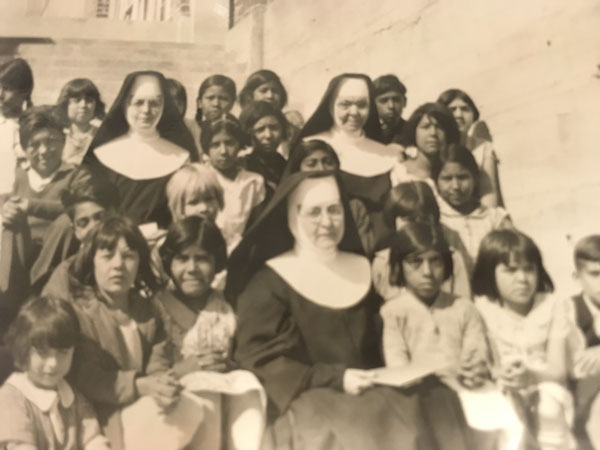
From May of 1931 until 1948, Sister Teresa taught Indian children at St. Mary’s Bengali Medium School for girls.

Now I’ll admit to a decidedly draconian view of childhood education in Catholic schools in the early years of the 20th century, here in the States that is. Jowly nuns nearly bursting out of their strait-jacket habits rule medieval classrooms by thumb-screws and other unthinkable persuasions.

I don’t know where those images come from – perhaps from my own Protestant (which is to say, anti-Catholic) boyhood. But maybe Louise Erdrich is to blame; the nuns in her novels reach out from between the covers and author evil in your own worst dreams.

Somehow it’s hard for me to think of little Sister Teresa, this diminutive young lady, barely more than a child, holding forth before an overcrowded classroom of little girls and being anything less than cherubic. Honestly, she couldn’t be draconian if she tried, right?

Who knows what little Sister Teresa might have been like as a teacher? Eventually the world came to esteem her greatly, not for creative lesson plans or cool classroom tricks, but because of her sacrificial rescue work among the world’s poorest and often abandoned little ones. Later on in her life, she wasn’t teaching multiplication tables, she was keeping otherwise wasted children alive.

But in her starchy black habit she stood before 17 successive classrooms of poor Indian children. We know how she saw her calling – or at least we know how she wanted others to think about how she saw her calling, her work. This is what she wrote to a Catholic magazine back home:

The heat of India is simply burning. When I walk around, it seems to me that fire is under my feet from which even my body is burning. When it is hardest, I console myself with the thought that souls are saved in this way and that dear Jesus suffered much more for them. . . . 
Wasn’t easy.

Then she goes on, in a very general way, to describe her classroom in terms any teacher will understand. “The life of a missionary is not strewn with roses,” she says, “in fact more with thorns. . .” Aha. Short attention spans likely annoyed her, as did vagrant eyes and minds, belligerence and boredom in her students. Most teachers feel such things at some time or another. I did. She had to know children whose out-of-the-classroom problems loomed so terribly before them that they simply couldn’t sit.

Think of her this way – she wiped noses, buttoned buttons, slapped hands that reached where they shouldn’t have. I bet she read more than her share of lousy assignments. Kids likely tangled in her class, hazed each other, made each other cry.

“[B]ut with it all,” she writes somewhat generically, “it is a life full of happiness and joy when she thinks that she is doing the same work which Jesus was doing when He was on earth, and that she is fulfilling Jesus’ commandment: ‘Go and teach all nations!’” (19).

Funny, even after forty years in the classroom, I always thought Jesus’s departing command was not to teach but to preach. But then, I’m Protestant, and I’m not a woman whose vows to be the bride of Christ gave her a very clear and cozy sense of mission in the classroom.

Maybe I’ve been wrong. No matter. Even though I was a teacher for all those

years, I can still learn.

And Mother Teresa, long after she quit and long after she died, can still teach.

All nations, too.

Sunday, November 03, 2019

Reading Mother Teresa--In the Classroom


“Go into all the world 
and preach the good news to all creation.” Mark 16:15 

From May of 1931 until 1948, Sister Teresa taught Indian children at St. Mary’s Bengali Medium School for girls.

Now I’ll admit to a decidedly draconian view of childhood education in Catholic schools in the early years of the 20th century, here in the States that is. Jowly nuns nearly bursting out of their strait-jacket habits rule medieval classrooms by thumb-screws and other unthinkable persuasions.

I don’t know where those images come from – perhaps from my own Protestant (which is to say, anti-Catholic) boyhood. But maybe Louise Erdrich is to blame; the nuns in her novels reach out from between the covers and author evil in your own worst dreams.

Somehow it’s hard for me to think of little Sister Teresa, this diminutive young lady, barely more than a child, holding forth before an overcrowded classroom of little girls and being anything less than cherubic. Honestly, she couldn’t be draconian if she tried, right?

Who knows what little Sister Teresa might have been like as a teacher? Eventually the world came to esteem her greatly, not for creative lesson plans or cool classroom tricks, but because of her sacrificial rescue work among the world’s poorest and often abandoned little ones. Later on in her life, she wasn’t teaching multiplication tables, she was simply keeping otherwise wasted children alive.

But in her starchy black habit she stood before 17 successive classrooms of poor Indian children. We know how she saw her calling – or at least we know how she wanted others to think about how she saw her calling, her work. This is what she wrote to a Catholic magazine back home:
The heat of India is simply burning. When I walk around, it seems to me that fire is under my feet from which even my body is burning. When it is hardest, I console myself with the thought that souls are saved in this way and that dear Jesus suffered much more for them. . . . (18–19)
Wasn’t easy.

And then she goes on, in a very general way, to describe her classroom in terms any teacher will understand. “The life of a missionary is not strewn with roses,” she says, “in fact more with thorns. . .” (19). Aha. Short attention spans likely annoyed her, as did vagrant eyes and minds, belligerence and boredom in her students. Most teachers feel such things at some time or another. I did. She had to know children whose out-of-the-classroom problems loomed so terribly before them that they simply couldn’t sit.

Think of her this way – she wiped noses, buttoned buttons, slapped hands that reached where they shouldn’t have. I bet she read more than her share of lousy assignments. Kids likely tangled in her class, hazed each other, made each other cry.

“[B]ut with it all,” she writes somewhat generically, “it is a life full of happiness and joy when she thinks that she is doing the same work which Jesus was doing when He was on earth, and that she is fulfilling Jesus’ commandment: ‘Go and teach all nations!’” (19).

Funny, even after forty years in the classroom, I always thought Jesus’s departing command was not to teach but to preach. But then, I’m Protestant, and I’m not a woman whose vows to be the bride of Christ gave her a very clear and cozy sense of mission in the classroom.

Maybe I’ve been wrong. No matter. Even though I’ve been a teacher for forty years, I can still learn.

And Mother Teresa, long after she quit and long after she died, can still teach.

All nations, too.

Sunday, October 20, 2019

Reading Mother Teresa--Holy Fool


“I remember the devotion of your youth, 
how as a bride you loved me and followed me through the desert, 
through a land not sown.” Jeremiah 2:2 

She was just 19 years old when, after six-weeks aboard a passenger ship, she started up the River Ganges, the “Holy River,” into Bengal, and met, along with the others, her “Indian sisters.” Then, in the convent chapel, together, she says, they “thanked our dear Saviour for this great grace that He had so safely brought us to the goal for which we had been longing” (17).

To her friends and family back home, she wrote, “Pray much for us that we may be good and courageous missionaries” (17).

Sister Teresa was only 19 years old, no different from the students in the chairs in my own classrooms, the very ones who text their friends the moment they shut their books; but she was ready to give her life away as a missionary for our Lord. At that moment, she had to be filled with equal measures of fear and conviction. She had to be, at that moment, near unto God. What she could not have known was how near.

She thought she knew what she would be – “a good and courageous missionary.” But in reality she knew next to nothing of what she would become, even less about the squalid world she was about to discover, a world overflowing with the desperation of children she would touch.

At that moment, her youth, idealism, and blind faith carried her triumphantly into a fray she didn’t know was there. She could have had no clue that her selflessness, her righteous dedication to the poor of Calcutta would, in time, establish for her a place among the most revered heroes of this world, a saint. She had little more than a child’s sense of what God almighty had in store for her. Really, she knew nothing at all.

In this complex world of ours, naiveté can sometimes prove a blessing. A young church down the block is filled with the Spirit these days, sure as anything that they’ve embarked on a crusade that is like none other in the community. They’re going to do things right; as a fellowship, they’re not going to be overrun by tradition or the way it’s always been. They’re the new Reformation.

It’s not rhetoric. It’s a mission they believe of themselves.

I’m older and tons less sure. It won't be long and someone what get angry. There will be divisions. Comes with the territory of our humanness.

But there’s something to be said about child-like dreams, of innocence and daring, something to be envied in a real holy fool.

Mother Teresa’s bravado as she takes her first baby steps into her ministry, given what little she really knew of what was to come, is downright astounding. But even more amazing is the grace that crowned her, even as a 19-year-old girl.