Morning Thanks

Garrison Keillor once said we'd all be better off if we all started the day by giving thanks for just one thing. I'll try.
Showing posts with label Book report. Show all posts

Monday, May 06, 2019

Book Report--The Art of Biblical Translation


Don't ask me to run it down anymore, but I've never forgotten an old story about two missionaries, sent by the church to an ancient pueblo, where they were commissioned to bring the Word of the Lord to the Zuni people. In background and training, they weren't worlds apart; both were Dutch Reformed, both of a similar age and era.  

Well, things happen. Soon enough strife grew between the two of them (just about the only palefaces in the community). One believed mission work among the heathen (their word) should begin with the adults of the pueblo; the other was sure the only means to save souls was to start with children.

But there was this other difference too. One of them--let's just call him Dominie Second--was borne with the remarkable ability to pick language easily. It's not somehow akin to the ability to sit down at a piano and play, but one of the missionaries had dexterity with language that could only be called a gift, an ear for language. He picked up the Zuni language quickly, easily, while Dominie First found himself  hopelessly tongue-tied.

It was a brand new mission, and the harvest was slim pickins. Soon enough, Dominie First grew envious of Dominie Second, then annoyed, then aggravated, then, well, angry, at full-volume, not at what Dominie Second did or said, but at the clearly recognizable ability Dominie Second had to engage the locals, with whom he could laugh. He'd learned the Zuni language well enough to make jokes, to banter, to play with nuance, to giggle. If Dominie First would walk into a room and hear Dominie Second cracking jokes with some locals, what Dominie First felt in his heart wasn't the love of Jesus. 

Eventually, there came a divorce. Other reasons were reported to the Mission Board, but one of them, unmentioned, was Dominie Second's remarkable lingual talents, which allowed him intimacy with the Zuni that Dominie First simply could not achieve. Neither of the missionary pastors would have quoted Buddha, but what the Buddha maintained might have been helpful: "he who envies others will never achieve peace."

Dante had envy-ers cast into ice cold water, which sounds about right, because out there on the mission field in the hot, high New Mexico desert, things got icy all right.

That old story came back to me when I read The Art of Bible Translation, by Robert Alter. Alter pounds home a thesis he gives at the outset and again and again throughout the study. Goes like this: ". . .meaning in the Bible or in any literary text. . .can never be separated from the nuanced connotation of words and their dynamic interaction as they are joined through sound, through syntax, and through poetic or narrative context."

Alter, who is Jewish, looks upon the Bible as literature. He has little sympathy for those who prefer it to be a "how-to" for getting along righteously. What's more, he loves the mystery of the book, is engaged by what can't be known, admires its gallery of poems and stories for their unique perplexity, not necessarily for what they teach us about life or how they point at a Messiah. The Old Testament may well be holy writ to some, but it's death to its own character if a reader forgets it is most definitely human writ.  

I must have read Psalm 30 ("mourning to dancing") a hundred times in my 71 years, but I never, ever thought of it as "expressing gratitude for recovery from a near-fatal illness." I never considered that psalm or even that verse in that kind of homely, human way. After all, the Bible is God's word and it simply isn't all that human. To Alter, it most certainly is. 

Will Robert Alter's The Art of Bible Translation change my life? I think not. But his fascinating linguistic stories make me more conscious of the wonder and mystery of the sacred texts. And, even at three score and eleven, that's a good thing.

Wednesday, January 03, 2018

Book Report: Small Great Things


I'm green with envy. I wish I could write like Jodi Picoult, who has churned out a novel a year for the last couple of decades, and done so very well, gathering millions of readers. The places she haunts are no more exotic than your and my family rooms. Her conflicts are not at all extraordinary, except in the way that really good writers can make the ordinary, extraordinary--she gets in there between moms and daughters, between husbands and wives. In a way all of her books are about "small great things."

And some, like her newest, Small Great Things, are about issues, maybe more about issues than about characters. Small Great Things is about an African-American nurse who's worked in a nursery for twenty years. Picoult's first chapter establishes not only her competence but her commitment, her sense of calling. Ruth Jefferson knows babies--let's put it that way. And we love her.

Into the ward comes a couple, skinheads, who see Ruth Jefferson as an African-American--well, as a n______, the enemy. They tell the supervisor they won't have that woman touching their baby. The setup is almost too neat: soon, an delivery room emergency thrusts Ruth Jefferson into a position where she simply must care for the skinhead baby, the baby goes into cardiac arrest, and dies. Turk, the skinhead father, sees Ruth being physical on the dying baby, trying to save her life. He assumes the worst, and we've got a story. 

Small Great Things a perfect book for travelling, so engaging you can't quite not listen, but so breezy that it doesn't steal your attention away from where it should be--on the road. On Monday, we were spellbound for the three hours and more it took for us to drive north for friends and olebollen (to die for). The novel is great and thoughtful entertainment.

Picoult uses three voices to tell the story--Ruth, Turk, and Kennedy, Ruth's rich-white-girl lawyer. And, like just about every storyteller in her genre--and mine--Picoult goes out of her way to be sure that none of the major characters is all good or all bad. Well, at least not all-bad. Turk is a racist pig, a scum bag, a bloody bigot; but, the kid had an awful childhood. He virtually worships his wife, and the baby? When it's born, it could just as well have been born in a manger--you know? When it dies, all hell breaks loose.

Picoult does just about everything in her power to humanize the guy, and because she does, I find Turk a little bit too hard to believe. I can't really suspend my disbelief for a reason that I'll try to summarize this way: any man  (or woman) who can love that well, that deeply, can't hate that much. I don't believe Turk.

Small Great Things does great things by dragging us directly into the racial mess that exists in this country, and it does so with a familiarity that is both disarming and engaging. The Reverend Al Sharpton makes an unmistakable appearance, even though Picoult gives him a different name.

But whenever Turk talks, my defenses rise because, right or wrong, I have trouble believing that someone that smart could be that hateful. 

"There are good people on both sides," our President said after the tragedy at Chancellorsville some months ago. Bigots are good people too, he might have said. Maybe he's right. Maybe I'm wrong. 

Maybe if I knew Turks, I'd think this one less of an animal for his reeking bigotry. Maybe my politics outfit me with blinders. 

I wish I could write like Jodi Picoult. Small Great Things was an absolutely great travel companion. It moves our culture's problems with race up front and personal. It would make a great classroom novel.

But I don't believe it. Maybe I should, but I don't.

Friday, May 20, 2016

Book Report--Slave of the Sioux


There's no accounting for taste, and I'm not trying to sell a book. The fact is, I really loved Slave of the Sioux, not because it's riveting or factual or because it has any of the characteristics one might expect of a literary ancestor of the memoir, a genre greatly beloved by our age. It does, but that's not why I read it.

What's worse, I can't imagine anyone recommending this book. It's insanely politically incorrect. Fanny Kelly was kidnapped by a terrorist band of Ogallala (Sioux) after what some would call a totally unprovoked attack that killed several of her travelling companions as they, like millions of others, wagon-trained over what had been traditional Sioux lands. 

Once in the story, she seems to understand their anger; she stops and explains the hatred they harbor for those endless train of white men and women and children aboard thousands of prairie schooners. But for the most part what she suffers at the hands of her captives determines her attitude, and it's simple: they are savages. 

The s-word was universally appropriate in the late 19th century, and Ms. Kelly sprinkles it liberally--"savages here," "savages there"--and sprinkles is most assuredly too kind a word. That usage also earmarks the fascination I have, I guess, for a book like Slave of the Sioux.

As its genre-ancestor almost two centuries earlier, The Narrative of the Captivity and Restoration of Mary Rowlandson, Fanny Kelly's story had to have been something of a best-seller back in the later decades of the 19th century, when the story of the West was vastly more interesting than it is today because people--red and white--were still living it. Kelly's story is set when it happened, 1864, when the white nation, for the most part, was far too taken by its own Civil War to pay close attention to what was happening in the great open spaces west of the Mississippi. 

But out here on the Northern Plains, a war was also going on, a clash between the armies of immigrants coming into the region and the red folks those newcomers so mindlessly displaced. Fanny Kelly is a casualty of that war. In the attack that led to her captivity, her small caravan of wagons and pioneers were murdered, massacred really, except for her and her adopted daughter. 

Ms. Kelly and her Christianized ways became something of a role model for disgruntled Ogallala wives; she simply did what her Native husband commanded. That compliance not only saved her life but made her so valuable that cavalry enterprises created to buy her back from her captors failed. She was, to her husband, too valuable. 

A community founded on violence as a virtue could not have been a happy home for her, and it wasn't. She found Lakota life brutal and merciless--and says so. To a contemporary reader who's adopted the "noble savage" characterization of Native America, what happens to Fanny Kelly will seem deliberately staged to make her white readership regard Native people as even more hideous. I'm sure it did in the mid-19th century.

But contemporary readers--no matter how they view the story of the American West--read a book like Slave of the Sioux in a completely different way 150 years later; and, for the most part, that's where my love of the book grows. What's of great interest to me is that significant difference. I can't help but read a story like Fanny Kelly's with a level of comfort and objectivity that, for the most part, wasn't available when it was first of all experienced and then subsequently published as a popular read (1871). The book is interesting in the way a thoughtful museum can capture our fascination.

Example? Easy. Fanny Kelly's family owned two slaves who traveled with them out west. Both were killed when in the Lakota ambush. Ms. Kelly doesn't really question the legitimacy of her family's owning servants, and when the survivors from the first attack have to bury the victims, they argue--seriously, she says--about whether or not Black victims can be buried with white victims. Finally, it is resolved that they will be, and when it is, Ms. Kelly notes it as a mark of their compassionate liberality. Amazing.

What happened in the American West--what happened in all of North America since the arrival of  this nation's first undocumented populace--was a cultural clash that had countless victims, the vast majority of whom were Native people. That raw fact is something that Fanny Kelly only obligingly understands and largely looks past. There was, after all, free land out west, land her husband and she simply determined offered for them and millions of others a far better life.  Call it "the American dream." That they could make such a blind determination still strikes me as greatly amazing as it is appalling.

But so it went with my people, even with my own family; all of which makes Fanny Kelly's story my story too, for all its sadness and horror. In a way, I was there too, just a bit downriver.

I don't need to apologize for reading Slave of the Sioux, and I'm not. To say I enjoyed it probably misses the point; but I did, not for the vivid action of the narrative (it is a 19th century action/adventure story), but for what it contributes to my own understanding of our own recent past and the story of America, a story I am very much a part of.

Monday, April 18, 2016

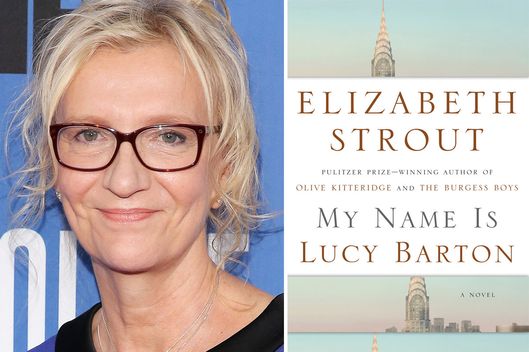
Book report--Elizabeth Strout's My Name is Lucy Barton


Disappointing, I thought, and I'll tell you why. 

I loved Olive Kitteridge, Elizabeth Strout's bundle of stories about an indefatigable woman whose pushy zany-ness was both a marvel and a blessing. Olive Kitteridge was a character you didn't need to like in order to love. 

Apparently, I was not the only reader in North America who thought so. Olive Kitteridge won the Pulitzer in 2009. That's affirmation.

My Name is Lucy Barton, Strout's most recent novel (2016), features a character I could neither love nor like, and the reason is this haunting sense that she's not telling the whole story. Look, in literature as in life it's somewhat rare to get the whole story from any aggrieved story-teller. Someone tells us an incredibly sad or disappointing story about him or herself, and most of us, no matter how sympathetic, can't help but wonder whether there's not more deliberately left unsaid, even another side. We can cry with the hurt and the lonely and still wonder how the bad guys might spin the same stories. 

Lucy Barton scares me because I can't help thinking she's being deceitful, and in the most dreadful way: she may well be lying to herself about herself. What that means, of course, is that I don't trust her. In this novel, I don't trust the storyteller.

Now the unreliable narrator has become a much beloved character these days. Writers create all kinds of wondrous possibilities by using narrators whose rendition of things seems scanty. We know the role because we're that way ourselves. None of us can be trusted to tell a story with divine objectivity because we're not divine. We all spin, especially when it comes to intimacy. None of our stories can ever be trusted totally.

But when the holes gape too much, distrust makes us wary; and I spent too much time being really wary of Lucy Barton's spin on those closest to her. Halfway through already, my BS meter started buzzing and not always softly; and when it did, I found myself half a continent away from Lucy's heart. That kind of distance is dangerous in a novel that's so deeply dependent on the voice of the teller.

When it's all said and done, Lucy Barton wants us to believe that she loved her mother deeply. Deeply. I didn't believe it, and still don't. Elizabeth Strout gives us cause for Lucy's estrangement--abuse and poverty--but most of us know people who've suffered far worse and come out less scarred. There's more to the story, more than we're not hearing.

That Elizabeth Strout knows her way around the human character is amply proven by her own masterful stories, but Lucy Barton leaves too much unsaid. You can't help but be interested in the matters of the human heart Lucy tells us, but I, for once, came away leery. 

One New Years Eve many, many years ago, we sat with a woman in the middle of a marriage that seemed to be unraveling. We knew her through church, which means Judgment was sitting there beside the three of us too: it was the estranged woman, my wife, me, and guilt--hers. When we accepted her invitation, we didn't know she needed to vent, but she did. So we spent New Years Eve, our first by the way, in the confessional. 

I was a kid, we'd been married for six months, but I couldn't help thinking there was more to the story. We left shaking our heads. 

Does that woman deserve a story? Certainly. She's as human any of us. In a novel, should we have to trust her? Not really--library shelves are full of unreliable narrators.

But Elizabeth Strout can't expect that a character like Lucy Barton will be loved. Even liked. Speaking for myself, when Lucy stopped talking, I was shaking my head. I didn't believe her.

Am I glad I read the book? Yes. Would I recommend it? Sure. Was I moved? I was as skeptical as I was one bad New Years Eve a lifetime ago.

Tuesday, November 24, 2015

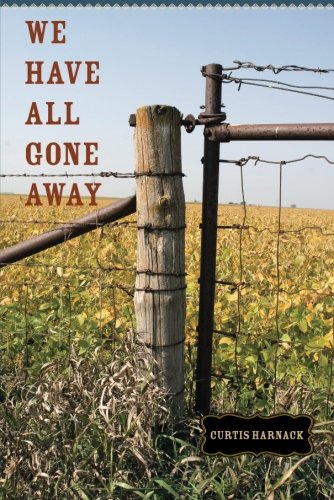
Book Report--We Have All Gone Away


It's a beautiful book, really, one of the finest I've read in some time. Curtis Harnack is local, born and reared on a farm not so very far from here, just outside of Remsen, Iowa, on land his family still owns. Unlike Frederick Manfred, who was older, Curtis Harnack's boyhood didn't include horses. Farming on his Plymouth County farm were more mechanized than they were in Doon in the early years of the 20th century, but still a whole era away from what we now call "agribusiness." 

But then Curtis Harnack learned farming from a man whose heart wasn't in it. When his own father died, Harnack's mother chose to stay on a farm that would be run by her brother-in-law, someone she determined would be the kind of father-figure her son would need. Uncle Jack figures greatly in We Have All Gone Away, although their relationship is somewhat love/hate, in part because Uncle Jack never really loved the chores that come with the territory and would have greatly preferred what folks used to call "tinkering."

But 'druthers' weren't in the cards during the Depression, when Curtis Harnack was a boy. Uncle Jack had no choice but to farm two chunks of land that came to him when his brother-in-law died. Harnack may well have picked up something of Uncle Jack's own disgruntlement because while the essays in this thoughtful book of memories are redolent with farm memories that are anything but disdainful, Curtis Harnack determined early on that farming northwest Iowa soil, as rich as it might be, was not going to be his lot in life.

His mother wanted more for her boy; and that, he says in the book, is the reason he had no choice but to leave. His mother looms over this memoir like no other character, even thought she remains mysterious and shadowy. Halfway through, I wondered why I knew so little about her. By the end, we know her better; but one of the most intriguing aspects of this wonderful series of essays is that it is so much about a woman we never really come to know. 

I'm not sure Harnack knew her either. She was always there at home, but what these elegant essays say more clearly than anything was that she reared her talented children (and they all were talented) to leave the farm and Remsen for worlds that didn't end at a fence row. We have all gone away, Harnack says, because that's the way mother wanted it to be.

Caroline Harnack died in a mental ward in a Sioux City hospital after attempting suicide twice. If he didn't really know her, it's possible no one did. But what Mother Harnack clearly imparted to her children was the necessity of finding themselves in a larger world than Remsen. 
So long as Mother could anticipate the unfurling of events in the lives of us children, her spirit was sustained; she was held together merely by being a witness of destiny. But once the true patterns became evident, and the playing out of our years meant we'd actually be more and moe removed from her, a weariness and hopelessness about her own remaining years descended. What was there left to envisage, in her future? Somehow, she'd imagined getting away, too, just as we were doing, but she wouldn't want to be an encumbrance, hang onto us, or interfere in our lives. we were to go off by ourselves without so much as a glance back; otherwise how could we create our lives to their fullest extent? She knew at last the clean, scraped-womb condition of her sacrifice to give us our chance.
I had no trouble putting down Curtis Harnack's short story collection Under My Wings Everything Prospers because I thought I was listening to a man with an identity problem, someone who wanted badly to be something he wasn't, someone who wanted to be something distinguished and academic and exceptionally literary--and not from the farm. Some of those short stories feature characters he didn't seem to know, and there's a mannerism to the writing that suggested he wasn't writing from the soul but for readers whose regard he wanted more than anything. I had trouble finishing the stories.

On the other hand, even though I was taken with the first essay in We Have All Gone Away, not until the end of the book did the book's strengths fully take me over. At his worst, Harnack tries too hard for a sophistication he is more than capable of achieving--he's a marvelously graceful writer. But art for art's sake doesn't work all that well in a book about the farm where he grew up.

Like a growing season, We Have All Gone Away is a collection of memoir essays you slowly come to love. By the end, you start to feel they're almost perfect. 

I've been on a kick for quite a while, reading books that grew up in the region. Harnack's We Have All Gone Away is one of the very finest. It's artful and literary and not for everyone, but it's beautiful in its design and almost perfectly lovely in its mystery.

Willa Cather had designs on leaving Red Cloud, Nebraska, behind her on the path to literary stardom, when a friend reminded her that Cather knew great stories from her Great Plains past. Thank the Lord for good friends. We've got Song of the Lark, My Antonia, O! Pioneers.

I wonder if something similar, somewhere along the line, didn't happen to the New Yorker Curtis Harnack became. Someone may well have suggested the Iowa farm boy write about Remsen. 

And he did. 

Wednesday, November 18, 2015

Book Report--A New Heaven and a New Earth


Did I read more enjoyable books? Yup. 

Is this one written with a grace that sings? Not especially. 

Did the story keep me up late? Not at all. The only reason I didn't fall asleep was that I often could read it fast, speed-skating over big chunks of material. 

Did it change my life? Not really.

But J. Richard Middleton's A New Heavens and a New Earth was and is the most influential book I read in the last year.

Once upon a time, America was blessed with a Secretary of the Interior from Colorado, a pious believer driven fiercely by his commitment to Christ. His name was James J. Watt. Just exactly what Watt believed and didn't remains somewhat controversial, but he was a devout dispensationalist Christian who fervently assumed, as many do, in the imminent return of Jesus Christ. If you truly and deeply believe that "the trumpet will sound" tomorrow, if not the next day, your attitude toward this world has to be affected. Watt's was. His tenure as Secretary of the Interior--for which he was an odd, odd choice--was as stormy as it was short, just two years.

Middleton's A New Heaven and a New Earth begins by disparaging the James J. Watts of the world. Middleton claims that our views of eschatology--our view of the end of time--not only affect our views of the here-and-now, but are sometimes--in fact, most often--dead wrong. Somewhere along the line, Christians got on a ship going the wrong way, and we've been out to sea ever since.

Middleton pledges he will never again use the word heaven in polite conversation. How's that for radical? He'll simply delete it from his vocabulary, not because he doesn't believe in a glorious afterlife--he does; not because he doesn't believe in Jesus Christ--he does; but because he believes scripture is clear about end times, and what it offers us is right there in the title of the study: A New Heaven and a New Earth.

Middleton's argument is not new, but I'd never seen it argued so comprehensively. Because what he's asking believers to believe is so controversial--there is no "heaven"!--he feels compelled to run down every last scriptural reference and study them in context. He attempts to put a lock on what he considers the Bible says; to wit, that there is no platform of hyper-space to which we'll ascend, no pearly gates, no streets of gold, no flights of heavenly angels in a half-empty choir loft that awaits our arrival. 

What he argues is nothing less than "God so loved the world," that He loves his creation and wants to make it flower, that the afterlife won't be stamped with some stratospheric zip code but be, for all intents and purposes, the here and now, more precisely here and redemptively then. 

Am I convinced? Well, maybe. The Bible, a story of love and truth and wisdom, is always easier to get wrong than right. On that score, we've got a perfectly abysmal track record. We never win. If there's one thing true about all of us and our persuasions, it is that we never get the story right, despite the fervent reaches of our piety. It's really all about grace, about what we don't have coming, about the goods only God almighty can and does deliver. We get it wrong, but he loves us anyway--that's the gospel.

For better or worse, I'll always be wary of anyone who claims to know the whole truth, even people like Middleton, theologians with whom I certainly share a species of the Christian faith. 

Somehow I don't think he'd fault my doubt. A little of it goes a long ways in this world.

But not the next, and that's the point, really. Middleton says John the Baptist's annoyance at Christ's slow ascension to power--"are you the Christ or look we for another?"--is a peculiar problem: "He expected too much, too quickly."
Historically, however many Christians have had the opposite problem. We have not expected enough. And what we have expected, we have often delayed until "heaven" and the return of Christ. We have not really believed that God cares about this world of real people in their actual historical situations, which often are characterized by oppression and suffering. Our understanding of salvation has been characterized by an unbiblical otherworldliness. So our expectations of the future have often not reflected the full-orbed good news that Jesus proclaimed at Nazareth.
I think Middleton's right.

Someone asked me yesterday to name the most influential book I've read in the last year. I savored novels and histories I loved more than this one. I read stories I found much more difficult to put down. I read books I poured over slowly, lovingly. Middleton's wasn't one of them.

But A New Heavens and a New Earth was the most influential book I read in the last year. Its argument profoundly concerns life and death and life once again in a kingdom newly realized. 

In that sense, I've still not put it down and probably never will.

Monday, November 02, 2015

Book Report--Laughing Boy


There is no way of knowing whether he ever picked up the book, but because Casey Kuipers, a CRC missionary at the Zuni pueblo for many years, was a graduate student at the University of New Mexico in the early 1930s, it's not unlikely he would have seen or heard about or even read Laughing Boy, a New Mexico novel by Oliver LaFarge that won the Pulitzer in 1930, the first novel about Native people so honored.

You can't help but wonder whether Laughing Boy didn't contribute to Kuipers's own literary dreams. After all, he wrote three novels himself a year or two later.

Oliver LaFarge was an Anglo graduate student when he traveled to Southwest almost a century ago. What he knew about Navajos was what he picked up when he studied archaeology and observed the culture.

Kuipers could well have determined that his years of experience with the Zunis gave him enough similar experience to write his own novel showcasing Native life.

But Casey Kuipers' novels never won a Pulitzer. In fact, I'm quite certain he didn't sell many books. By choice and creed Kuipers, a schoolteacher and a missionary, carried a wholly different agenda into the novels he wrote about New Mexico's indigenous people. There are no schoolteachers or missionaries in Laughing Boy, but their effects loom over everything that happens in this touching old love story because mission schools essentially create the tragedy at the heart of the story. 

Laughing Boy is a darlingly naive young Navajo blessed with abundant skills in traditional arts from horsemanship to leather work to silversmithing. His naivete arises from his character, as well as his lack of contact with a world outside of his clan and their neighborhood. In 1915, when the novel is set, much of the Navajo reservation was composed of clans and communities left largely unaffected by Anglo cultures surrounding them. They'd suffered horribly through warfare and mass displacement, just as many Native American tribes had; but by the time the first automobile showed up on the reservation, many young Navajos likely knew very little about life just a state away in California. 

Laughing Boy falls in love with Slim Girl, who has been away to boarding school in California. And there lies the tale. She's a full-blooded Navajo, but her school experience has turned her into something of a prostitute. When the two of them marry, she finds the old ways of Laughing Boy's people quite repellent.

But attractive too, because Slim Girl knows she has no identity, no heritage, no one who loves her. Missionaries brought her the gospel, then banished her when she became pregnant by a white man.

She marries Laughing Boy believing he will help her regain what she's lost. From the first time Laughing Boy sees her, he simply adores her; she thinks he'll do. Slim Girl is a schemer and a liar, a woman without a country, but someone who is motivated to her deception by hate and desire for revenge against white people. 

The narrative line of the novel is how she learns to love Laughing Boy and his sweet sincerity. The tale is that story, the story of their love growing toward a tragic end created when Laughing Boy discovers Slim Girl's deception. The two of them are as star-crossed as any couple in Shakespeare. What happens is textbook tragedy that simply wouldn't have happened if Slim Girl hadn't been, years before, hauled off to boarding school. 

Loss of life, but triumph of love--that's the story.

Did it happen? No. Could it have? Yes. Did boarding schools rob their students of heritage and identity. Yes. Were they evil? Ay, there's the rub. 

What I'd love to know is what a thoughtful, loving missionary/teacher in New Mexico in 1930 would have thought of Oliver LaFarge's Laughing Boy, especially when that novel won the Pulitzer Prize. 

I wish I could ask Casey Kuipers, born right here in Orange City, Iowa, because he had to have had an opinion. After all, it was his work in the school and his Christian faith at the dark heart of all the sadness in this prize of a novel. What did Kuipers think?

Tuesday, September 29, 2015

Book Report--The Killer Angels


I have memories of the Gettysburg battlefield. Somewhere, I'm sure, I've got pictures because I remember wondering how best to compose a shot of the tall trees where Lincoln stood to deliver the Address. I remember the huge diorama of the battle, thousands of tiny troops pitched off against each other on a field perfectly matched to what we'd just been riding through outside, the setting for those awful days, early July, 1863. 

The Civil War battlefields I've visited look greatly alike, most of them developed and opened in the era of towering granite monuments. Here fell the boys of Iowa's 5th, or whatever; here, Wisconsin's Third; there, a heroic column of Virginians. Most I've visited look like broad cemeteries of particularly massive stones.

History is in the landscape, of course, but if you want to know the story you've got to read more than the inscriptions on monuments. Even a walk around that huge ancient Battle of Gettysburg diorama won't bring it all home.  A visit to the battlefield, no matter how well meant or perfectly planned, will get you only so far--you simply have to read.

Michael Sharra's The Killer Angels tells the story of the Battle of Gettysburg so movingly that it will forever be the map by which I read the battle and its outcomes--and book is fiction. I love history, always have, always will; but Sharra's immensely compelling novel outfits the story in human flesh in a way that history books cannot. That's what fiction does.

For most of my life I considered Stephen Crane's The Red Badge of Courage (1894) the best novel of the Civil War, largely because someone somewhere along the line--some teacher, I'm sure--told me it was. I hadn't read any others. Still, what Crane achieves in that novel is a testimony to the power of fiction because what he called his "psychological portrayal of fear" was undertaken and accomplished even though Crane himself was not a veteran and hadn't set foot on a Civil War battlefield. He did what fiction writers--he imagined the story, then outfitted it in human  flesh.

I wouldn't doubt that true historians would tell me my view is jaundiced somehow, but I will probably never think about Gettysburg again outside of the template fashioned by the central conflicts of this withering novel. The Killer Angels relies heavily on the journals of Confederate General James Longstreet and is, to a great extent, his story.

The conflict Sharra puts at the heart of things (there were hundreds of thousands of stories at Gettysburg, millions) is the story of two men, Longstreet and Robert E. Lee. Lee treasured Longstreet, who some historians call the greatest Field Commander on either side of the battle lines; and Longstreet worshiped Lee, as many do yet today. 

Their disagreement about tactics at Gettysburg is the dynamic that shapes action in The Killer Angels, as it did on the battlefield, a conflict between two brave and wise men, "killer angels," both determined to do the right thing. Yet, the decisions of these two great men determined how 157,000 would fight at Gettysburg, and how 51,000 of them would die.  

Longstreet thought Pickett's charge was suicidal. Lee considered that charge the only possible way the South could win. Lee was boss, Pickett charged, thousands died, and the Rebel armies withdrew. Lee was undoubtedly right: had Pickett broke through, the Union Army could have been routed. But he didn't, as Longstreet had guessed, and the Rebs--what was left of them--went home. That's the story Sharra tells.

Two men were utterly conflicted while making huge life-and-death decisions, not just about troops but the entire outcome of a war both understood hung in the balance. With that immense responsibility, both remained sworn to moral high ground. In Sharra's hands, they both are angels. Robert E. Lee wasn't pro-slavery; he led the Confederate armies, Shaara says, because the South was his homeland and its people were his people. Longstreet served Lee at Gettysburg, followed orders not because he thought "the old man" was right about the battle but because Lee was his superior and a man of unquestioned honor. The novel captures the dimensions of their profound tactical disagreement amid their commitment to righteousness.

The Killer Angels bounced around for quite some time before picking up a publisher because, well, some would claim that one doesn't really do history the way Shaara does. The Killer Angels is a novel, after all, a fiction, and not a history. But when in 1975 it finally found a publisher and a readership, it was awarded the Pulitzer Prize for fiction.

Last month, we stumbled on a tiny federal cemetery in Hot Springs, South Dakota, perfectly alabaster grave markers sweeping artfully over a hill, all of it honorably managed and perfectly manicured, the grave markers of war veterans, many of them from the Civil War, who came to the Veterans' Hospital at Hot Springs to spend their last days. 

The United States of America has lost just about 1,250,000 of its own in wars. Think of it: roughly half of those were killed in the War Between the States. The Hot Springs graveyard holds but a fraction. For a federal cemetery it's a tiny place.

I sat there by myself early one morning last month, amid the perfect rows. It's off the beaten path, hidden away on the outskirts of town; but if you're alone in the silence, it's as impressive a monument as you'll find on any battlefield.

Michael Shaara's highly celebrated Civil War novel, The Killer Angels, tells the story of several men in leadership at Gettysburg, all of whom were, in fact, exactly what he calls them. It's a great read and a great book.

Thursday, September 24, 2015

Book Report--To Purge This Land with Blood


U.S. Highway 75 runs from just south of Winnipeg all the way to Dallas, bisecting the continental United States at the eastern emerald edge of the Great Plains. In northwest Iowa, it runs right through little Sioux Center, just two blocks from the house where we lived for a quarter century.

So we decided to take it once upon a time, avoid interstates and follow Highway 75 south to Tulsa, where our son had found a girl he would eventually marry. Easy enough, get on the highway two blocks from our garage, and don't get off for a whole day, all two-lane.

I knew something about the story of John Brown before that trip, knew John Brown was an abolitionist whose personal history remained, 150 years later, something of a puzzle. But I knew little more.

We weren't pressed for time, so I followed the signs when the highway let us know we were approaching some kind of historical marker. We got off 75, followed some country roads, and came to an overgrown spot in eastern Kansas--one of those places marked with a sign that seemed to have been alone in the wilderness for quite some time, well off the beaten track.

What we'd happened upon was the backwater spot where John Brown and his sons and his men carried out cold-blooded murder. Five men, angry Southerners, "Border Ruffians" committed to the cause of slavery in these United States, men who were committed to violence themselves were hacked to death by abolitionists armed with machetes. History says Brown didn't do the killing, but that he was the instigator was indisputable. His commands were the ones that mattered in what became known as "the Pottawatomie murders."

I knew nothing of that story and nothing of John Brown ever having been in Kansas, nothing of "Bleeding Kansas," a series of conflicts many mark as the real beginning of the War between the States. 

I knew that Marilyn Robinson's great novel, Gilead, alluded frequently and powerfully to the cause of abolition here in Iowa. What I also knew from talking with her is that she was herself greatly taken with the abolitionists, most of whom, like John Brown, were profoundly religious.

Modernism once determined that religion was a vestige of barbarism that contemporary life was, thankfully, abandoning. What humanity had awakened to was the realization that we had no need for God. Where people worshiped some spiritual being, they did so out obligation to ritual to non-existent ancient mythologies. 

But the nature of the conflict in the heart and soul of the story of John Brown remains the heart and soul of the conflicts in this country today, a country, most say, as divided in spirit and temper and character as it has been any time since the Civil War. Religion not only continues to play a role in our lives, it often still determines behavior.  A clerk of court chooses jail to freedom because of her religious views. Candidates for office need to parade their religious affiliations as if they were awards for bravery. Today, six years into his second term as President, 54% of Republicans still consider Barack Obama is Muslim. Religion is the base from which many of us--most of us--operate and by which we identify ourselves.

A devout Christian presidential candidate says no Muslim should be President of these United States. Some condemn him. Others--many--run to his side in his support. 

How do we balance our own contrary commitments--our commitment to God with our commitment to America? How do we give unto Caesar that which his and etc.? How have we determined such questions in the past? Was John Brown hideously insane or, as he himself determined, someone identifiably chosen by God to destroy the sinful, hideous American institution of slavery? As I said just a few days ago, the man was strengthened by scripture: "in all thy ways acknowledge him and he shall direct they paths" is a verse he quoted often and even used as a testimony.

I'm no historian, but I'm betting that To Purge This Land With Blood: A Biography of John Brown, by Stephen B. Oates, published way back in 1970, remains the gold standard on the life of the most famous American abolitionists. I found Oates's study utterly captivating and relentless in its determination not to leave the records unturned. Aligning sources and marching them out in an orderly fashion is an epic job all by itself in any retelling of the John Brown story, but Oates was working with one of this nation's most incredible narratives when he chose to follow the life of a man whose body, a'moulderin' in the grave, begat the music sung around a thousand Union Army campfires. 

The life and times of John Brown is a story I'm glad to know better--righteous anger creating bloody violence. Brown was a radical, a terrorist, a murderer, and a madman who did it all in the name of Jesus because what he was fighting for--an end to slavery--was right there on the paths of righteousness for His name sake. His death, which he deliberately shaped into national martyrdom, probably did more to begin the bloody surgery required to end slavery in these United States. His death mobilized both sides, making Civil War more even inevitable than it already was.

There are no easy answers to the life of John Brown. Nothing is black and white, and that's what make the story so richly human. If you'd like to know more about John Brown, start with Stephen Oates' nearly fifty-year old abundantly researched biography. It's a story from heart of who we are.

Friday, August 28, 2015

Book Report--Fierce Patriot: The Tangled Lives of William Tecumseh Sherman


The man in the middle with his hand up is unmistakable. The man to his right is his top military general, Ulysses S. Grant. To his left sits Rear Admiral David Dixon Porter. The man holding forth across the room is General William Tecumseh Sherman, remembered (and vilified) still today primarily for "Sherman's March to the Sea."

The story goes that this meeting was somewhat serendipitous. It was March of 1865, the war was drawing to a close, and President Lincoln was aboard a river boat somewhere close to Grant's headquarters. It just so happened that General Sherman was in the neighborhood. Thus, the meeting of "the peacemakers," a meeting Admiral Porter later described like this: "I shall never forget that council which met on board the River Queen. On the determinations adopted there depended peace, or a continuation of the war with its attendant horrors."

The painting, done by George P. A. Healy, is titled The Peacemakers and meant to celebrate this moment, "an occasion upon which," Admiral Porter wrote, "depended whether or not the war would be continued a year longer. A single false step might have prolonged it indefinitely."


In Fierce Patriot: the Tangled Lives of William Tecumseh Sherman, military historian Robert L. O'Connell, claims this famous portrait captures Sherman perfectly. He is obviously holding forth. The others, each of whom outrank him, of course, are his audience. Lincoln seems spellbound, but Admiral Porter and General Grant seem, well, wary. O'Connell says where Sherman was there were always words. Sherman could fill and room and did so, time and time again. And he was good at it.

As you can imagine, no one was better at telling the stories of the March, and everywhere Sherman went once his men cut the South in half and basically ended the war, people--important people--wanted to hear them. O'Connell says the system of warfare that Sherman created was, for all intents and purposes, brand new to military history. General William Tecumseh Sherman was, O'Connell says, an innovator, a man who not only created basic techniques of modern warfare but also designed what O'Donnell claims is the unique strength of American military units ever since, the indomitable strength of a democratic army.

Whether all of that is true I'll leave to military historians who know the history of the American military far better than I. But have no doubt about O'Connell's purpose in this fascinating biography: he is determined to show that Sherman's March to the Sea is the forerunner of every great American military victory since 1865. Sherman, known lovingly as Uncle Billy to his men, was the man and mind who created it.

What O'Connell marshalls to the fore in his retelling of the March is Sherman's methodology. He gave his men a very clear and abiding sense of the purpose of their mission, but turned them loose to get there on their own, four separate military movements through the heart of the South. His troops knew the direction, but how they got to the destination was up to them. 

It was, in some ways, the beginning of a species of guerrilla warfare, O'Donnell says, and when it worked--and it did--Sherman's democratic strategy, letting his troops determine their own fate, living on the land as they did, that strategy ended the bloodiest war in American history. 

In war, Sherman was fierce and unrelenting; but the moment his men brought a measure of peace to the country they conquered, he became, O'Connell says, a paragon of virtue, dispensing aid as if he were a father dispensing discipline to rebellious kids whose abominable behavior required a strong hand.

During the "summer of  Trump," it's good to be reminded that men with over-sized egos have manipulated the press and the public for more than 150 years in this country. Sherman hated the press but had a knack for ringing banner headlines from them and stories that created respect, even adoration for him in the minds and hearts of American people. He was beloved as a military leader, but he could be a shyster.

He was subject to depression that at times took him out of the character he wanted to show to the country and away from the kind of rule he needed to maintain as a rising star in the American military. He had to have been a strain on those around him, up and down like the war effort itself in those early years. But Grant wouldn't have been without him. Neither would Lincoln.

Sherman's relationship with his zealous wife was on again, off again. She was herself no wall flower, but her passion was her Roman Catholic faith and she fought him, tooth and nail, for the love of their children. Like a famous recent President, General Sherman wasn't above an occasional roll in the hay with other women.

That O'Donnell admires Sherman is not only clear by the central argument of his biography. But his admiration blind him to Sherman's humanness. I have relatives in Ringgold, Georgia, a small town just outside of Chattanooga that was in Sherman's sights as he began his Atlanta campaign, My relatives say their neighbors don't hold General William Tecumseh Sherman in such high esteem. I'm sure that's true.

General Sherman is undoubtedly worth a dozen biographies, maybe more because there's likely always more to be said about a man who himself always had more to say. To Robert L. O'Connell, William Tecumseh Sherman was to many in his day an American hero. And still is. Or should be.

Fascinating character. Fascinating reading.

Wednesday, June 24, 2015

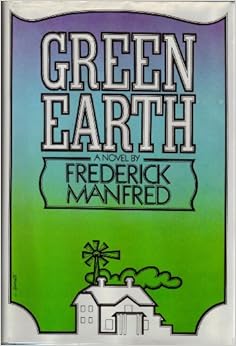
Book Report--Fred Manfred's Green Earth


If you're looking for a pot boiler, grab the next one off the shelf. If you're looking for apocalypse, sci fi or fantasy, you're in the wrong section of the bookstore. Inspiration?--don't make me laugh. A how to?--nope. This one is straight-up realism with never-ending jolts of earthiness that make you scream or at least look away. There are moments along the line when you speak to Frederick Manfred, the author, when you say, "Dang it, you honestly didn't have to include some of the stuff because, doggone it, I really didn't want to know." 

But if you like museums, pick up Green Earth and start into one of Frederick Manfred's thickest tomes--over 700 pages of a kid growing up amid endless farm life minutia in Siouxland (he always claimed to have given the place its name) in the 1920s. No one else tells that story. No one else could. 

Manfred wanted to tell at least two stories during his writing life. One was regional, a story he told in five "Buckskinman" novels, the much-heralded Lord Grizzily, Conquering Horse, Scarlet Plume, Riders of Judgment, and King of Spades, each of which explores an era in the history of section of nation he lovingly chose to call his home.  

The other story was his own, a story he told in novels he called "rumes," from rumination (he rather liked making up things, even words). A writer ruminates about himself and his world and tells the story using those materials. When Green Earth appeared (1973), the age of the memoir hadn't. He was himself rooting around for a way to tell his own story. Not content with calling what he does in Green Earth plain old autobiography, he wants to create a hybrid all his own borne from the freedom to take what he wants from what actually happened and refashion it into what he would happily and even blessedly call "art."

Whatever that is. 

Today, we baptize everything with that word. Good autobiography, like good memoir, is "art," right?  "The Art of Reality Television"--someone had to have written that essay already.

Green Earth, a "rume," chronicles the life of Free Alfredson, although any fool knows it's really about a kid named Feike Feikema, a tall, gangly farm boy who loved baseball and wasn't afraid of a little hard work because, back then, hard work simply came with the territory. Fred's family moved around a lot, so did Free's. Fred's family included six knock-around boys; so did Free's. Fred's mother was deeply religious; so is Free's. Fred's father, a good man, wasn't; neither was Free's, who was also a good man.  

Just about every inch of Green Earth is Fred Manfred's story. What isn't is up for grabs.

When it comes right down to it, Green Earth tells the stories of two people--Free and Ada, which is to say, Fred and his mom. For Free, the story is the passage from childhood into adulthood. Green Earth begins with Ada's tragic love affair with a man who got another woman pregnant and therefore, by community custom, married the girl with child. The novel tells the story of her romance with a kind and hard-working Frisian boy from a town up the road, their marriage, Free's birth, Free's childhood, and Free's high school years. Free's story is all of our stories--how we grew from innocence to experience. 

But the unique story at the heart of Green Earth belongs to Ada Engleking, Free's mother, a woman whose deeply religious heart colors the emotional tone of the novel the way a Siouxland dawn in June colors the never-ending sky. Her story is a love story in every way--how she learned to love her husband, how she learned to love the world around her, and, most specifically, how she learned to love her son, a son who was not like any other in the neighborhood.

In a deathbed scene that's unforgettable, Free is freed to think and imagine and even write. It's hard to believe from a Dutch Reformed point of view, but meant to be definitive by the emerging writer. "I'd rather have you in hell than a hypocrite in heaven," Ada tells her son, freeing him, just moments before she dies. 

Did that conversation actually happen? Did a deeply religious woman who becomes, in Green Earth, almost divinely sympathetic actually tell her son when he was 17 and she was dying, that he should follow his heart and his dream, even if that road brought him away from the salvation she had to have wanted for her first-born son? 

Manfred would say that isn't the question you should ask. The question is, is Green Earth art? 

Talk amongst yourselves.

I love the novel, loved it more this time, thirty-some years after I read it before, despite the fact that as a novel it's wearying. It plods through years as if pulling a plow. It's 700+ pages. A thousand loosely fitting anecdotes. Endless specificity about a way of life that's gone. It's a chronicle--a chronological biography of a tall kid with literary aspirations in a specific time--the 1920s--and place--the rolling hills around the Rock River and town named Doon, Iowa. 

But it's a museum between covers, an anthology of rural life, a how-to of farming with horses.  It's all in there, Manfred would say, everything he ever knew as a boy on a farm. It almost makes holy a way of life that's now long gone from ground people like the Alfredsons--which is to say, the Feikemas--once worked so hard.

We visited Manfred's grave last night in the Doon cemetery. It's adorned with a quote. Here it is.


If you want to know what made Fred Manfred write Green Earth, he might say himself, "It's all here." It's all in the line on his stone. Everything--even the pain and the hunger--was life, "and all moments of life are very precious." 

It's all there in Green Earth. If you're looking to turn pages, look elsewhere. But if you've got the time to wander through a rich adorned museum, then take it off the shelf and tell the librarian you want an extension even before you get out of the library. 

And if you can, read it here, in Siouxland. You'll probably love some moments; others you'll hate. I'm sure some moments will disappoint, others will disgust. Trust me.

But that's life, Fred would say. And it's all there. It's all in the book.