Morning Thanks

Garrison Keillor once said we'd all be better off if we all started the day by giving thanks for just one thing. I'll try.
Showing posts with label Book Review. Show all posts

Tuesday, September 04, 2018

Book Review--Educated

See the source image

I found Tara Westover's searing memoir, Educated, easier to put down than to forget. Some moments in the story of her childhood years are so horrifying that if the book were a novel, I would have simply thrown in the towel and said "I can't believe this." 

Her father is not only unbelievable, he's almost unimaginable--and remember I'm a Calvinist, someone convinced of the actuality of Original Sin. Her father is a Mormon, but his daughter lets that aspect of his faith alone, in part because he could be a believer of any stripe, as long as he was so totally convinced of the imminence of the Day of Judgment. The only surprise, to Mr. Westover, is that the Armageddon didn't happen yesterday, so evident, to him, is the omniscience of evil. His faith pits the entire world against him. He is the only one faithful.

He's a survivalist. Just about everything he does is created by the war he wages against the spirits of the age. What keeps his soul hot is a violent conviction that soon and very soon the Evil One will come after him and his family, the remnant righteous hiding away in the mountains of Idaho. He's a madman with a propensity for violence. Even though he doesn't hit her, what he does to his daughter is abuse. 

And she loves him. Or respects him. Or fears him. Or can't escape him. There lies the riveting myster of the story. Buckets of blood are shed in this memoir--Mom, Dad, kids all suffer horrifying injuries from the work Mr. Westover believes is at the core of righteousness, preparation for tomorrow's End Times. 

I kept thinking there was going to be a reckoning in this story--there had to be. But there really isn't. Despite her incredible scholarship, Tara Westover could go back home to Idaho any weekend and fall into the same junkyard madness that kept her prisoner for most of her childhood years.

Oddly enough, there's a fairy tale quality to the story too, because who can really believe that a young woman who never spent a day in school (she was home-schooled--sort of, but not really), could pass college entrance exams thinking, for instance, that Europe was a nation? Who could believe she could get into Oxford and to Harvard when she hadn't sat in a classroom until she was 17? She did. 

Maybe, just maybe, she did because she was raised the way she was. She may have sworn off her father's violence, his paranoia, even his apocalyptic faith, but kept his ferocity in her fists in a fashion that keeps her, even today, strangely enthralled.

By my reckoning, the old man doesn't get what he's got coming in his daughter's memoir; and neither does his enabling wife, who faithfully and lovingly washes the blood from her children's scars but buckles under to her husband's mad determination that doctors are poison. Life-and-death accidents happen every other chapter in this story, but time and time again the family refuses to call an ambulance. 

There are those who claim Tara Westover's father carries the a species of faith/madness that arises more frequently in the LDS mind. After all, ever since Joseph Smith, the idea of a real live messenger from God, someone with a direct line to the Creator of the Universe, has been central to the Mormon faith. The Prophet speaking God's Truth is a fundamental of Mormonism.

I'm no expert. But I do know some things about faith, and what I see in Tara Westover's family is sheer madness, not faith. 

I found the book terrifying. There were moments I simply quit reading. But I've not forgotten it. 

Some claim that the memoir has deposed the novel as the premiere book-length narrative, in great part because the memoir doesn't allow or expect you to suspend your disbelief. The story is real--that's what she wants you to believe. It's not made up. Tara Westover still has the same father and mother, and they haven't changed. Whatever horrors were hers as a child continue to be hers as an educated adult. The book strongly suggests that even today she's not truly emancipated. “Part of me will always believe that my father’s words ought to be my own,” she writes.

That's more scary than anything else in this very trying story of a young woman's violent life.

Friday, September 22, 2017

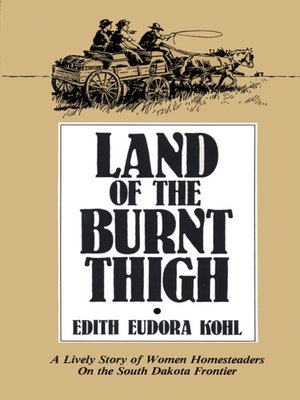
Book Review--Land of the Burnt Thigh


The incredible speed of the transformation of the untouched plains; the invasion of the settlers in droves, lighting on the prairies like grasshoppers; the appearance, morning after morning, of new shacks, as though they had sprung up overnight; the sound of hammers echoing through the clear, light air; plows at last tearing at the unbroken ground—the wonder of it leaves me staggered now, but then I was caught up in the breathless rush, the mad activity to get things done.
A South Dakota rancher from west river told me I really should read The Land of the Burnt Thigh, a kind of homesteading memoir by Edith Eudora Kohl, and I'm glad she did. By definition, I suppose, the book is a novel, because Kohl uses her own life in the telling, and her sister's; but she compliments their story with the lives of other women homesteaders she knew in a telling that documents how really tough it was for men and women, white men and women, to put down roots on land that had really never been broken.

That it had never been broken doesn't mean, of course, that it was uninhabited. There were people throughout that endless grassland, people who hadn't determined the land beneath their feet was theirs to "break," to "conquer." "The buffalo and the Indian had each had his day on this land," Ms. Kohl says, "and each had gone without leaving a trace." The blindness in what she sees is almost as breathtaking as the land she describes so richly. But there's no lament here, no memory, and nothing but awe in the face of human possibilities.  
It was untouched. And as far as the eye could see, it stretched, golden under the rays of the setting sun. Whether the magnitude of the task ahead frightened or exhilarated them, the landseekers were all a little awed at that moment. Even I, seeing the endless sweep of that sea of golden grass, forgot for the moment the dry crackling sound of it under wheel and foot, and the awful monotony of its endlessness which could be so nerve-racking.
Ms. Kohl writes very well. It's hard not to get swept away in the rhapsody she creates. If the story is closely biographical, it's clear that Ms. Kohl and her sister, adventurers from out east, never intended to stay in South Dakota. Once they arrived and found the tar-paper shack some crook told them was a house, they could think of nothing but leaving, maybe even the next day. 

But they fell in love with the openness, the freedom, the opportunity, the creativity required simply to live and even to flourish. Last year at this time, I spent two weeks at the National Homestead Monument, just outside of Beatrice, Nebraska, a place that tells the epic story of ordinary people making a life out of a land that wasn't and still isn't all that hospitable. The poverty was immense, the heat unbearable, the cold deathly, the winds constant. That story Edith Eudora Kohl tells and tells movingly. 

But what she doesn't see, what her racism blinds her to, is the displacement of a people and a culture who thrived on the plains, "a people who had gone without leaving a trace," she says, eyes shut tight. I really like the book, but anyone who's read Black Elk Speaks can't help but be shocked at what Ms. Kohl doesn't see.

Mark Charles is a Navajo activist, writer, and speaker, who says unequivocally that one of the reasons for the divides which exist and even threaten this country and its people is the fact that we have no collective story. We tell and believe different histories. Until we can create a story together, we'll not live in the same world.

Edith Eudora Kohl's The Land of the Burnt Thigh is a lovely book. It really is. I enjoyed reading it. It documents the hard road white people took to make a Great Plains home for themselves. I'm glad that west river rancher told me it was a book I had to read. She was absolutely right.

But The Land of the Burnt Thigh is also an embarrassment. It documents the racism of white man's blindness. In so many ways, it's a memoir that has so much teach.

Friday, April 28, 2017

Book Review--Plainsong, by Kent Haruf


Kent Haruf, sad to say, is gone. He doesn't need my praise, and neither do his books, Plainsong especially, a finalist for the National Book Award when it was published in 1999. I read it then, and loved it. Read it again last week and loved it again, this time I think, even more.

I know readers who crack the same novels over and over again, many of them kids, of course, but adults too. Millions Netlifix their favorite movies as if those movies were a high; once upon a time an old friend of mine could recite every last line of The Wizard of Oz. I don't believe I'll start traipsing back to my favorite novels anytime soon, but reading Plainsong again, umpteen years after the fact was pure joy, not because I was surprised by the goings on--I was the first time around--but because the givens of the story are so darn good.

Don't be mistaken--there's enough sin to go around in Holt, Colorado: bad kids and good kids who do bad things. There are lousy fathers and mothers who don't have a clue they are; there's sex that probably shouldn't have gone on; and there's abject abandonment that leaves people's souls in tatters. People do bad things in Holt, and there's even bad people, men (mostly) who don't come around when they should and do when they shouldn't. "Is this heaven?--no, it's Iowa." Maybe so, but Holt isn't heaven.

But the place has its glories, even its angels. People, most all of them troubled, do good things in Holt, Colorado. They take on others' burdens. They give themselves away in a fashion that feels almost miraculous in modern life. They confront sadness, grief, and rejection. They help. They give food to the hungry. That doesn't make them sinless, but they can and do bestow grace that steps forth boldly in and from the darkness.

No one who's read the novel will ever forget the McPherons, a pair of bachelor farmers about a month or so away from the eccentricity that accrues in people who simply don't get out anymore. Just exactly how it is that Maggie Jones, a divorced teacher, even thinks of bringing a little pregnant high school girl out to stay with them is beyond me, but she does--and it's believable, and those old farts take to their needy border as if she were the child they never had. She needs them, but, Lord a'mighty, they need her--and that's what Maggie knows.

Not everyone, but some in Holt operate in the trust that is there but almost always goes unspoken. Once upon a time a student of mine, in class, told me and the whole bunch in the classroom that when his father told him to get out to the barn and milk the cows because it was time, what he really meant was "I love you." Holt has just enough of those kinds of people. 

In one of the most beautiful scenes in Plainsong, a pair of kids with a mother suffering from depression begin to understand that she's not going to come home and that their parents' marriage is over. Dad's not around. He has his own business, his own pain. Besides, in Holt the only parents who talk much to their kids too often say the wrong things. These two little boys wander, really, to the upstairs apartment of an old woman who's on their paper route. Maybe they go there because they don't know where else to get the love they need. I'm not even sure they know why they visit the old lady, but they do. 

Together, they bake cookies. The old woman, who has no apparent family anywhere near, gets visited by two boys she comes to understand need her. Even though nothing is said about their mutual loneliness--they don't talk through their problems, not at all--when the boys leave an hour or more later, everyone knows that what's hasn't been said, has. They've all been blessed, and so has the reader.

My mother used to get a colorful magazine on expensive paper, something called Ideals. I have no idea if it still exists, but I remember it because it seemed imported, something from far away. I suppose the danger of Kent Haruf's Plainsong is that it too comes on thick and shiny paper, that it somehow deludes us into thinking that human beings are, as if by nature, warm-hearted and warm-souled. It's easy for me to be so hoodwinked.

I hope I'm not, however, because my second trip to Holt was just as much a blessing as the first, maybe more. To people who live out here in rural America especially, Holt is forever just up the road. Stop by sometime, even if you've been there before. I swear a good visit over there will make you smile.

Tuesday, January 10, 2017

Book Report: Born a Crime


I'll be honest. If you think Donald Trump is an answer to prayer--lots of people do--then you'll hate Trevor Noah. No question. Noah's politics are decidedly left of middle-of-the-road, and, nightly, he skewers the PEOTUS as viciously as the PEOTUS skewers whomever fails to bow before his many thrones. (Most recently, the "highly-overrated" Meryl Streep). 

Trevor Noah doesn't always use nice language, but then neither does Trump, so they're flush on that one. Lots of people I know would call him a smart ass--and he is. But it's his job, his work, his calling. Besides, he's doing something I didn't think any one could: replace hall-of-fame-r Jon Steward before an immense audience Stewart created.

Seriously. Imagine replacing the star of The Daily Show. Impossible.

And Noah is a kid, not even thirty, who's South African, born and reared half a world away from the U. S. of A's political swamps. Honestly, I wondered whether the show's producers had simply set the kid up for a fall so Jon Stewart would disappear more quickly and be replaced by someone with five stars.

Not so. Trevor Noah took over The Daily Show. And even though John Stewart can grab an audience and a headline whenever he wants to, today nobody watches the show for any reason other than tuning in to hear a smart-mouth, mixed race kid from South Africa. 

I don't know that he has other books in him. The longer he succeeds with the crowd who love him, there'll be publishers galore who'll be more than happy to shop his words out to an adoring public and thank him with six or eight figures. 

But what Trevor Noah has done with the memoir of his life is really something; and even if you hate him, even you think him a profane liberal Obama-ite--all of which he is--I think you'd like Born a Crime: Stories from a South African Childhood.

He was. Trevor Noah was "born a crime" under South African apartheid, a child of the determined effort of a mother so resolutely Christian as not to be believed. She determined she wanted a child, then chose a Swiss (white man) friend, and got herself pregnant. No marriage involved. Love?--I don't know, but they were friends, very good friends.

And of course all of that was illegal under apartheid, as their marriage would have been. But his mother's resolution didn't give a fig about the law, and thus was Trevor born, a kid who was a walking, talking crime, soon enough a multi-lingual smart ass.

The stories Trevor Noah tells treasure his mother, her indefatigable faith, her iron-clad reliance on prayer, her determined will to raise her boy to be the same kind of believer she is--three different churches every Sunday, weekly prayer meetings and youth church; the kid did it all. 

But then his mother is neither sweet and kind or darlingly pious. Trevor Noah respects her; more than that, he loves her. But he doesn't pull a hand break on her problems, the major one of which is her subsequent marriage to a man who loves her but can't live with a woman more successful than he is. There's violence in his story, shocking violence. To say Trevor Noah was reared in a dysfunctional world would not be off base, but his mother's intense Christianity is never at fault. Born a Crime is not stand-up comedy; it's personal and heart-rending. 

Trevor was forever an outcast--not black, not white, and always, wherever he went, recognizably "different." They were poor and penniless. In a particularly startling passage he remembers eating worms, describes the look and feel and texture so well his description almost makes you retch. There's nothing romantic about Trevor Noah's childhood.

Except his mother's never-failing Christian faith. I'm not making this up.

Read the book and you won't see the same kid on the nightly set where once upon a time Jon Stewart held forth, where a score of stars and comics got kick-started into careers that have only grown since they started out on their own. 

The cover is just right, I think, because what looks like a comic book actually is not. It's a scene on a Soweto-like street made obvious by a South African woman who isn't a cartoon looking up at an ad on a nasty wall that's very much real. The cover is it's own work of art because what it suggests so poignantly is that what you'll find in the memoir is much more than what meets the eye.

You will. 

Tuesday, April 28, 2015

Book Review--Prairie, by Walter J. Muilenburg


The shocking headline makes you wince. This year--this school year--three boys from Palo Alto High School, one of the nation's best secondary schools--walked across the street to the railroad tracks and stood in front of passing trains. Three kids, in Silicon Valley, where the average home is worth three million.

Such suicide clusters are real, and they don't happen only where the pressures to succeed are mammoth. But in a place like Palo Alto, where material success is both assumed and required, the pressures are heightened by what some call "doublespeak": 
on one hand parents claim they're allowing their kids to just be kids, while on the other they hold relentless expectations.

“They say, ‘All I care about is that you’re happy,’ and then the kid walks in the door and the first question is, ‘How did you do on the math test?’ ” Silicon Valley therapist Madeline Levine told Matt Richtel of the New York Times. “The giveaways are so unbelievably clear.”

The problem, David Brooks says, is a reduced definition of what love is. 

Children in such families come to feel that childhood is a performance — on the athletic field, in school and beyond. They come to feel that love is not something that they deserve because of who they intrinsically are but is something they have to earn.
Brooks says we live in a "meritocracy," created by the deep desire parents have to help their children "succeed." But "the meritocracy is based on earned success," he says. "It is based on talent and achievement." Then he moralizes in a fashion that few cultural commentators do, but a way that is both refreshing and, IMHO, enlightening. "But parental love is supposed to be oblivious to achievement," he writes. "It’s meant to be an unconditional support — a gift that cannot be bought and cannot be earned. It sits outside the logic of the meritocracy, the closest humans come to grace."

There's been no suicide clusters in my neighborhood, but Lake Woebegon has known all its children are above average for the last quarter century already. And if Walter J. Muilenburg, a son of one of the founding fathers of Orange City, Iowa, is to be believed, the overt pressures to succeed were perfectly capable of making life miserable for young men and (presumably) women way back in the days people here broke virgin soil.

Muilenburg's novel, Prairie (1925), follows Elias Vaughn, the prodigal son of his father's stern religiosity and the sheer bigotry that such bone-headed spirituality creates. Elias turns his back on his father and his father's ways and marries a neighbor girl, a sweetheart whose family clearly lacks old man Vaughn's determined industry to create "the good life" on a Siouxland farm. Elias's father shuts the door on his son for marrying down; and Elias, looking to be free, sets out west to Nebraska, where, despite the odds and the opposition, he makes a life for himself basically by becoming as fierce as his father.

Somewhere along the line, Muilenburg clearly picked up an infusion of the literary naturalism still fashionable at the time. Prairie is not Laura Ingalls Wilder. Elias seems to understand that he's treading treacherously close to his father's way of life. He has moments when he tries to love his Lizzie, but too often he simply can't because she, like her father, lacks the wherewithal to handle the hard work and loneliness of the prairie frontier. They succeed in building a farm but not a life.

She can't. He can and does. The marriage suffers, but Lizzie dies.

Literary naturalism is satisfying only to those who truly believe that we're all somehow victims of powers that grind us up into mush. In Prairie, it's a climate of stifling heat and brutal cold, a contagion of storms, tornadoes, grasshoppers, grass fires--and unending loneliness. The only way to "make it," Muilenburg suggests, is by becoming a force of nature, which is to say by giving up one's humanity and moving a long, long ways from living in a loving way, as David Brooks says, "the closest humans come to grace."

Elias Vaughn isn't an animal. In some ways, he gets it--he understands what's happening to him. He tries not to be what rugged prairie life is sculpting him to become. He doesn't want to be his father; but when all is said and done, he's planted a homestead as successfully as his father had, but just as clearly lost the capacity to love.

Muilenburg documents the phony religiosity of his forbearers, a spirituality of hard work, back-breaking work, the soul-rending work of making a home on the prairie.

I loved the book, not because I liked the novel. I loved the book for what it lays claim to about the world I still live in, a world an entire century and one gargantuan bankroll removed from Silicon Valley, but a world where success is still immensely expensive.


Those Palo Alto parents certainly have a problem, but Walter Muilenburg's Prairie makes very clear that they are not alone.