Morning Thanks

Garrison Keillor once said we'd all be better off if we all started the day by giving thanks for just one thing. I'll try.

Thursday, October 14, 2021

Second Cut ii - the theology


Edgar watched his mother moving around the stove.  He glanced at the bluish dishes hung from the wall and at the figure of the farmer on the shelf, all brought over from the old country.  The chair creaked into the silence as he jerked up his hand to scratch his forehead.  No one else moved.

"I must finish the shoe, Father." He rose unsteadily, and went back to the shop.  All of this was new to him.

And he knew Gerrit and Peter, although they were older than he, for they too, he remembered, had sat here on these stools and barrels when they were younger, and waited with their fathers for shoes or shares.  In recent years they had been well-known in the little town, for they were fine ball players, even heroes to the younger children.  As they had grown older, the eyes of the village had seen their wagons standing outside the tavern across the street from the shop.  It was no secret that they took out American girls.  Their behavior had grown into something of a scandal in the otherwise settled community.  Now they would never go to the war they had dreamed of.  Edgar poked at the fire which had already lost its force.

His father returned.  His silence was still conspicuous.  He took up the hammer and returned to the anvil.  With his left hand, he drew a piece of glowing iron from the fire, and began, at his usual pace, to shape it into a shoe.  Finally he spoke, dropping the hammer to his side.

"Edgar," he said, "you know the boys.  How do they live?"

Edgar kept pushing the wheel.  "I don't know, Father."

Side by side they worked for several hours; they had spoken nothing else of Gerrit and Peter.

It was just after dinner that Monday when Cornelius Den Boer made his usual entrance at the shop.  There was something different this time, Edgar realized, for the old man's thick white eyebrows were drawn low and deep, adding even more wrinkles around the corners of his eyes.  Nor were there any stories of Holland, or of the immigrants who set first homesteads in the Oostburg area.  He sat slowly on an empty barrel near the door, after the conventional nod of greeting.

“You know, Henry?" His voice was harsh and raspy.

"Ja." Edgar stopped his work, looking at his father who stared at the guest.

"The Lord took them, you know, for a purpose." There was no spark of his usual jovial nature.  He unbuttoned his black top coat as if he had just come in from the cold.

"Ja," came the reply, "He did."

"We can have little hope for their salvation." Den Boer pulled a stained yellow pipe from the pocket of his old black coat.  He stuck the pipe somewhere in the thickly bearded jaw and struck a match across the rough cooling tank.

"We must teach our children to learn from this." The little flame illuminated the drawn face under the black, wide-brimmed hat.  A huge mass of pale-gray smoke rose, then hung like a rain cloud about his head.

"We worship a righteous God, Den Boer, but we cannot judge these boys or the state of their souls so easily.  We don't always know His will."

"There was no Christian life there, Henry.  We know that, ja?  They swam on the Sabbath.  There is only hope for us if here we see the hand of the Lord."

Edgar, like his father, did not stop working.  He expected to be excused from the shop at any moment, but as long as he did remain, he made a pretense of being quietly occupied at the wheel.

"Cornelius, the Lord always works in these mysterious ways." Edgar's father was slowly forging a wagon hitch.  The pace revealed his respect for Cornelius Den Boer.

"Our children are losing the faith." Den Boer puffed gently at his pipe.  "ja, I been afraid more than once of things like this."

Edgar paused momentarily and listened intently.  He did not face the old man.

"The Lord will punish us and our children for our sin.  We do not obey the commandments as He wants us to yet.  He shows us His wrath, and He has today, to teach us to believe in Him and obey His law."

Wednesday, October 13, 2021

Second Cut -- i


THE ONLY ROAD EAST out of town was packed hard and dry by the heat of the July sun.  Clumps of clover and awkward thistle stems jutted from the edge of the road into the dusty ruts which pointed to the summit of the hill.  Edgar Hartman walked slowly, for he was in no particular hurry to arrive on the job.  Jung's second cut would not go so easy as the first; the mid-summer heat and humidity made field work more oppressive.  And, a healthy coat of dew still glistened on the roadside grasses, delaying, for a time, any thought of haying.

When he reached the top of the slope, he turned back to the little community of dwellings.  The rectangular gray buildings all looked alike from here; they stood straight and square among the oaks and maples that shaded the village. And there was that kind of closeness in the town, the only home he had known in his fifteen years.  Out of the face of a gusty west wind, he turned to the north to look over three-foot corn and several acres of alfalfa, then to the south and to already barren fields where June peas had been harvested.  To the east lay more Wisconsin farmland, bordered finally by a belt of timber that underlined the gray-green horizon of water.  As far as he could see to the left and right, the big lake touched the sky at the eastern horizon.

For several days now, winds from the west had turned this great body of water into a roaring king, and even from this point he could hear and feel, almost, the unusually powerful surf pounding on the heavy shore sand.  All night, from his home a mile west of the shoreline, he had heard this relentless beating.  But Edgar kept walking now; nothing had been done yesterday, so he knew there was much to be done today.

The roaring of the waves last night had been as disturbing as the day itself.  All day long his father's blacksmith shop had been full of quiet business; few men had spent all day in the field; the funeral had brought entire families to town.  Throughout the day the dusty main street was alive with subdued movement as farmers decided to use the trip to town to accomplish other purposes as well.  Heels clicked all day long on the thick wooden sidewalks; horses and wagons moved constantly up and down the seldom used streets, carrying a thick layer of dust into the shop.

His father had had work to keep him busy yesterday, of course, keeping the fire hot, and, when things were busy, sharpening blades and shares.  But the steady clang of the hammer on the anvil was the only sound to break the unsettled order, for things were purposely hushed.  The men of the village, usually brimming with talk of weather and fields and crops, were remarkably calmed on the day of the funeral.  Even the usually spirited talk of the war in Europe failed to excite the contemplative atmosphere of shop and town.

Only the anvil spoke conventionally, as Henry Hartman's work proceeded, unhindered by outside events.  Edgar's father was not a tall man, but his years as a blacksmith had molded his body into a straight, bulging stump of strength.  He had seen his father working late into the day, the sun long set, only the jumpy rays of a noisy fire providing needed light.  Late into warm, spring evenings his thick, muscular arms, wet with sweat, swung that hammer, always in the same monotonous beat, pounding, shaping, bending stubborn iron into implements for the farmers.  But as much as he admired his father's strength, Edgar saw and knew him as a respected leader of the little Dutch community in which he lived, for Henry Hartman's impressive physical stature was equaled only by the strength of his character.

Men were drawn to his father somehow-family problems, church problems, financial problems; his father heard them all, it seemed, but Edgar heard none.  Often, just as he was turning the glowing iron into an arc, he heard that quiet command, "Edgar, go to your mother," when some somber-looking man would enter the shop.

But last Monday things had been somehow different.  Teunis Jansen had come in with the news: Gerrit Van Ess and Peter Blom were dead, drowned in the lake on Sunday afternoon.


His father had stopped his work; he had looked at Teunis. The shop had been very quiet, Edgar remembered.

The bodies already had been found, one close to where they had gone swimming, the other far up the beach near Amsterdam.

Edgar's father said nothing then; he glared, it seemed, at the anvil.  The fire crackled and dimmed slowly.  A few more words passed quickly, the funeral. . .the families. . .then Teunis left.

Quietly, his father motioned him to follow into the house.  The wooden steps creaked under their feet.  Edgar's mother greeted their unexpected entry silently, and, without asking, heated the coffee.

"The boy of Van Ess, and oldest boy of Blom. They are dead, Dina. In the lake yesterday."

His mother stopped moving momentarily, turning her face as if she'd been slapped.  "Och heden, " she said, mumbling almost, then looked back to her husband.  Saying no more, she continued her work, looking away again.  His father rested his forehead in his hand; Edgar felt a cloud of anguish lying like lake fog in the steamy kitchen.

"On Sunday?" Mother asked.

His father replied softly.  Silence returned.

Edgar watched his mother moving around the stove.  He glanced at the bluish dishes hung from the wall and at the figure of the farmer on the shelf, all brought over from the old country.  The chair creaked into the silence as he jerked up his hand to scratch his forehead.  No one else moved.

Tuesday, October 12, 2021

Second Cut--intro


THIS PIECE OF FICTION THAT WILL APPEAR HERE FOR THE NEXT FOUR DAYS HAS A PROTOTYPE, but that story’s setting is nowhere near the lakeshore where I was born and reared. Two boys from Rock Valley, Iowa, went swimming in the Rock River and drowned—on the Sabbath, decades ago. The kind of spiritual hand-ringing that occurs in this story would be far more typical of my father’s—or his father’s—generation than my own. I’m guessing the actual story occurred sometime during or just after the Second World War.

On sunny Sunday afternoons, I grew up having to let dry a heavy coat of sweat from playground basketball before I dared walk into our house. I knew something of the righteousness strict Sabbath observances offered kids who stayed on the paths of Sunday righteousness. I preferred basketball.

At the heart of the action here is a tragedy that occurs on Sunday and involves activities most specifically abhorred by the strictest of the Calvinists. It is, for that reason, a story of and for the Dutch Reformed, especially of my generation. My own children would have problems related in any way to the action at the heart of things.

I have only the vaguest of memories of my grandfather’s blacksmith shop, but I used what I could here. That little shop stood behind the filling station he and his son slowly developed when local farmers stopped using horses altogether, when there were no shoes to shape or shares to sharpen.

My grandpa is here in the story—or an image of him anyway—in the smoky darkness of the shop. He’s a man I saw—right or wrong—as a tribal elder, someone to whom people came for more than plowshares and horseshoes. As you will see, the blacksmith understands the persecution of the old ways and understands, although vaguely, that the community’s new life in a new world calls on strengths they needed to develop. The blacksmith’s son does too, the boy I gifted with my great uncle’s name—Edgar Hartman, the character who plays me in the story.

I’ve never written much of anything that wasn’t a simple variation on this very first story’s primary theme—most specifically, the choices we’re forced to make between a gospel of love and the gospel of judgement, or to put it another way, the difficulty of knowing the difference between being in the world or of it.

I wrote “Second Cut” the summer before we left Arizona for Iowa a half century ago, the only story dreamed up, created, and finished while outside the Dutch strongholds where I lived my life in the rural Midwest. .

“Second Cut” has borne hundreds of offspring through the years. It is, in all likelihood, the only story I will ever write. It owns me, I suppose I should say. It has long ago taken up residence in my heart and in my soul. Shake my soul though I may or might, it has never left, nor will it.

In 1983 or so, I read it at a small literary conference at Calvin College, Grand Rapids, Michigan. Through the years, that conference blossomed into an event that drew thousands of guests, as well as some of this country’s finest writers. At the beginning, the attendees were almost all blessed with Dutch names.

After the reading, people said nice things—I was very pleased. I don’t know that I’d ever read a story in front of a literary audience before, and I knew that somehow I’d done well.

Monday, October 11, 2021

MAID--something of a review


Trust me on this: if you're going to watch Netflix's hot new series, MAID, don't, like us, watch at the same time you're reading the book of Job. The combination could be lethal.

Especially in the opening scenes of the series, it's almost impossible to wonder what more could go wrong in the life of Alex, played powerfully by Margaret Qualley. When who and what and why slowly become untangled, we discover a young mom totally--totally--beset with horrors. She determines to leave a go-nowhere relationship with a bartender named Sean, who has fathered her precious child but has surrounded her with an echo chamber of fear and ugliness. They live in a long, narrow trailer house where some cheap picture is purposely hung over a hole in the paneling created by the man she once loved when, in rage fueled by drink, he punched it with his fist.

What she fears is not just him--she fears him also, and with good reason--but the prison she finds herself in, a life that is stalled on "Go" and promises, well, nothing but more of the same.

So, she bolts. Unlike Job, she doesn't decry her horrors or create elaborate theological reasons to try to explain and understand why she is so critically unloved, she simply leaves with nowhere to go. Nowhere. She has no car, no money, no parents, no friends, no job, no education, no skills, and now, as the show begins, no home.

But she has her child, Mattie, who, at three, deserves an Emmy. Alex may not be Madonna--although one could make a case for it--but Mattie certainly is the "child." We're told at one point that she raised cain with her father, but we never see even a dirty diaper. Like the Babe in a Manger, no crying she made. Really?

Mattie compounds Alex's problems, of course. Nothing in her freight train of misfortunes is as central to the elements of her being able to live alone--getting a job to get money to buy gas, to get away from Sean to get a place to live--has a different focus: to get day-care. Mattie needs day-care. That's where the search has to begin. Of course, day-care costs money. It's just one dang thing after another.

Paula, her mother (Andi McDowell) is and has been, throughout Alex's life, a basket case. An unregenerate late 60s hippie, she's lived a life totally out of control, so far off the rails that her daughter has had to babysit her and continues to, even though Alex has more than enough horrors of her own to face down. Paula fashions herself an "arteest" of inestimable worth, but she's never been anything more than a horrifying New Age pain in the ass.

The men live lives of quiet desperation, trying to make it from one AA meeting to the next, and, occasionally, failing. Mattie's father is a carbon copy of Alex's father--the parallels, at times, become almost melodramatic. Let's give the men this much: occasionally they try to be better than they are. Sometimes they even have their moments. But mostly they're pretty much despicable.

With the possible exception of Nate, an engineer with what seems a heart of gold. But he doesn't want to help Alex as much as he wants to date her--I think that's what we're supposed to feel and dislike--and therefore, with Alex already suffering from PTSD, he's just another "user," which is to say "loser." Men don't fare well in this story.

There's something about MAID that left me unsettled, but that's attributable, I think, to the genre. Memoirs that seek to clear the air of familial stench can't help but create in me a desire to visit the story from another angle. Alex and Mattie are not Madonna and child, and sometimes her almost suicidal quest for independence and freedom gets pushed a bit by the script.

At one of several really low points throughout the series, Alex is offered a place with a rich client (Alex is the maid in MAID). At that point, she has a choice, really: she could take up the offer and lose her independence, or turn it down and almost inevitably put her daughter in a much, much worse position. She chooses her independence. Prudence, it seems, argues differently here, but politics wins the contest. 

MAID is a raw, clear-eyed look at the white working class, at women of the white working class in our culture and nation. It hurts, like the book of Job hurts. 

Job is, stem to stern, horrific theological wrestling with the very idea of God. Sadly enough, in MAID, He is not a presence. Alex's horrors are immense and they stop only when Alex sees her way clear to leave for a college, where she'll learn to become a writer and tell this particular story, or at least, the story that created a scenario for the scriptwriter who did this one. She will, finally, get her independence.

If I've come off a little negative here, don't not see MAID. It's raw and intense and, for this viewer at least, a glimpse into the lives of people I don't know and rarely even see.

An old friend once worked in human relations at a local factory who, like others around here, had trouble hiring workers. "Schaap," he told me, "I work with people every day you don't even think about."

Watch MAID. It's television at its best--and most difficult.

Sunday, October 10, 2021

Sunday Morning Meds--He knows


“But the Lord watches over the way of the righteous.” Psalm 1:6

I know one Q & A from the catechism I was raised with (I know more than one actually, but don’t press me), and that is the very first—“What is your only comfort in life and death?” The answer begins this way: “That I am not my own, but belong. . .”

I’ll spare you the entire answer, but I’m sure that one of the reasons this particular q-and-a sticks to the my otherwise Teflon memory is the answer’s tone and texture, its emotional color: the word of the moment here is comfort: What is your only comfort? What makes you feel good? What settles your nerves, helps you sleep, gets you over the blues?

And the answer is, that I am not my own but I belong to God.

The first psalm’s final verse begins with a phrase you can pull up to your chin on a cold winter night: “The Lord watches over the way of the righteous.” But just for a moment, I’d rather consider the King James, which says, “He knows the way of the righteous.”

"He knows."  He understands. It’s no mystery to him. For the Lord God Almighty, right and wrong and good and ill is all part of a day’s work. He knows. He’s got it down. It’s that simple, really. I find that immensely comforting.

Perhaps because life isn’t. Oh, I know I sound pessimistic, but really, when you add up the whole works it amounts to nothing more or less than a sidewalk eighty years long, maybe, a rock-hard path that leads the grave. Not comforting.

I have a plaque my father was given after twenty-some faithful years at the bank where he worked. Not expensive. His employers got it from a place that turns out trophies for longest putt at company golf tournaments. On its own, that plaque is worth nothing, zero. Dad died a decade ago, but that plaque is on the bookshelf here in the basement because I just can’t throw it away, even though the investment it represents is just gone.

Last week in church, a man stood up and asked for prayers for a woman in Chicago, half a continent away. She’s dying of inoperable cancer, and her diagnosis is grim: she’ll be gone soon.

I could have wept, honestly, even though I haven’t seen her for years and barely know her. As I grow older, I am more affected by such stories. When I was young and the trajectory of my life seemingly had no end, I was nowhere near as affected by other people’s miseries as I am today. Maybe that’s good. Today, other people’s sadness weighs heavily.

Psalm 1 begins with a word that’s hard to define—blessed; and ends with a pretty strong hint at what “blessedness” means. In the tribulations that are ours—occasioned by sinners (like myself) and by sin itself—we’re not going to want to forget that God knows. The Bible tells me so. God knows. He gets it.

And it’s not just a sweet idea. Be assured of it, David says, the shepherd-ly poet. God knows the way of the righteous. He understands. His boy was once one of us, after all.

To be blessed is to know, in life and in death, in sickness and in health, that God knows—and that he loves, even us. That’s blessed assurance.

Thursday, October 07, 2021

A blessed day for sub-Saharan Africa


Part of the shock that first morning at a rural medical clinic in Ghana grew from my innocence, my substantial prejudices, the hefty files of caricature and stereotype that most of us lug around quite unknowingly. I didn't know that ordinary folks in some African countries dressed as brightly as that waiting room full of people had that morning.

The immensity of color that had me reeling. It was still early morning, but the clinic's waiting room was so awash with color it almost made me dizzy, as if a whole carton of crayons had melted in a bright African sun. Imagine, say, forty women, maybe more, within the walls of room slightly larger than a classroom, all of them dressed brilliantly. Here and there sat a man much more plainly dressed, a grandpa maybe, but it was the brilliant colors of the women that seemed almost blinding.

At St. Luke Hospital, Kasei, Ghana, sick people go and healthy people take their children. Amid the splashes of color, I had to remind myself why they were there. 

But then that wasn't particularly difficult because there were more than a few young moms, like this one, who held children who seemed exhausted, limp. It was the end of the rainy season, a time of great blessing for rural people in Ghana, but also a time of great blessing to hoards of mosquitoes, and mosquitoes, in west Africa, are fighter pilots armed to strafe the world with malaria. 

As colorful as it was that morning, the hospital waiting room was heavy laden with dark concern. I didn't hear this child's specific prognosis, but you could hardly be wrong in assuming the little boy was there for malaria.  

I'd been to Africa before, but not to a place like St. Luke, a place of refuge in a time of storm and sadness. I'd never been to a place where people in need come for medical services they simply might not get if it weren't for this oasis. 


Malaria is a mass killer, a series killer, in Africa. But most of the patients here--men and woman--won't be among its victims because established treatments can most often be effective. St. Luke is going to win the vast majority of cases.

Of the 500,000 people who die from malaria each year, half are African children. Half of that number is children under five years old. Yesterday, the World Health Organization announced what it told reporters was a historic development: the very first vaccine created and proven to actually prevent the disease.

Even in those regions where most people sleep under insecticide-treated bed nets, children can average six malaria episodes a year. Introducing a vaccine into that community where the disease is that frequent a visitor will have almost miraculous effects on the quality of life.


It's next to impossible to imagine a news story as huge as the one that broke yesterday when the World Health Organization announced that a vaccine for malaria has been created, tested, and approved for general use in places where this dreaded childhood disease still devastates communities.

This morning's thanks is the impossible gift of health and life that from a striking breakthrough by researchers around the world. May malaria, as we speak, begin to die its own silent death.

Wednesday, October 06, 2021

Holiday

Some program in my desktop's innards reminds me almost daily of pictures I shot some years ago. Yesterday, I was technologically reminded of Tabaski. I hadn't forgotten and never will. . .


To me, the word Tabaski sounds more like a seasoning than a holiday—but Tabaski, Festival of the Sacrifice, is an age-old Muslim gala of biblical proportions sometimes called “The Great Feast,” one of the biggest celebrations on the Muslim calendar.


A few years ago, Tabaski happened to fall on a day I was in rural Niger. Markets closed. Horses raised dust on village streets, their riders bedecked in traditional finery right out of Alibaba and the Forty Thieves.

The truth is, I’d never heard the word Tabaski before. But what did I know about Islam anyway? --only what I’d heard, what’s current after the latest terrorist horror. I was retired one of only two North Americans in the city that day—let me be blunt: one of only two white men. To say I felt anything near to being at home would be a stretch. I wasn’t afraid, and most certainly an alien.

The massive street fest that is Tabaski celebrates a biblical story that often seems too scary for Sunday School: God commanding Father Abraham to sacrifice his son on a burning altar, then jamming the operation in reverse and pointing out some poor ram in a thicket to become the sacrifice Isaac—or Ishmael, depending on your faith--was to become. It’s a story only Muslims celebrate.


Sheep are for sale everywhere the day before. Men make deals for holiday fare the way, mid-November, Siouxland shoppers clean and jerk 15-pound turkeys from Wal-mart freezers.

Heads of families buy sheep because everyone celebrates. Everyone eats. I saw sheep sit athwart moped seats and riding the upper decks of semis.

After prayers on Sunday morning, those poor sheep met their ends in a massive murderous ritual moment, a butcher shop outside every front door.


Blood soaked into Main Street dirt. Once heads and hooves got tossed, skinned-out bodies were impaled on wooden cross staves and made ready for the flames, home-brew sauce painted on with whisk brooms, six or eight drawn-and-quartered sheep leaning into a fire so big you’d need a cane pole to brown a marshmallow.


Two North Americans and a pair of African doctors, our hosts, walked down dusty city streets. Tabaski is a family holiday, and it’s all outdoors—just about everything in Niger is. Tradition has it that a third of that ram is for family, a third for friends, and the remaining third for the poor. To my righteous ears, that sounded more Christ-like than, well, “Christian.”


A kid comes out with a paper plateful of something or other. Hadn’t a clue what was being offered. “Don’t ask,” one of the doctor whispers and shovels it in. It’s fried meat morsels, spicy and crisp and dipped in a hot sauce—wonderfully spicy, I thought. As hors’ oeuvres, we could have done worse. The little crispies were sheep liver cut into peanut-sized bites and deep-fried.

The main course was hours from medium-well, so we kept walking and ended up at the gated palace of the Prefect, a politician whose power and authority was buttressed by men in camouflage, AK-47s hanging from their shoulders.

We were honored guests. The locals don’t often see Americans, guests of the doctors. Inside, instead of doors, thick curtains, theater-like, and high ceilings to trap the heat of equatorial Africa.


We sit, as does the Prefect—and his wife. We are in the presence of power. “Will you eat with me?” he asks. The room is surrounded. It’s not that we have a choice. We say yes. He offers no menus.

The entrée is delivered by a bald giant so perfectly proportioned he could have been groomed for the Packers. He offers, and I take a plate. First the yams, largely tasteless, and then the main course, mutton, all of it in a rich sauce spicy and strong enough to cover any unpleasantries. Agreeable, I think.

Things are formal, but slowly as we eat and share a table, the pomp-and-circumstance wears. I sit at an appointed place at the end of a long couch, the Prefect’s wife on my left, the Prefect himself on her left.

On command, that giant produces a point-and-shoot. A photo of all this is requested, or so the Prefect rules. Thus, the three of us pose. I pull myself close for the portrait, even throw an arm around the Prefect’s wife’s shoulders, as I might have done back home.


When I see that strange picture today, all I see is a big bald white guy, Moby Dick well out of water. I can’t help but think the Prefect and his wife have never forgotten the Americans who came by on the Festival of Sacrifice, especially that heavy one who slung his bare arm around the Prefect’s wife on the Prefect’s sofa in the Prefect’s palace.

Whether I offended anyone that day I’ll never know. But Tabaski is a religious holiday, so I’ll hope for forgiveness. For a moment at least, our ritual meal behind us, in that high-ceilinged room we were odd but smiling friends, brothers and sisters having broken bread together, African and American, black and white, Muslim and Christian.

Five years have passed an email tells me. Some new Prefect likely rules beneath those high ceilings.

But wherever he is today, when he and his good wife see that photo, I hope they giggle at the strange and ugly American. I would be happy to have given them that holiday pleasure.

Tabaski, or so it seemed to this stranger, was far less about religious piety than it was about grace.

Tuesday, October 05, 2021

Morning Thanks--South pond


I love the walk. Takes about an hour or so. There's really not much to see, but a couple of weeks ago I took a scythe along and whacked off undergrowth so the path through the trees to the river wasn't a tangle. Don't know if anyone else uses the path, but it just a dream to hike a while and then sit up on the bank and watch the silence.

I took my camera. Don't usually, but I did this time--heavy, cumbersome thing, but I wanted to fool around with the new lens, which isn't new anymore really, been in the case for about a year. Huge, ungainly thing, 100x400, big and heavy, needs to sit on a tripod which I didn't take. 

It's fall. Everything takes on an a burnished autumn tan. There'd be plenty of color, I thought when I snapped that shot above, just not much to shoot at. Still, when you're just looking for beauty, what you find can be amazing.

Here's where I am, standing above or beside a river so tiny it barely merits the name--little more than a creed right now. A couple inches of rain last week swelled this skinny thing a bit, but you can tell its normal size by the color. Generally, the Floyd is more healthy. Right now, it's almost pathetically scrawny.

The light was gorgeous. What good light does for photography goes far beyond thanks. There isn't much color arising from the prairie this time of year--some late-term goldenrod and, here and there, a bouquet of white astors; but mostly it's just a tangle all around. Still, the abundant grace of a lavishing sun can turn almost miraculously turn anything into gold.


Once I got to the river, it became clear that the most interesting shots were going to be at its scrawny edge. Honestly, there's nothing remarkable about what's here--a dead branch in the languid flow of the Floyd. No matter--it's something remarkable, even beautiful. 


Who'd a thunk this single yellow leaf could sing? 

I sat there awhile, hoping someone would visit, when sure enough, just down the river, a cormorant showed up. Honestly, I couldn't have caught him without that beast of a lens, so when he showed up I was thrilled I lugged the thing along. Against the technicolor bank, he's sheer blessing.


I had all 400mm out there to get him. He wasn't close, and I wasn't moving. But somehow, he--or she--got into her head that she'd had enough, so she took off. I kept snapping.


I grabbed a couple more shots from the bank, then snapped what I could find on my way out of the woods, and started on my homeward way.


Back up on the prairie, I stopped for milkweed because the mass of seedlings the pods produce every October are just beginning to be born. Very few images of prairie life are as singularly delicate as a fluff of milkweed seedlings. Don't be fooled: they're mightily fecund. Next year, there'll be more to keep the monarchs happy.


And then there's this one, a Halloween.


She's right, Dorthea Lange: "A camera teaches you how to see without a camera." It's just amazing what's there on a sunny afternoon in little more than a field of grass beside a languishing river. 

Beauty is a blessed gift for which, this Tuesday morning, I'm thankful.

Monday, October 04, 2021

What is inside

The kid was "a youth of peculiar appearance and manner," or so says Francis LaFlesche in The Middle Five: Indian Schoolboys of the Omaha Tribe, a memoir of his days at the Presbyterian boarding school on the Omaha reservation just a few short years after the Civil War. "He was tall and muscular with a prominent nose and cheekbones," LaFlesche says, but it wasn't the big kid's stoicism that set him apart.

Aleck excelled in sports, even invented games some the boys played; but what Francis LaFlesche remembers best about him, he says, is a steely reserve that didn't shush him, but served to make him operate almost emotionlessly: "we never knew him to change the expression of his face, either in pain, anger, or mirth."

Aleck's unyielding personality must have been remarkable, because LaFlesche claims he and his buddies used to talk about it and him. Everyone noticed Aleck never laughed; his thin face never changed, not a whit. They assumed the active register of his emotions was somewhere not seen, or so their leader, a boy named Brush, asserted. Aleck was "turned outside in," Brush told them all, so that "all his laughter, anger and sorrow were inside and couldn't be seen."

Brush had the kid figured out, but his thoughtful understanding seemed, to me at least, a wise and surprising revelation. Francis LaFlesche is remembering a bunch of schoolboys whose English is barely understandable and whose arithmetic isn't much better, a bunch of boys, children, whose adolescence was just then only dawning.

One of the little ones, Edwin the story-teller, claims the reason for Aleck's striking fortitude was that in the days following his father's death in battle with the hated Sioux, Aleck had simply determined not to smile again. "He was reserving his laugh," Edwin told the boys, "for the time when he would take revenge."

The man who's remembering all of this, Francis LaFlesche, went on to become a celebrated anthropologist who did much to preserve the disappearing culture of his Omaha people, as well as their neighbors, the Osage. Maybe Francis wasn't just an ordinary Omaha kid.

Still, it's a remarkable story amid all the boyhood shenanigans chronicled in The Middle Five, remarkable because it distinguishes the boys, despite their years, as quite astounding analysts of human character, as thoughtful as they are youthful.

I dog-eared the page because I honestly wouldn't have thought PTSD to be a problem in 1870 on the Omaha reservation, where death was a frequent visitor and, in a way, violence was institutional. Amazing--here's a bunch of boys, on their own in a three-story Presbyterian boarding school, a brick monster, a bullwork above the wide Missouri, a bunch of children putting their heads together to try to understand a wounded soul, a bunch of Indian kids long before the 20th century learning, on their own, how to become more blessedly human.

That's it, I suppose. That's why I dog-eared this incidental little story of a kid his teachers named Aleck and the legacy of war that left him fatherless--and, the boys who admired him and tried hard to understand the steely reserve forever registered on his face. It's a moment as sad as it is blessed--Aleck, or so the boys reason, is waiting for the moment he can bloody his own profound grief, or so the boys reason. 

I just wouldn't expect those Omaha boys to be so caring, so thoughtful, so human.

Francis LaFlesche

Years ago, Desmund Tutu told Krista Tippett that he once waited at the gate of an airport in South Africa and watched the crew come up the stairs and go into the plane. He couldn't help but feel a certain kind of fear, he said, when he saw the pilot was Black. That's Desmund Tutu, the South African anti-apartheid and civil rights champion making the point that racism has a place in the heart of just about everyone.

Me too. I loved the story of Aleck because I just couldn't believe those Indian kids could be that sweet and that smart. 

That too is racism. 

Sunday, October 03, 2021

Sunday Morning Meds--The light of your face


“Let the light of your face shine upon us, Lord” Psalm 4

Like all of us, Moses’s brother Aaron stumbled through a life that was less than perfect. Because he conceded to the Israelite mob that demanded an idol to worship, Aaron was almost single-handedly responsible for the his brother’s wrathful smashing of the God-inscribed stone tablets, not to mention the display of God’s wrath on his own chosen people. No one ever mentions Aaron in a roll call of the saints.

Yet, Aaron’s words ring throughout millions of church fellowships around the world every week. The Lord told Moses (see Numbers 6) to have Aaron bless the Israelites with words that you can still hear almost any place two or three are gathered to worship God: “The Lord bless you and keep you; the Lord make his face shine upon you and be gracious to you. . .”

If I’ve heard it once, I’ve heard it a million times. King David likely did too.

And maybe that’s why the line itself has lost its visual character; simply said, I’ve heard it so often. Just for a moment, it’s helpful, I think, to create the picture this famous benediction offers. Penitents, millions of them through the ages, are on their knees (it’s almost impossible not to see them in some kind of supine position physically) and in some kind of darkness, waiting for a brightening glance of Godliness, just a glance.

Now delete millions of those people from that image and picture just one penitent. Put yourself there, on your knees, eyes slightly arched but staring downward in helplessness, a nervous shakiness in hands and arms and legs in anticipation of a passing glance, and repeat: “Let the light of your face shine upon me, Lord.”

I dare say that the only people who can effortlessly create that image of themselves are those who, for whatever horrifying reason, have spent time themselves in that position. Those who, like me, have never suffered significant bouts of abandonment or grief or despair have trouble creating an image of so great a helplessness. After all, I might say, I’ve got fairly substantial bootstraps to prove my internal strength. What I’ve done, I’ve done on my own.

It seems so medieval almost, doesn’t it?—the image behind the blessing; so, well, Islamic: hoards of people, face to the floor, hoping for a fleeting glance from the King of Creation. Good capitalists create their own fates, after all; we seal our own successes with the sheer tonnage of our personal industry. We make our fate.

But the line we repeat so often—and hear repeated as a blessing to us—offers a wholly different portrait. There isn’t a dime’s worth of self-sufficiency in David’s abject request here: “Just a glance, Lord.”

Embedded in the old line is something of the sun, of course—God Almighty as iridescent force whose rays bless abundantly. And what David wants, as has each and every one of us who’ve been in that prostrate position, is but a glance of divine favor, a glimpse of light in the darkness. We’re not even asking to meet God’s eyes; the line begs for something to take away those heavy shadows, just a glance.

It’s so medieval, so lords and serfs and country manors. It’s so impotent, so paralyzed, so defenseless. It’s so blasted un-American.

And yet I know—I really do—that such helplessness is what He wants.

Friday, October 01, 2021

The Fool Soldiers -- finis


The St. Ange

When Father DeSmet came to Fort Pierre in 1851, it was an event to be remembered by the Indians. Cholera had taken its toll from the lives of the people; there was suffering everywhere, and to cap the climax, smallpox was coming on. The Indians were in terror, but the good Father had had the cholera the year before as he traveled up the Missouri in a steamboat and had also had the smallpox. He was familiar with the treatment of these diseases, and he went from tent to tent relieving the sick and baptizing the dying. Many Indians remarked on the mercy of a man whose religion took him to minister to those with the dread diseases. Many a man, woman, and child were saved from death.

Josephine Donovan offers what to me seemed to be a whole different explanation for heroic foolishness of "the Fool Soldiers." But then again can she be trusted?--which is to say, can the testimony of the old ones she interviewed be trusted? After all, what they told her can't be proved.

What's more, Josephine Donovan was herself a strong Christian, a Roman Catholic, who would have looked upon Father DeSmet as an absolute reservation saint.

When I read what Donovan wrote, I knew exactly the story she is referring to, the story she says explains the miraculous ability of the great "Black Robe" to minister to the Native suffering amid the horrors of smallpox and cholera. I first read that immensely powerful story in a diary kept by the Swiss artist Rudolf Friedrich Kurz who, with Father DeSmet and another Belgian priest, Father Hoeken, were aboard the St. Ange, a Missouri River steamer, when the passengers were suddenly beset by illness. That story I've told elsewhere--you can hear it if you click here. 

Mad Bear

Donovan goes on. "At this time Mad Bear," she says, "was a mere lad of about fourteen years, but like many at the time, was greatly influenced and impressed by the principles of the black-robed priest."

Mad Bear was also one of the "Fool Soldiers."

But she doesn't stop the story there. She keeps going.

Ten years later, some of the warriors Father De Smet had taught formed a society, and pledged themselves to uphold what was right, always to do good as far as they could, and to right all wrongs that came their way. These men who formed the first Christian society west of the Missouri River among the wild tribes . . . called themselves Strong Hearts, but because they did so many unusual things in fulfilling their pledge to keep law and order and in punishing many a lawless man, the other Indians called them Fool Soldiers.

Josephine Donovan says the Fool Soldiers were "the first Christian society west of the Missouri River among the wild tribes." 

Is she right? Is her assessment accurate? No one will ever know. But given the scenario she creates in Witness, it seems to me that her story is plausible. What's more, it helps me understand what's written on Four Bear's cemetery stone, and helps Four Bear's own great-great-great-great grandchildren understand what that stone testifies. 

For more than 36 years
a faithful Christian
and loyal friend of the
whites.

The measure of blessing I received from piecing this story together a year or two ago was so great that telling it again is a joy. It's a story of Christian ministry that created a profound blessing in the here-and-now. 

What believers can argue--and should--is that mission work led to the "conversion" of many thousands of Native people. They found the Lord. They got saved.

But that argument holds little weight for those who don't buy its premise. If Josephine Donovan is right, then the foolishness of the Fool Soldiers is, in fact, the Christian faith. 

The Fool Soldiers were, in truth, 19th century Native American "holy fools."

Thursday, September 30, 2021

The Fool Soldiers -- ii


Del Iron Cloud Going Home 

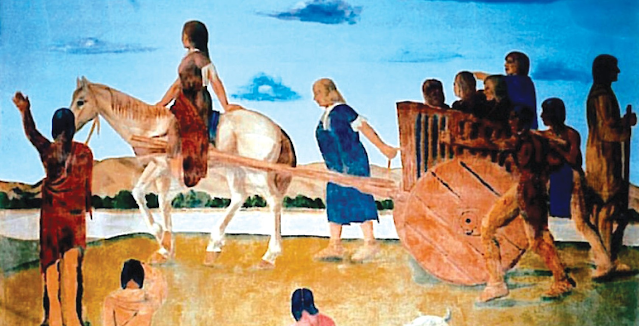
What both illustrations of the Fool Soldiers' rescue share is the single horse and travois, and a warrior--in this case, two warriors--looking behind them. Even though they'd argued successfully and given up whatever they'd brought with them in exchange--horses, blankets, guns; even though they had the hostages with them, even though they were well on their way back to Ft. Pierre, they were scared to death that White Lodge and his band would catch up with them, take back the captives, and get rid of "the boys."


They were wary. No, they were afraid. They were warriors, but they were young warriors.

You can't help but wonder why they did what they did? Take a trip only a fool would entertain mid-winter, blizzards and all. Hands, feet, noses froze. White Lodge and his people were anything but neighborly, and being on the run the way they were made them even more desperate. They were starving. Those hostages were human capital, and White Lodge knew it. Just giving them up to some "boys" from the Two Kettle camp made absolutely no sense. His Santee warriors were neither afraid to die or afraid to kill. The warrior Charger and his friends were fools all right. They were. No kidding.

The most reasonable explanation for their behavior is a dream/vision one of them swore came to him unbidden. A herd of elk arose and the biggest one approached and spoke to him, a young warrior named Kills Game. “There will be ten of you,” that elk told him. “You must be strong and respected.” It was neither odd or strange for a warrior to hear that directive, bravery and courage being foremost among the attributes of warriors.

Charger called the others together to consider what the elk’s prophecy might mean for the warrior society they had named, the Strong Heart Society. His interpretation began with something his father had told him, that being that dreams are often “contrary” visions, meant to be understood in opposite ways to what they might explain themselves to be. 

No one will ever know, of course. However "the boys" described their motivations is buried in an unreachable past by this time. What remains is simply the story of their foolish heroism. The accepted motivation for what they did is the dream--and its interpretation to do the opposite of what that big elk spoke.

But there is another. When her nine children were out and on their own, Josephine Waggoner, a Hunkpapa Sioux from Standing Rock reservation, went on a mission. What was happening all around was the deaths of the old ones, who remembered the days before the white man, the old ways. They were dying.

She'd learned English at Hampton. When she returned to Standing Rock, she translated sermons for both the Episcopalians and the Roman Catholics, as well as letters Sitting Bull, also a Hunkpapa, received from lots of fans (he'd become something of a celebrity). When Sitting Bull was killed, she'd helped lay his body out in traditional ways for his burial. 

Once her children were out of the house, Josephine Waggoner told herself she'd get the old, old stories from all the old, old men and women. So she set out to do just that.

What resulted is a sprawling series of narratives taken directly from the heart and the lips of the old ones. The manuscript she put together took years to get published because oral history--the only kind of history the old ones knew--had no footnotes. It couldn't be documented, as white man's history must be. However can we trust the veracity, the truth, of what some old people say? some publishers told her. It's impossible.


So Josephine Waggoner's Witness: A Hunkpapa Historian's Strong-Heart Song of the Lakota wasn't published until 2014, long after her death.

Amazingly, there's another story of origins in Witness, an explanation for the almost insane foolishness of the Fool Soldiers, an explanation that is real soul food.

That story, tomorrow.

The Shetek hostages

Wednesday, September 29, 2021

The Fool Soldiers--i


The text of this historical marker goes like this:


In 1862, a dramatic rescue of white captives held by a band of hostile Santee Sioux, took place near this spot. A group of eleven young Teton Sioux boys left Ft. Pierre on a cold November day determined to overtake and meet with the Santees to negotiate the exchange of nine women and children for the food and blankets which they took with them. The Santees had taken the captives on a raid of a settlement near Lake Shetek in Minnesota four months earlier.

Memorial at Lake Shetek


The August 20 attack, part of the Dakota War of 1862, left 14 people did and several women and children hostage. The Santees chased up north and west, all the way into North Dakota before turning back. Along the way, they sought refuge with various other bands of Sioux, but generally got little welcome. Other bands were aware that the massacre of white folks at Lake Shetek wasn't going to go unpunished. 


That four-month trek brought them into winter, and as temperatures dropped and snow began to fall, simply securing provisions to live became difficult. One of the groups who would not take them in was a Two Kettles band, who fed them, but determined that they would have to leave. "The boys" the historical marker speaks of, were members of that Two Kettles band.


The boys: Martin Charger, Kills Game and Comes Home, Swift Bird, Four Bear, Mad Bear, Pretty Bear, Sitting Bear, One Rib, Strikes Fire, Red Dog, and Charging Dog had decided on their own to attempt this dangerous and entirely selfless mission of mercy after hearing of the plight of the Lake Shetek captives. The hostile band of about one-hundred and eight Santees was led by Chief White Lodge.


The woman standing near the sign (above) is Marcella LeBeau, whose ancestors include Four Bear, one of "the boys" the sign identifies as "Fool Soldiers." In the last few years, she's become a friend of mine.


History states that they came upon the Santee encampment on the east side of the Missouri River at a point opposite the mouth of the Grand River. The Santees drove a hard bargain and the young Tetons had to give all of their worldly possessions, including their guns and horses, to effect the exchange. Only one horse and wagon was left to carry the weak and distraught captives the one hundred miles back to the nearest white settlement at Ft. Pierre. The Tetons walked and gave their clothes to the white women and children. This Christian act of mercy by the Tetons was never rewarded by the U. S. Government and no record can be found of any repayment for the personal possessions given in exchange.


Because the Santees had been on the warpath, the odds against success were very high. Thus, the Teton boys were dubbed the 'Fool Soldier Band.'”


The Fool Soldiers' heroism happened at a spot along the Missouri River now under the waters of Lake Oahe, created when river was drawn and quartered by a series of dams that created reservoirs for farmers and ranchers, as well as immense recreational resources for tourism, but also buried all kinds of history and culture of the Native people who lived there.

Today, the town of Mobridge celebrates the story of the Fool Soldier Band with markers in the downtown cemetery, and one of seven murals painted into the ceiling of the municipal building downtown, murals undertaken and finished during the 1930s, when the Works Progress Administration hired the Lakota artist, Oscar Howe to honor the Lakota people.
 

Just exactly why the Fool Soldiers Band determined to rescue the hostages White Lodge and his people had captured and abused is a question no one will ever answer with certainty, but this almost non-sensical act of bravery and heroism had to have cause. 

Tomorrow, I'd like to offer a possible answer.