Morning Thanks

Garrison Keillor once said we'd all be better off if we all started the day by giving thanks for just one thing. I'll try.

Thursday, December 16, 2021

Just now at Sunshine Village

They've been friends for years, snowbirds, except for Madeline, who long ago just stayed in Florida and ended those tedious trips back up north to New Jersey. She and Bob finally said to heck with it, and just stayed down at Sunshine Village, even though Florida in July took some getting used to.

Audrey and her husband just rolled in again, and the two old friends were happy to reunite in the pool, where they exercised together late mornings, as they had for years.

Bob was gone for a decade maybe--Audrey couldn't remember exactly how many years. He'd died one summer, when Audrey and her husband were in Michigan. But the story she heard from Madeline that very first morning was that Madeline--who's 92 years old--was, once again "in a relationship," as the young folks like to say. That's right, she'd taken to hiking over to this new guy's trailer three nights a week or so; after which they just switched love nests, and she put him up at her place for the next three. Kind of a rotation thing. 

The two of them, Audrey and Madeline, are swimming, right? That's when the big sleepover news comes out. Now Audrey's been around, and she's never been much of a prude anyway. So when Madeline's story is told, she's quite taken, but she doesn't quit exercising. "No kidding," Audrey says. "That is so sweet." And then, "what's his name?"

"Bob," Madeline says, matter-of-factly, a whispery smile over her face. 

Audrey stops dead in the water. "You got to be kidding," she says. Bob was her long-time husband's name. "This one's a Bob too?"

Madeline jerks her bathing cap down a bit to cover her hair. "Yup," she says, "another Bob."

"My word," Audrey says. "You're making life difficult. How do you keep them separate?"

Madeline doesn't miss a beat. "One of them doesn't say much," she says.

And so it goes at Sunshine Village.

Wednesday, December 15, 2021

Mr. and Mrs. Cole in the blizzard


By 1870, thousands of Civil War veterans were putting down roots with land scripts that made endless miles of the broad land out here a real bargain basement. If Chancellorsville or Missionary Ridge, if Gettysburg or the siege of Vicksburg, if any of those were in your rearview mirror, you--and your spouse--were eligible for a dreamy 160 acres, sometimes more. 

By 1880, Nebraska was home to thousands of Civil War vets, men like Albert V. Cole, who, not yet thirty years old, had lived through a dozen bloody lifetimes before he crossed the Missouri and grabbed a plow. In addition, the man had been an orphan, his father having died when he was two months old, his mother as much as giving him up when he was ten. Little Albert got himself shuffled around from one house to another. "I had never had a home," he says in his pioneer reminiscence. 

Now Albert V. Cole's young wife, on the other hand, was but a filly when she came out here to the end of the world, a place where his darling bride missed her Michigan family dearly.

He doesn't say it in that reminiscence, but Cole was a warrior. He'd joined Company C, Fourth Michigan Infantry in 1861 and engaged in almost countless Civil War battles: Yorktown, Newbridge, Hanover Court House, Savage Station, White Oak Swamp, Ellison's Mill, Gaines Hill, Fredericksburg, Malvern Hill, Second Bull Run, Antietam. 

Albert V. Cole was a vet. Was he ever. 

He reenlisted in December '63, signed up with Custer's famous Michigan brigade, and saw more action at Todd's Tavern, the Wilderness, Beaver Dam Station, Yellow Tavern, Meadow Bridge, Mechanicsville, and Pomunky River, until he took bullet at Haw's Shop and was forced thereby to lie on his back for six months without moving, suffering, or so his biography says, "in the most excruciating agony. . .as gangrene and erysipelas set in."

After all of that, Cole set out to homestead Nebraska land. He'd blazed through more horror than any fierce Great Plains winter could offer, even the big storm he couldn't help write about when he sat down to tell his story. 

It was late Easter afternoon, and the bloodied war veteran had a wife for the first time, a sweetheart named Susan B. Crane, who, at just 19 years old, had never been "a thousand miles from her people," he admits, nor "separated from her mother" before coming out west to marry him. Cole's memoir doesn't as much as mention the Civil War, instead it goes on and on about that blinding Easter blizzard. 

And it's not hard to understand why. In the middle of all that howling, Mrs. Cole told him what was on her mind and in her soul: "she made me promise that if our house ever blew down, I would take her back to Michigan." Albert V. Cole, storied Civil War vet who went down during the seven-hour battle at Haw's Shop, was scared to death of a broken heart.

There's more. In that three-day Easter storm, things got complicated. The Coles put up some neighbors and friends in what amounted to little more than a three-room shanty. Those neighbors, a couple building their own place a half-mile east, had been out for a ride on a lovely Sunday afternoon when the storm hit. They needed shelter, and so did another family, so that the Coles' little shanty held six adults and one child. If you're wondering, the three women and the child slept together on the bed, the men went on the floor. 

That blizzard was no picnic, but Albert V. Cole's great worry was Susan Crane Cole. "Mrs. Cole almost prayed that the house would go down," he says, "so she could go back east." He can't have known that; but the almost in that memory suggests his real concern, and his love. "Almost prayed," he says. I can't help but think the man who took a bullet at the seven-hour battle of Haw's Shop, was a bunch more worried about his homesick wife than he was about some battering blizzard because Albert V. Cole--orphan, vet, pioneer--had a new and wonderful home that was, for all practical purposes, his first. "I had a home of my own and was delighted," he says, right in the middle of his description of that storm, "yet my heart went out to Mrs. Cole."

Yes, indeed it did.

It'll please you to know that Mr. and Mrs. Albert Cole had five children, and that soon after those first years Mrs. Cole's brothers and even her parents put Michigan behind them and homesteaded beneath the dome of sky in central Nebraska, where Mrs. Cole's own mother became a neighbor. 

That's a picture-book end.

Tuesday, December 14, 2021

First Snow and Luci Shaw


That we've never gone south in January is a fact that should not be misunderstood--neither of us love frigid temps and that evermore dangerous slickness that attaches itself beyond the reach of snow shovels or blowers or blades. Winters are more treacherous with every passing year. Yesterday, I almost went down on a my way to church.

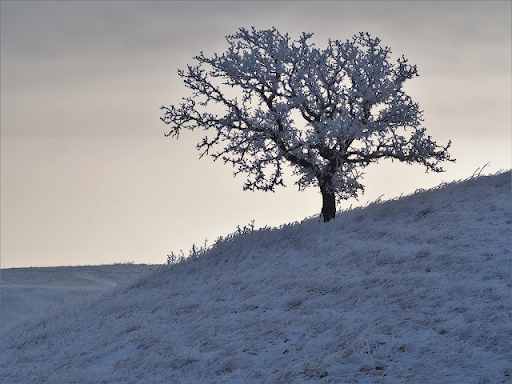
Still, there's something stark, something beautiful about the first snow. There'd been a powder a couple of weeks ago, but even though Friday night's much ballyhooed blizzard didn't fulfill a host of prophecy, it left us with a couple inches of new snow, the first of the winter, and made it hard not to take out the camera even though I knew getting good pics would be tough. 

Enough fell for a fine alabaster quilt, so I circled the south pond and went down to  the river, only to discover that I'd forgotten how a couple inches of snow makes a two-mile hike more than a little wearying. But I wasn't wrong--truth be told, surrounded by all that angelic richness, there wasn't much to shoot at.


By March, nothing that you see here at the riverside will be worth lugging a camera, but this whole virginal first snow has a peculiarly divine character that's perfectly charming. The world's white.


First snow gives long December shadows even more character, don't you think?

But I wouldn't be putting these pictures up if it weren't for Luci Shaw's Christmas card for 2021. She always sends a poem, and this year's little gem, "Snow," compliments the world of the first snow just outside our door.

Snow

With what calm and gentle grace
last night's fresh poem of snow
was laid across the land, whitening the hills, 
filling the simple spaces between
the birches. Fallen snow is an easy essay
in quietude, in anonymity. And when
the Baby came--He who carved 
those hills, who designed each lacy branch
on every tree, who shaped that uniquely
gleaming signal star borne from high heaven--
It was He whose splendor fell to earth,
simply and quietly as a flake of snow
tp bring to all our troubled, broken world
his gifts of grace and beauty. 

To be sure, the first snow on Luci's home turf in Bellingham, Washington, looks nothing at all like ours; yet, by way of her wonderful wide-angle lens, differences smelt away. 

Consider her poem a gift, as it was for me, as the brilliant first snow was for all of us--and as it was, I'm sure, for Luci.

Monday, December 13, 2021

Christmas at Red Butte

[The sweet conclusion of Lucy Maude Montgomery's famous Christmas story (which I'd never read before last week!).]

Theodora, knowing that her assistance was not needed, and that she ought to get home as quickly as possible, went on her way as soon as she had seen the stranger in safe keeping. When she reached the little log house she crept in, cautiously put the children's gifts in their stockings, placed the turkey on the table where Aunt Elizabeth would see it the first thing in the morning, and then slipped off to bed, a very weary but very happy girl.

The joy that reigned in the little log house the next day more than repaid Theodora for her sacrifice.

"Whoopee, didn't I tell you that Santa Claus would come all right!" shouted the delighted Jimmy. "Oh, what splendid skates!"

The twins hugged their dolls in silent rapture, but Aunt Elizabeth's face was the best of all.

Then the dinner had to be prepared, and everybody had a hand in that. Just as Theodora, after a grave peep into the oven, had announced that the turkey was done, a sleigh dashed around the house. Theodora flew to answer the knock at the door, and there stood Mr. Lurgan and a big, bewhiskered, fur-coated fellow whom Theodora recognized as the stranger she had found on the trail. But—was he a stranger? There was something oddly familiar in those merry brown eyes. Theodora felt herself growing dizzy.

"Donald!" she gasped. "Oh, Donald!"

And then she was in the big fellow's arms, laughing and crying at the same time.

Donald it was indeed. And then followed half an hour during which everybody talked at once, and the turkey would have been burned to a crisp had it not been for the presence of mind of Mr. Lurgan who, being the least excited of them all, took it out of the oven, and set it on the back of the stove.

"To think that it was you last night, and that I never dreamed it," exclaimed Theodora. "Oh, Donald, if I hadn't gone to town!"

"I'd have frozen to death, I'm afraid," said Donald soberly. "I got into Spencer on the last train last night. I felt that I must come right out—I couldn't wait till morning. But there wasn't a team to be got for love or money—it was Christmas Eve and all the livery rigs were out. So I came on horseback. Just by that bluff something frightened my horse, and he shied violently. I was half asleep and thinking of my little sister, and I went off like a shot. I suppose I struck my head against a tree. Anyway, I knew nothing more until I came to in Mr. Lurgan's kitchen. I wasn't much hurt—feel none the worse of it except for a sore head and shoulder. But, oh, Gift o' God, how you have grown! I can't realize that you are the little sister I left four years ago. I suppose you have been thinking I was dead?"

"Yes, and, oh, Donald, where have you been?"

"Well, I went way up north with a prospecting party. We had a tough time the first year, I can tell you, and some of us never came back. We weren't in a country where post offices were lying round loose either, you see. Then at last, just as we were about giving up in despair, we struck it rich. I've brought a snug little pile home with me, and things are going to look up in this log house, Gift o' God. There'll be no more worrying for you dear people over mortgages."

"I'm so glad—for Auntie's sake," said Theodora, with shining eyes. "But, oh, Donald, it's best of all just to have you back. I'm so perfectly happy that I don't know what to do or say."

"Well, I think you might have dinner," said Jimmy in an injured tone. "The turkey's getting stone cold, and I'm most starving. I just can't stand it another minute."

So, with a laugh, they all sat down to the table and ate the merriest Christmas dinner the little log house had ever known.

Sunday, December 12, 2021

Sunday Meds--He knows


“The days of the blameless are known to the LORD. . .” Psalm 37:18


I believe David—I honestly do. This isn’t hyperbole or poetic license. I honestly believe him. But, like Job, I don’t necessarily understand. Wish I did.

The joy of this line from David’s song, its open, warm, and loving hands, extended to us each morning, is the assurance that, simply stated, God knows. He’s not off on a cruise or so wrapped up with the crisis in Iraq that he has no time for our problems. The comfort of this verse is not only that he knows us—which isn’t pocket change—but also that he knows our entire lives. He knows perfectly well what we live through each night and each day. That’s what this verse says.

Those of us who suffer emotional or mental problems find life—simply living from day-to-day—an immensely severe trial all by itself. Those of us who care for them find ourselves dragged along, powerless sufferers too, of another stripe.

That famous Ecclesiastes passage doesn’t say “there’s a time to give thanks.” If it did, maybe it would suggest that there’s also a time not to give thanks, because this morning, I’d prefer not.

After a night of thick fog I’d rather not ever relive, I’m thankful for what my fingernails can find to hold. It would take so very little, it seems, for him to sneak some sunshine into the darkness, so very little. Believe me, time and time again I’ve asked the Lord to deliver the goods—day after day.

This morning’s brilliant sunshine through the window above my head cannot brighten my heart and soul. But I’m thankful for this single verse, even if it doesn’t usher out the fog. Here’s the promise that gives me morning breath: God knows.

I’m certainly not, by definition, blameless. Almost any psychologist would see quickly that I figure into the equation of the emotional distress this loved one is suffering. But, trust me, I’ll take the promise any day of the week when the world looks as dark as it did last night—and again this morning.

God knows my days. God knows our days—all of ours. The eternal God knows the times. He was here last night, and he’s here this morning. Through some kind of divine physics, the mystery that is God constricts himself into the fleeting sweep of the second hand over every last clock I see. He’s in my world. He knows. He’s transcendent, but he’s imminent. He’s here.

Maybe something will change, a step taken toward happiness, something ever so slight to push back the darkness, even if it’s only for a couple hours.

Then again, maybe not. We’ve been on our knees so long I won’t be surprised if nothing changes. And I’m not alone. I know dozens who suffer this way. But I believe that the poet and King is telling the truth: God knows every last one of our days.

That line of the angels to the shepherds—it’s here again in this single line, in spades: fear not. That’s my comfort this dark morning—every morning, rain or shine.

Saturday, December 11, 2021

Christmas at Red Butte (ii)


[Continuing the seasonal classic by Lucy Maude Montgomery, the author of Anne of Green Gables.]


At seven Mrs. Martins bells jingled at the door and Theodora flew out. "Go right in and get warm, Auntie," she said. "I'll take Ned away and unharness him."

"It's a bitterly cold night." Mrs. Martin stood for a moment and seemed to want to shake out the cold. There was a note of discouragement in her voice. "I'm afraid it means no Christmas for the children tomorrow," she thought sadly, as she led Ned away to the stable. When she returned to the kitchen Mrs. Martin was sitting by the fire, her face in her chilled hand.

"Auntie—oh, Auntie, don't!" exclaimed Theodora impulsively. It was such a rare thing to see her plucky, resolute little aunt in tears. "You're cold and tired—I'll have a nice cup of tea for you in a trice."

"No, it isn't that," said Mrs. Martin brokenly "It was seeing those stockings hanging there." She waved at the fireplace without looking. "Theodora, I couldn't get a thing for the children—not a single thing. Mr. Porter would only give forty dollars for the colt, and when all the bills were paid there was barely enough left for such necessaries as we must have." She stopped for a moment, seemingly as if still stunned. "I suppose I ought to feel thankful I could get those." She shook her head. "But the thought of the children's disappointment tomorrow is more than I can bear. It would have been better to have told them long ago, but I kept building on getting more for the colt." She shook her head resignedly. "Well, it's weak and foolish to give way like this. We'd better both take a cup of tea and go to bed. It will save fuel."

When Theodora went up to her little room, she took a small box from her table and carried it to the window. In it was a very pretty little gold locket hung on a narrow blue ribbon. She held it tenderly in her fingers, and looked out over the moonlit prairie with a very sober face. It was the locket Donald had given her just before he started for the Klondike. She had never thought she could do such a thing. It was almost the only thing she had to remind her of Donald—handsome, merry, impulsive, warmhearted Donald, who had gone away four years ago with a smile on his bonny face and splendid hope in his heart.

"Here's a locket for you, Gift o' God," he had said gaily—he had such a dear loving habit of calling her by the beautiful meaning of her name. "I couldn't afford a chain too, but when I come back I'll bring you a rope of Klondike nuggets for it."

Then he had gone away. For two years letters had come regularly. He wrote that he had joined a prospecting party to a remote wilderness. After that was silence, deepening into anguish of suspense that finally hopelessness. A rumour came that Donald Prentice was dead. After all, none had returned from the expedition he had joined. Her locket was doubly dear to her now.

But Aunt Elizabeth had always been so good and loving and kind. Could she not make the sacrifice for her sake? Of course she could and of course she would. She took out of the locket the bits of hair—her mother's and Donald's—which it contained, then hastily--and not tearlessly--donned her warmest cap and wraps because it was only three miles to Spencer; she could easily walk it in an hour and, as it was Christmas Eve, the shops would be open late. She must walk, for Ned could not be taken out again, and the mare's foot was sore. Besides, Aunt Elizabeth must not know until the whole deed was done.

As stealthily as if she were bound on some nefarious errand, Theodora slipped downstairs and out of the house until she was hurrying along the trail in the moonlight. The great dazzling prairie surrounded her, the mystery and splendour of the northern night all about her. It was very calm and cold, but Theodora walked so briskly that she kept warm. The trail from Red Butte to Spencer was a lonely one. Mr. Lurgan's house, halfway to town, was the only dwelling on it.

When finally she reached Spencer, she made her way at once to the only jewelery store the little town contained. Mr. Benson, its owner, had been a friend of her uncle's, and Theodora felt sure that he would buy her locket. Still, her heart beat quickly, and her breath came and went uncomfortably fast as she went into the store. If he wouldn't buy it, there would be no Christmas for the children at Red Butte. She couldn't think of it.

"Good evening, Miss Theodora," said Mr. Benson briskly. "What can I do for you?"

"I'm afraid I'm not a very welcome sort of customer, Mr. Benson," said Theodora, with an uncertain smile. "I want to sell, not buy. Could you—will you buy this locket?"

Mr. Benson took up the locket and examined it. "I don't often buy second-hand stuff as a rule," he said, after some reflection, "but I don't mind obliging you, Miss Theodora. I'll give you four dollars for it?"

The locket had cost a great deal more than that, but four dollars would get what she wanted, and she dared not ask for more. In a few minutes, with four crisp new bills in her purse, Theodora was hurrying to the toy store, and half an hour later she was on her way back to Red Butte with as many parcels as she could carry—Jimmy's skates, two lovely dolls for the twins, packages of nuts and candy, and a nice plump turkey. Theodora beguiled her lonely tramp by picturing the children's joy in the morning.

About a quarter of a mile past Mr. Lurgan's house the trail curved suddenly about a bluff of poplars. As Theodora rounded the turn she halted in amazement. Almost at her feet the body of a man was lying across the road, a man clad in a big fur coat, and a fur cap pulled well down over his forehead and ears. Almost all of him that could be seen was a full bushy beard. 

She had no idea who he was, or where he had come from, but she realized that he was unconscious, and that he would speedily freeze to death if help were not brought. The footprints of a horse galloping across the prairie suggested a fall and a runaway, but Theodora did not waste time in speculation. She ran back at full speed to Mr. Lurgan's, and roused the household. In a few minutes Mr. Lurgan and his son had hitched a horse to a wood-sleigh, and hurried down the trail to the unfortunate man.
___________________________

End of story on Monday, although you've likely got in mind where all of this is going. Remember, "Christmas at Red Butte" is a classic, like A Christmas Carol, and it's somehow so wonderfully "prairie."

Friday, December 10, 2021

Christmas at Red Butte

[I stumbled on this fine, old Canadian classic Christmas yarn a couple of weeks ago and was charmed. It's pitifully smarmy, but so is Dickens at Christmas. Who cares?--Christmas is, after all, the time for miracles--as in, you know, a king in a manger. The writer's name is Lucy Maud Montgomery. Yes, that's her atop the page, and yes, she's the blessed woman who wrote Anne of Green Gables. It's a sweet story--that's all I say. It'll come in installments. Enjoy!]


"Of course, Santa Claus will come," said Jimmy Martin. Jimmy was ten, and at ten it is easy to be confident. "Why, he's got to come because it is Christmas Eve, and he always has come. You know that, twins."

He wasn’t wrong, and the twins knew it. Cheered by Jimmy's superior wisdom, their doubts passed away. There had been one terrible moment when Theodora had sighed and told them they mustn't be too much disappointed if Santa Claus did not come this year. After all, the crops had been poor, and he mightn't have had enough presents to go around.

"That doesn't make any difference to Santa Claus," scoffed Jimmy. "You know as well as I do, Theodora Prentice, that Santa Claus is rich whether the crops fail or not.” He pointed outside, as if there were proof. “They failed three years ago, before Father died, but Santa Claus came all the same. Probably you don't remember it, twins, 'cause you were too little, but I do. Of course, he'll come, so don't you worry a mite. And he'll bring my skates and your dolls.” He looked up at his sister. “He knows we're expecting them, Theodora, 'cause we wrote him a letter last week, and threw it up the chimney. And there'll be candy and nuts, of course, and Mother's gone to town to buy a turkey. I tell you we're going to have a ripping Christmas."

Theodora wasn’t taken by his language. "Well, don't use such slangy words about it, Jimmy-boy.” She couldn't bear to dampen their hopes any further, and she told herself that Aunt Elizabeth might just manage it if the colt sold well. Theodora sighed again as she looked out of the window far down the trail that wound across the prairie, red-lighted by the declining sun of the short wintry afternoon.

"Am I going to always sigh like that when I get to be sixteen?" asked Jimmy. "When you were only fifteen, you didn’t do it, and I wish you wouldn't. It makes me feel funny—not a nice kind of funniness either."

"It's a bad habit I've got into lately," said Theodora, trying to giggle. "Old folks are dull sometimes--you know that, Jimmy-boy."

"Sixteen is awful old," Jimmy said. "I'll tell you what I'm going to do when I'm sixteen. I'm going to pay off the mortgage, and buy mother a silk dress, and a piano for the twins.” He rapped his knuckles down on the table top. “Won't that be cool? I'll be able to do that 'cause I'm a man.” He took a poke at his aunt. “‘Course if I was only a girl I couldn't."

"I just hope you'll be a good, kind, brave man and a real help to your mother," she told him, sitting down before the cozy fire and lifting the fat little twins into her lap.

"Never you fear," Jimmy told her, squatting down near the fire on the little skin of a coyote his father had killed four years ago. "You only get one, you know.” Suddenly, his eyes perked. “Now tell us a story, Theodora—a really good, you know, with lots of fighting and stuff. Only don't kill anybody. I like to hear fighting, but I’d just as soon the people come out alive."

Theodora giggled again, and began a story about the Riel Rebellion*—a story which had the double merit of being true and exciting. When finally she finished, it was quite dark and the twins were nodding, but Jimmy's eyes were still sparkling.

"That was great," he said. "How about more?"

"Bedtime for you all.” Theodora laid down the law. "One story at a time is my rule, you know."

"But I want to sit up till Mother comes home.” Jimmy always found a way to postpone bedtime.

"She may be very late, because she might have to wait to see Mr. Porter.” Theodora looked straight into Jimmy’s eyes and let out a big smile. “Besides, you don't know what time Santa Claus might come,” and then, cautiously, “. . .if he comes at all.” She pointed outside as if he were on his way. “If he were to drive along and see you children up instead of being sound asleep in bed, he might go right on and never call at all."

That was all Jimmy needed to hear. "All right, we'll go. But we have to hang up our stockings first.” He suddenly became the big brother. “Twins,” he ordered, “get yours."

The twins toddled off in great excitement, and brought back their Sunday stockings. After Jimmy hung them along the edge of the mantel shelf, they all trooped obediently off to bed.

The hope, of course, was that Mother could sell the horse. That’s about the only way that Santa would come. Theodora seated herself at the window, where she could both watch the moonlit prairie for Mrs. Martin's homecoming and knit at the same time.

If the truth be told, Theodora was no worry wart. She was the jolliest, bravest girl of sixteen in all Saskatchewan, something you would have read in a moment in her shining brown eyes and rosy, dimpled cheeks. She couldn’t help but fear the children were going to be disappointed--worse, heartbroken if Santa Claus did not come, and missing Christmas would hurt her hardworking little mother more than anyone else.

Only five years before had Theodora come to live with Uncle George and Aunt Elizabeth in the little log house at Red Butte. Her own mother had just died, and Theodora had only her big brother Donald left, and Donald had caught Klondike fever. Uncle George and Aunt Elizabeth were poor as church mice, but they had gladly made room for their little niece, and Theodora had lived there ever since, her aunt's right-hand girl and the playmate of the children.

They had been very happy, and then Uncle George had died just two years before this Christmas Eve. Since then, there had been hard times in the little log house. Mrs. Martin and Theodora had done their best, but it was a woefully hard task to make ends meet. And then, this year, their crops had been poor. Theodora and her aunt had made every sacrifice possible for the children's sake, and at least Jimmy and the twins had not felt the pinch very severely yet.

__________________________________

The table is set. It's time for action. Stop by tomorrow.

*The Riel Rebellion, 1885, included the Metis people (mixed blood), as well as the Cree and Assiniboine First Nations, all of whom were convinced Canada was out to destroy their people and culture. Louis Riel led the rebellion. Eventually he was hanged. Some Canadians still think of him as a martyr, others a firebrand rebel.

Thursday, December 09, 2021

Stopping by on a Tuesday afternoon


Came home from Sioux City yesterday via Hwy 12, which hugs the Big Sioux River and thereby is, hands down, the most beautiful drive in our corner of the state. When, just for a few miles, the Loess Hills Scenic Drive veers east up a gravel road and ascends the hills of the Broken Kettle reserve, I usually leave 12 behind and look for buffalo. 

Sometimes, yes--sometimes no. I'm lucky if I see any really. The herd isn't huge--200 or so--and there's 3000 acres out there where the buffalo roam. Honestly, this guy just looked like some kind of looming shadow when I came up. I didn't think he was what he was but he was. I never expected to see just one. 

But this big fella' was all by his lonesome, working on the 25 pounds of grass he grabs daily. Barely raised his head toward me, in fact. He was just all busy with that good stuff all around him.

The story goes that when old bulls start to feel their time has come and gone, they just wander off by themselves for greener pastures. It's a kindly thing to do really. You don't want to cause any commotion or anything, you know? Just want to move off the stage in silence, without a stir. Life goes on. In't that the way it goes? 

Read that somewhere about old bulls. Don't know if it's true and didn't ask. Don't even know if this guy is as old as I thought maybe he was either. All I know is I didn't see hide nor hair of any of his friends and family--just him. He was nowhere near the herd. He'd wandered off over the hills.

So the two of us--we chatted for a while about how it is the younger generation sure as anything has to find its way yet or risk the whole mess going all to pot. He says he's a little verklempt about the fuss over "critical race theory" because he thinks idiot Republicans aren't going to let teachers tell his story anymore. After all, it's not a sweet one. I told him not to worry. I'd keep harping away. 

Then the two of us nodded our hoary heads, and I took off north. He kept loading up on prairie grass.

That's pretty much the whole story. 


Wednesday, December 08, 2021

The Blessing of a New Alliance


Take time to be holy,
The world rushes on;
Much time spend in secret
With Jesus alone;

The life of William Dunn Longstaff, who wrote those lines, spanned most of the 19th century. His friends included Dwight L. Moody, who preached to overflow crowds in Longstaff's native England. When Longstaff heard Moody repeat a line from the I Peter: "Be holy because I am holy," he penned the poem that was sometime later set it to music, an oldie.

"We are called upon to emulate him in partaking of his divine nature and expressing his holiness (2 Peter 1:3-4)," or so the devotional accompanying the poem directs us. "The first stanza tells some of the things we can do to attain this holiness," it says. "We can spend time with the Lord is prayer, abide in his presence, feed on his word, fellowship with other Christians, and do good to others."

Sounds like old classic stuff, right? "Holiness," we read, "means to be separate from all that is common." I've heard that for years. So have you.

In Honduras, the Association for a Just Society (ASJ--they take their initials from their Spanish name) takes some liberties with that groundwork biblical principle, and does so, in part, because thinkers like Nicholas Wolterstorff make a convincing case when they say that when the Bible uses words like "holiness" and "righteousness," it is just as surely talking about what we think of as justice: "He leadeth me in paths of righteousness," says Psalm 23; but that line could just as easily be said this way: "He leadeth me in paths of justice."

And if that famous psalm did use justice, we'd likely read that famous line differently.

Instead of "be holy because I am holy," people like Wolterstorff claim we might say: "Be just because I am just," and harvest, thereby, meaning and intent different from the classic definition. Thus, "Holiness means to be completely separate from all that is common" doesn't work anymore, because justice doesn't walk away from all that is "common," instead, it embraces the ordinary.

Two years ago--and just before Covid--we were in Honduras, in great part to see, first-hand, the work of the AJS, which has become something of an industry there, dedicated researchers, journalists, and advocates who take forging a just society as a mission. We were deeply impressed and remain so.

Politics in Honduras recently took significant shift after the election that was something of an upset. The more conservative Nasry Asfura, whose National Party had been in power since ousting the previous government. Asfura was judged by many as corrupt. He went down in an a surprisingly spectacular loss. 

The winner?--Xiomara Castro, the new President of Honduras, a woman, the first female President in the nation's history. Castro beat Asfura by landing 51 percent of the massive vote, to Asfura's 37.

People consider the election clear and convincing evidence of a new day dawning in Honduras.

At ASJ, the result was gratifying but a little scary. As a policy, AJS long ago determined to work with the government, no matter the government's leanings or even its record. They knew the new government could be wary of AJS because of what they might have been read as complicity with the corrupt National Party government.

But, one day after the election--just one day--ASJ received a call from the new government, who said the word on the street was out that ASJ had created a plan to reopen schools and thereby begin a return to normalcy after the long Covid siege. Would they be willing to talk for an hour or so with the new government?

That was an answer to prayer. AJS spent three hours the next day with the Libre people and were asked to return.

ASJ said they would love to return--and to help. Love to.

It's an amazing story, really, a miracle of hard and devoted work to be a witness in government, in politics, in the national life of the people of Honduras.

ASJ takes time to be holy all right, but it does so by way of justice, PTL.

__________________________

Want to know more about ASJ?  Visit their website here.

Tuesday, December 07, 2021

Morning Thanks--Joy and Miracle

The woman (above) is Joy Donley, someone I met years ago when we both performed at some long-forgotten Christmas program in the Twin Cities. She's adapted a short story of mine for a church service, her church, a place named Awaken, in St. Paul. 

"Joy and Miracle" was published in Christianity Today years ago, when the magazine asked me for something for Christmas. It's one of several stories Baker published (again, years ago), a collection of Christmas stories titled Startling Joy (it's out of print). Just so you know I'm not making this up, some of that info you can see, just faintly, on the screen above her. 

What Joy Donley is doing here is breathing life into an old story of mine, a story that has all but disappeared. Her adaptation and performance of it made it new to me, which is a bit ironic because the story itself is about breathing new life into old stuff, breathing new life into an old, old story that takes place in a shed in a Israeli town called Bethlehem. 

What Joy does is perfectly beautiful. It'll cost you little more than ten minutes or so, but I'm thinking if you make a place for it somewhere in your holiday celebrations, you will be, as I was, magnificently blessed. 

https://www.facebook.com/AwakenWestSeventh/videos/305733991413799/ 

You'll find Joy's performance 32 minutes into the worship service. What she does with "Joy and Miracle" is pure blessing, for which, this morning, I am greatly thankful.  

Monday, December 06, 2021

Morning Thanks--Soul Food


It's not a great shot. I'm not sure that, should I be there today, I could do any better. It doesn't have the focus I'd have liked; but then I'm trying to shove ten square miles or so into the camera, asking my Olympus to do work the human eye can't fully accomplish. West River South Dakota is plain huge. 

After the Ft. Laramie Treaty of 1868, any bands of Native people not on the the ground they were appointed to, the ground the government declared to be their home, they were officially "hostiles." What led to Little Big Horn was the government's insistence that Indians had to be where white folks said they had to be. What Custer was up to was creating, militarily, a giant ever-tightening circle around bands and tribes who, like naughty kids, had run away.

In a nutshell, that's the story of West River during the final years of the Great Sioux Wars: white folks amassing land once home to nomadic Native tribes who had for a century or more, essentially, chased buffalo, which, by the way, were disappearing. 

Anyway, as open as it looks and as open as it is, 

often as not, cavalry troops under the direction of Civil War vets, simply couldn't find them--or, like the brass at Little Big Horn, were utterly thunderstruck at the sheer numbers of Native men, women, and children there on the banks of the river. 

Every time I'm out there, I'm struck by scale, by how immense the world really is out there and elsewhere in the region we call, as we fly over, the Great Plains. Honestly, it seems endless when you're in it and not a native (small n), the kind of place where, as I've said a dozen times, for three days you can watch your dog run away in any direction. 

And yet, I'm dumbfounded by the fact that, often as not, the U. S. Cavalry could not find Indians. Let me emphasize that, "They couldn't find them." Not because of their military incompetence (although some might allege that), but simply because the world out there was so absolutely endless (and I'm reaching for paradox). 

Up in the right hand corner of the shot at the top of the page--you have to look good to see it--is one of those behomoth John Deere tractors. Trust me, it's there. Tell you what, I'll pull it up again so you know I'm not fibbing. 

There. What you might have missed (I did!) is the fact that the rancher might well be dropping some goodies off for his cattle. They're all in a bunch anyway, as if just now feasting. Just for kicks, I tried to find out how much a John Deere like that might cost, but most places on line want you to call. On a screen, price tags loom huge, I suppose. 

Look again at the top picture. Find that John Deere. The cattle are ants, a hair-line fracture in the sweep of the land.

What was "the Great Sioux Reservation," included just about everything west of the Missouri River and beyond. It was mammoth, so big that even here, where I'm tempted to say there would have been nothing at all distinguishable on the long carpet of buffalo grass, even here, the U. S. Cavalry could go for miles and miles and not find an Indian. Even here, where from any knoll whatsoever you can see for twenty or thirty miles, they were nowhere to be seen.

I just find that immensity staggering, and impossible to photograph. 

I'm not sure I buy everything Wallace Stegner says in Wolf Willow, but I'm on board with most of it: “It is a country to breed mystical people, egocentric people, perhaps poetic people. But not humble ones…Puny you may feel there, and vulnerable, but not unnoticed. This is a land to mark the sparrow’s fall.”

I don't live out there, but whenever I'm perched aboard its massive shoulders, oddly enough I can't help but feel small.

And that's okay. Unlikely as it sounds, it feels--to me at least--like a place to pick up soul food. This morning, I'm thankful to have been there again.

Nebraska plains, fifteen years ago. Just the second time I was out on the Plains with a camera. 


Sunday, December 05, 2021

Sunday Morning Meds--Darkness


. . .all your waves and breakers have swept over me.” 
Psalm 42:7

Lots of my students affix Bible verses to their e-mail messages, but the message that sticks with me every time I read it belongs to Colleen, a secretary, whose notes always end this way: “***You cannot really live until you are ready to die***”—including the asterisks.

I can’t know all the reasons why she has attached that particular line to her e-mails, but I think I know one of them: she lost a child. Some might disagree, but, as a parent myself, I can’t imagine any single event in any person’s life being more devastating.

Years ago, when I was a toddler, an aunt of mine was killed in a freakish car accident. I know how hard that death was on my mother, but I never knew how awful it must have been for my grandma until another woman told me a story that happened just a few years later, the story of her own brother’s sudden death. She told me that she’d never forgotten how my grandma was the first to visit her mother after her brother’s death. They were neighbors, so her visit made sense. But I knew why Grandma went to visit there right away, even though I didn’t know my grandma’s grief. She walked across the street and through her neighbor’s back door because she knew exactly what that mother was going through. She could bring real comfort. She’d been there.

I’ve never known that depth of grief. In some ways, when I look at these words from Psalm 42, I realize I’ve been blessed with innocence and serenity because I’ve been spared something of the worst.

Just now I stood outside and remembered telling myself, a quarter century ago, that, should I die on the airplane I was boarding, I could live with that—that I knew my wife and little children would go on, that they’d be cared for, that, with time, life would continue on its way without me. I told myself that, 
like all things, I too must pass. That realization on a stairway into a jet is a moment I’ve never forgotten, an affirmation, in a way. What I knew, were I to die, was that I could live with who I’d been.

Nothing’s changed. A quarter century later, I stand by that determination. I honestly believe I can meet Colleen’s challenge because I’m okay with the life I would leave behind me.

But what I know now, for the first time in my life, is what a blessing that is, that affirmation; and I know it because now I know something of the ravaging horror of depression, of those who can’t say it. Depression has taken hold of someone I love as much as Colleen loved her son; and even though I don’t know personally the terrors the poet David describes in this line, I do know, and love, someone who does. I’ve seen the tremors from those breakers. I’ve felt the waves of darkness storming.

I can only hope and pray that he, like so many others who suffer this darkness, can take heart from this line in an especially memorable Psalm because King David offers us this, for sure, some company in grief—as this psalm might have for Colleen, for Grandma’s neighbor, for Grandma herself, for all of us, not to mention my mother in her son’s trying days. To know that David knows profound sadness, fear, and despair—and God himself knows, the Father who himself lost a son himself—just to know that is a breath of blessed assurance.

We’re not alone. That’s the theme of these lines of David’s story. Even though there is darkness, that He is with us, all of us, is no small comfort.

That’s the single story of the Bible, I suppose.

Friday, December 03, 2021

Bicentennial Banners (ii)

Once upon a time, some blessed two-year-old, now fifty-something, took a red crayon to this handsome local pair. Mom and dad, I'm sure, were greatly taken by their sweetheart's obvious talent, even if the descendants of Mr. and Mrs. Chris Geels, Orange City, Iowa, might feel their ancestors rudely besmirched. 

When this Mrs. Geels passed away--before her time, as they say--Mr. Geels remarried, and his second wife bore him a son named John, who was,  a retired CRC pastor in 1976, or so the magazine notes.

No, it's not Saskatchewan, although it could be. If you have any experience at all in the rural Midwest, that bare and endless prairie says Dakota.

It's Corsica, SD, on some holiday or another, probably the Fourth (note the platform up front and the crowd forming at bottom right. The ordered, center aisle parking may well have simply been the way it was done back then, but the promenade those Model Ts create suggest a town and a people proud of what they've grown in that empty land.

The steepled church just a block down Main is the local CRC. Another, half a block to the right. . .well, if you're following these at all, you can guess its identity because where two or three are gathered, in all likelihood there'll soon be two or three churches. 

(It's the local RCA.)

And this is nowhere near Corsica. As the inscription makes clear, it's a log church. In Corsica a century-and-a-half ago, you would have to travel a considerable distance for logs. This is the place my dad grew up, at least that's what he used to tell me. He was a preacher's son in Lucas, Michigan, which is to say northern Michigan, a phrase that even feels cold, as it must have been when whatever filled those gaping cracks between the logs dried up and fell away.

No matter, of course. Just like the Catholics just up the block from where I live, one of the first orders of business in this new land was to construct a place for worship. Cold?--sure. But first things first.

Who knows what'll happen this year or the next, but for 75 years or so, forty percent of the CRC was Canadian. This young family in the Frazer Valley are "old-timers," immigrant Dutch whose roots were set firmly into gorgeous British Columbian land already a century ago. They're looking prosperous, aren't they? Of course, back then, before cell phones, a photograph was a rare and blessed thing.

For decades, the denomination didn't worry much about church growth as waves of immigrant Dutch came to Canada following the mess the Netherlands had become during and immediately after the Nazi occupation. Many of them--men and women--were or aided the Dutch Resistance. If you fought Hitler's henchmen, the perils of immigration didn't amount to much. 

Couldn't pass this one up. Featured here (Kellogsville, Michigan CRC, circa 1898) is the good Reverend R. L. Haan and the juffvrouw, Mrs. Maggie Haan, nee-Hemkes, as she would have been noted back then. Goodwife Haan's sister, Gertrude Hemkes (both daughters of Geert K. Hemkes, a seminary professor) was Mrs. John C. Schaap, herself the juffvrouw of yet another reverend, my grandpa. Reverend R. L., stayed at Kellogsville only two years, an abbreviated tour. Why he left, I don't know. Might well be an interesting story.

But then, his brother-in-law, same era really, stayed in his first charge for only two years also. What letters right here in my files suggest is that Grandma Schaap's  professor father back in Michigan felt his sweet daughter simply way too far from civilization in a place called South Dakota. Why, they still had Indians out there!

This one yet, and I promise I'll quit. 

If you're thinking some kind of prison camp, the smiles suggest otherwise. The pails--and that historic vacuum--suggest a cleaning detail, an army of Dutch-American women armed for battle against dust and dirt and whatever foul agents stand in their way, cleanliness being right there beside Godliness.

It's an army of church women ("Onward Christian Soldiers) from the CRC in Highland, Indiana, circa 1925, on their way to clean the church. 

Despite the smiles, no editor would put this shot on the cover of any magazine today because it testifies, some would say, to the exploitation of women, who were considered worthy of getting down on their knees to scrub sanctuary floors, but little else in the church. 

Some, I'm sure, would consider the photo demeaning, even repugnant. 

We live in a different world today, a world where the church's history can no longer include the dreams of strangers in a strange land. Our history is still our history, but we can no longer own it.

And that's a good thing, because an fortress whose walls are built of ethnic tales has no future in a multi-cultural world. But it's a bad thing too because a people without story is not a people at all. 

The people who sent me a manilla envelope full of old Banner covers were right--they knew I'd like them. I did and do, and I hope you did too.

But now I'll do what they couldn't and slide them into the wastebasket because while they sure enough do tell our story, that story can feel blushingly self-centered, seeking only its own, featuring only its own and, in the telling, marginalizing all others. 

Even if it is no longer the story of a church, a denomination, it's a human story. I can't help but think we imperil our future by not telling it. 

No matter--the whole bunch are going in the wastebasket. Still, somewhere, I know, a library has digital copies. 

They exist. So does the story.

Thursday, December 02, 2021

Bicentennial Banners

This is how it came off the press in ye olden days--it's the printing crew of The Banner, circa 1930s (?). Used to be that printing the mag was an in-house job; years later, it got shopped out and still is today. This is the veteran squad who made it their calling to get out the denominational magazine the old fashioned way, by tending the big press. 

In 1976, The Banner, the official magazine of the Christian Reformed Church, ran a series of covers drawn from the old days. It was, after all, the year of the American Bicentennial, and people all over the country were digging up roots. Just for fun, here's a bunch.

This Banner production room pose is one of a couple dozen covers sent to me by old friends who didn't know where to get rid of things they hated simply to burn, and therefore decided I might well be a convenient waste basket. 


"Because we thought you'd like 'em," they said. Little hand-written note. 
Problem is, they're right, and that's why you're seeing them right now.

This year's Synod promises to be a cooker. LGBTQ issues dominate. There'll be the ordinary stuff (as there had to be in 1936, mid-Depression here), but the angst to come in summer, 2022, is all "gay marriage." 

Most everyone on the floor that year had no clue what the word "gay" means these days, which isn't to say there were no gay people around. Quite likely, there were. But gay marriage didn't tear the place up in '36. Other issues did, like "modernism," always handy, or "worldly amusements" like dancing or playing cards. 

Meanwhile, there were places in the denomination where real growth was taking place--like the hospital at Rehoboth, New Mexico. The undeniable success of that mission (not to say we white folks got everything right) has to rank as one of the denomination's most precious gifts to American life and culture, a gift that came, at least initially, by way of the hospital's special blessings to the Navajo and Zuni people.

Hard as it is to imagine, this farm sits right on 28th Street, Grand Rapids, Michigan, August, 1903, a family portrait all the rage back then, especially for immigrant families looking to show people back home in Holland how well they were doing. Everything and everybody is on the picture--Mom behind the fence, holding the baby.

With a family portrait like this, you didn't have to say much. "See that horse?--see that child aboard? We're doing just fine over here. Big places, bigger plans. Wish you were here."

 
Iowa, you're thinking? Good guess. That corn's hardly up there by today's standards, but it was sky-high in 1912, when these two young ladies waltzed out to check it out. Sorry--it's not Peoria or Hull, but (are you ready for this?) Hudsonville, MI. What's more, that young lady on the left is a celebrity, although her fame grew from Nigerian soil. It's Johanna Veenstra, who would become the most beloved missionary figure the denomination ever sent abroad. 

The corn doesn't look all that bad really, and I'm an Iowan.

More tomorrow. This is fun.

Wednesday, December 01, 2021

Morning Thanks--Cerulean


With cheek and jaw stiff with Novocain, I figured I could spend that ugly frozen time outside yesterday, given that the weather was scandalously warm for what should be winter. 

The story of the pond I often circle on a walk is hardly worth your time. It's here, south of town, because of the highway overpass just beside it. If you want to see what was here before the water, the trucks just north of you are on it. God didn't create that little pond; some highway crew did.

And the tawny world around it is unremarkable right now too. It wears winter's garb, a bit of blush maybe, in the dead grasses, but nothing to light up a camera. 

For me at least, yesterday the South Pond was beautiful because the temps were, and because it was so much better to be outside than in. What I couldn't help but notice when I got there was that the water--the plain, old water--was royally gorgeous. 

My granddaughter's eyes are strikingly blue, as are her father's, and his mother's, and her father's before them all. My son says people often notice his daughter's eyes, remark about them, almost as if stunned. Throughout the population, less than ten percent of us are so blessed. Sorry, I can't help but think she's stunning too, even though blue eyes in our family are not at all foreign or rare.


My mind was stuck on the word cerulean, not because I knew exactly what it meant, but because I know people use it when they see the deep blue of a rich, prairie sky or what was coming up just then from the overpass pond. 

It's not a strange color. It's up-front primary, and sits between two other beauties--purple, the robes of royalty; and green, the treasured hope of early spring. Still somehow, blue is and forever will be associated with bleakness and blahs and feeling somehow bummed. "The Blues," a genre of music some consider the unique American gift to the arts, rise from the darkness of slavery and will forever carry at least some appreciative dolor. 

But yesterday, with stuck cheeks and lips, taking a hike around that cerulean gem seemed--and was--a blessing. At one season or another, Thoreau called Walden the eye of God. I get that.

I told you the story: the south pond is nothing more than what was left when a half-dozen diggers dug out good Iowa dirt that now lays beneath the overpass an eighth of a mile north, and less. Just last month, the whole southern edge of that little pond was a mess of yellowing lily pads. 

But yesterday, the mess was gone, and what was left was perfectly cerulean, a mirror of the endless heavens above. 


I sat down east beside the river for a while, then came back and circled the northern edge of the pond before returning to the truck, my mouth considerably unstuck by then, loosened up enough at least to smile.

The blue in that water--like the blue in my granddaughter's eyes--that's subject enough for this morning thanks.