Morning Thanks

Garrison Keillor once said we'd all be better off if we all started the day by giving thanks for just one thing. I'll try.

Wednesday, February 16, 2022

"Chasing scabs"

The news-worthiness of the story is the difficulty of a young woman's significant choice--church or union. Then again, for her the question was not so much a choice as a position the church had pushed her to when it posed that question: what will it be, Miss Beatrice Phillips (who was barely "of age," just 18 years old)--your membership here in Third Kalamazoo Christian Reformed Church, or your membership in the labor union that had stuck a local company that made corsets--yes, the female variety. The consistory, decisively, made their position clear.

Beatrice Phillips lost her job at the factory because she'd likely made no particular secret of joining the union. When the strike at the corset factory ended, she was fired for being an active member of the union. Working conditions at the factory were less than humane, she said, so she joined the strikers, "working to better those conditions and for the uplift of humanity in every way," or thus she explained it in a letter to the church consistory, a letter that detailed her determination to walk away from the church where she'd been raised.

After her firing from the factory, she traveled to Iowa and began working for the union at factories related to the Kalamazoo company where she'd got the pink slip. That's when the church sent her a letter detailing the church's criticism of her work. 

The consistory. . .has been informed that you are in Davenport, Iowa, working on behalf of a union to interfere with the work of a company that is doing or attempting to do business in that city. We have heard that the nature of your work is such that it may be called "chasing scabs." If such is the case, we, the consistory, feel that is our duty to warn you and kindly ask you to cease it. It will be for your own benefit if you do so.

They added this:

You must not forget that you are a member of this church and you must let your light shine before men to glorify God who is in heaven.

Apparently, to the consistory at least, working for a striking union was not "letting your life shine before men." Faced with the choice Third Kalamazoo had created, Beatrice Phillips walked out of the church. "You undoubtedly know," she wrote them, "that the factory's working conditions were horrible." And more:

I am not working in this union for myself alone, but for the wage slaves in this factory and many more. For what benefits one will always benefit others in time, as we are uniting to better conditions and we are progressing in spite of some people who are working for our downfall. 

With that she was out of the church and in with the union. 

I do not want you to think that I am disgusted with religion, for my belief in Christianity is the same. And I intend to live as good a life as I know how to life, but I am disgusted by the tactics they are using in that church, therefore I cannot be a member.

The original "cease and desist" letter from the consistory is signed by "J. C. Schaap (Minister)." 

The year was 1911. J. C. Schaap is/was my grandfather.

I'll have more to say tomorrow.

______________________________ 

You can find the story here-- https://scontent.fdsm1-1.fna.fbcdn.net/v/t39.30808-6/273010111_669739877796835_3965204844466307832_n.jpg?_nc_cat=106&ccb=1-5&_nc_sid=730e14&_nc_ohc=xw6uF0xGzLoAX-oc8an&_nc_ht=scontent.fdsm1-1.fna&oh=00_AT9oUDkwnoWxybH48WicYxKb1uoAWMVC3OkQ-lBKch0gCA&oe=6212C5A6 

Tuesday, February 15, 2022

Just boys


Honestly, I don't want to get disagreeable. I may be feeling this way, as if I'm on a track toward irascibility, given that Friday is my birthday. This bit of psychic depression graying the world may just be a temporary thing, a phase, a moment in time. Once I've passed it--my birthday, I mean--I'll be fit to live once again in the real world. It may just be a birthday--for me, 74th.

But I doubt it. It's more. 

Last week I lost a roommate. I may have lost others I don't know about, but this one was a relative and friend, my mother's first cousin, even though an entire generation separated the two of them. He was far closer to my age. 

In his youth he was a star athlete, a talented sprinter who once, almost entirely on his own, just about won the state track meet having taken first in two hurdle events, high and low. Oostburg High School lost that state meet by a half point.

He sort of got me my first job, let me know that the state park down by the lake needed help, the park where he'd worked the previous summer. It was a great job, even though, back then, it meant cleaning more pit toilets than any human being should in a single lifetime. You rarely did the same thing two days in a row, and the gang of workers were almost always outside, almost always on the beach or close. The tasks may have been disagreeable--raking up whole schools of dead ale-wives every other morning for a while--but the job never was. Everything was outdoors and on the lakeshore.

"Everything tastes better outside," the boss used to say when we ate the lunches we'd packed together. He was a Korean War vet with a big, jovial personality, a man who rarely got angry and loved to stay around after work for a cold beer from the ancient refrigerator in the office basement, generally confiscated Pabst Blue Ribbon or Schlitz or Kingsburys, the bounty we collected from underage drinkers hamming it up in the park. 

This friend of mine who died, he didn't really join in that festive hour after work. It wasn't his thing to slug down a cold beer or two before going home. It hadn't been mine either before I took that job, but I didn't stay away from that fridge in the basement and learned, thereby, to be a little less Dutch Reformed.

He asked me if I'd like to room with him when he returned and I went to college. He was a junior; I was a freshman. I was leaving a girlfriend, he was taking his with. If they weren't yet engaged, they were certainly on that flowery path. The two of us slept in the same room, but weren't in the same classes, nor did we find the same table in the commons. He attended chapel religiously. I did what I could to hide away.

I smoked a little, but then most everybody did. He didn't. Wouldn't. I remember hiding my Kents, kind of, in my desk drawer; but he wasn't my mother and never tried to be, only got testy about my conduct once, when an elaborate prank got out of hand and just about sent a innocent kid into shock. "Now you've gone too far," he said, a bit angrily. It's amazing that I remember those words. Not amazing, however, that those words suggest an assessment of my behavior that was growing throughout the semester. I don't remember his otherwise trying to discipline his trying roomie, but he must have thought about it--"Now you've gone too far."

He loved science. I was beginning a lifelong affair with literature and art. He was driven. I was a wanderer. He knew exactly where life's journey would take him. With every passing week, I was less sure about what I'd been told was Truth. It was the 1960s; I grew increasingly anti-war. He was consumed by his studies, his lab work, his girlfriend. To this day, I don't know how he escaped the draft.

For years, I'd seen him when we'd visit the town we both called home. He moved back. I didn't. But I'd see him in church--them, his wife and their growing family. He grew into a devoted environmentalist, turned his own property into a haven, a sanctuary, a woodland retreat. For many years he taught in the local Christian school and led discussions outside the classroom. He was a believer, sometimes a true believer. 

He became deeply committed about the evils of evolution, touted, in fact, a six-day creation, wrote letters and articles criticizing those followers of Jesus who were not as faithful or devoted. He came to the college where I taught (and we'd attended) to quiz the profs who would be his kids' teachers because he wanted to know where they stood with regards to Darwin. He was orthodox. Wanted to make sure Dordt College was safe. 

It was not difficult for me to assume, later in our lives, that he saw me as a kind of opponent, someone who didn't live by his strenuous orthodoxy. But we always spoke kindly to each other, just as we had while cleaning toilets and picking up dead fish so many years before. We were always friends and relatives. He and his wife and family were kind and generous with their hospitality.

As a boy, he'd lived out in the country, closer to the lake than I did. When I was old enough to pedal my way down to the beach, by chance we used to meet there, a mile south of "straight down," near the boat club, not far from where my mother sometimes picked up fish when I was just a little shaver. 

Fishing was done, and the lakeshore was a playground back then. Only a few of the homes that now line the beach were there, so on a gorgeous summer day we'd have most of that wild world to ourselves, no one chasing us away. I don't know that it happened often, but once when my friends and I happened to be down there, as he was, we found a fairly hefty piece of driftwood lined with protruding nails.

It was one of those few days when Lake Michigan water happened to be warm--there weren't many. We were kids, a year or two too young to bale hay. It was perfect weather to be down there, a long, long ways from the pointed steeple of the church we both attended in town. 

I don't know whose idea it was, but I'm tempted to say it must have been his because, at that time at least, I lived in his shadow--he was, after all, two years farther along on the road to becoming a man. He sprouted hair where could I only dream of. I was, at best, pudgy; he already had the fitness he never lost. It wouldn't have been my idea to lug that driftwood log out into the water the way we did, then strip down to nothing at all and tie the strings of our swimming suits to that floating barge. He was the leader of the pack.

That floating long boat meant we could skinny dip all afternoon without having to leave our suits on shore or worry about getting in and out.  And it was grand, as skinny dipping always is. It was a moment in time, maybe four or five boys suddenly and warmly conscious of a joyful sexuality we were only beginning to understand and, well, tolerate. 

His death last week reminded me of so much that was conjoined in our lives and what was not. We worked together, lived together, worshipped together, sang together, played ball together, and sometimes, down by the beach, played together. 

We were friends, just friends, and the world I live in is no longer quite the same now that he's gone. We weren't buddies, save for a day or two on Lake Michigan, somewhere around the Boat Club, when we spent most of the afternoon in the cool, breaking surf, our swimsuits tied securely to a raft that floated beside us. Just kids. Just boys.

Makes me smile, that memory does, and that's a good thing, this week especially. It's a good, good thing.

Monday, February 14, 2022

The Pikes of Captain John Brown


Don't worry--they're facsimiles, not the real thing. Tons of these things--pikes, real ones--still exist because John Brown, abolitionist John Brown, ordered 900 of them, 900 pikes. They were intended to be an instrument of war, a formidable weapon. Brown somehow assumed that if he'd covertly spread them around among Southern slave families, pikes could become a bloody defense against weapons slave-holders created for subjugation. Why pretty it up with a word like subjugation?--a pike, Brown thought, would mitigate the whips, the leg-irons, the chains of slavery, the pure evil of slavery.

Charles Blair, a Connecticut forge master, told John Brown he could turn out a bunch for a dollar a pike. Brown, historians say, didn't hesitate for a minute. At a buck a shot he must have smelled a bargain. That he didn't have the money was not a consideration for him; he was, after all, called by Creator of Heaven and Earth to free the slaves, an dangerous role to be sure, but considering the source of his inspiration, no particular burden. "Make me 900," Brown must have said, which explains why, today, the honest-to-goodness John Brown pikes aren't exactly rare. Exactly how many of the 900 he ordered are still around, I don't know; but unlike Brown himself, his pikes never quite made it to war. 


Because there was wholesale men on the battlefield, because there were a score of casualties and some death, because the battle pitted partisans from both sides of the issue of slavery, what happened at Black Jack, Kansas, in 1856 is often considered the very first battle of the Civil War, the Civil War. The pro-slavery "border ruffians" were led by Charles Pate, who brought his Bowie knife to the action and gave it up, in a gentlemanly fashion, to John Brown, once the smoke cleared. 

Brown liked it, a battle trophy, but he wasn't alone. The Bowie knife, a title whose specifics varied widely back then and still do. The Bowie knife got its name from Jim Bowie, one of those Davy-Crockett types whose name and regard and big knife grew into legend. A Bowie knife, even back then, was simply a BIG knife--a double-edged, cross hilted, clip-pointed weapon, a real toad-stabber you wore at your side or slid from your boot. For a time in American history, the Bowie knife was so popular that Southern gentlemen, even some from the U. S. House and Senate, made sure there was one in their boots, if you can imagine.

They were menacing things, their horror created by their immensity. Charles Pate's Bowie ended up in the hands of John Brown. Having one apparently put him in mind of what might be done on Southern plantations should he get them, wooden handled, to slave families. Even though swords as weapons of war had lost their importance by the early 19th century, Brown was greatly taken by the idea of pikes slicing up slave-holders, creating bloody scenes that would certainly hurry along the whole movement to free the slaves.

"How about this?" he must have said to himself. "How about we put them on six-foot wooden poles?" Mr. Charles Blair must have said he could do that, and did. Hence, the John Brown pikes, many of them in museums yet today.

You may have noticed the white whale behind the image of John Brown above. It's hard not to think of Melville's Captain Ahab as a Brown-type figure, someone so obsessed with his mission as to be totally unable to separate himself from the urgency. Monomania, some call it. Then again, some say it was insanity. 

But Brown wouldn't let anyone call what went down at Harpers Ferry insanity. At his trial, some abolitionists wanted him to plead that way and thereby save himself from the noose. He refused. To him, his God-ordained, moral crusade was anything but insane. And he was hanged for it.

Credit him or bury him with this: he put everything, even his family, even his children, on the line for work he believed the Lord of heaven and earth called him personally to, to free the slaves. 

Paragon of virtue or hideous, insane zealot, John Brown may be a character in American history whose profile will never, ever fade into obscurity.

There's still a lot of pikes around.

Sunday, February 13, 2022

Frettin'*


“Do not fret because of evil men . . .” Psalm 37:1

My mother, who is gloriously upbeat in many ways, tells me she thinks the world is sinking toward some black hole that will suck most all of us in, until the Lord, in glory, comes again. She frets about some of our culture’s seamy edges, and her continual frettin’ affects her mood. She listens to too many radio talk show hosts.

She’s old enough to deserve my respect no matter what her views or how much she frets; besides, she’s my mother. But I’m not taken by the way she flirts with darkness because I don’t think she should spend the last years of her life frettin’ the way she does.

We live in strange times. I don’t think it’s possible to locate an era in the last century or more when spirituality was ever quite so popular. Most Americans claim to believe in God. A significant majority go to worship frequently. Crime has been down, as is drug use, as is teen-age pregnancy. Even abortion rates are lower than they were.

Just about every college student I know wears a T-shirt with a Bible verse. Students flock to praise-n-worship gatherings voluntarily and exude a piety that existed only among the most devout kids just twenty years ago. Lots of parents tell me their kids are far more spiritually mature at 18 than they themselves were at that age. Most of them go on church work groups or missions, many of them to the poorest regions of the world. Where I live, faith is almost hip.

For the last few years, the U. S. government has been in the hands of Bible-totin’ Republicans, my mother’s party. Many politicos and pundits claim the 2004 Presidential election was a wake-up call to many opinion-leaders who never took Christians seriously. Most major newspapers now concede that for too long they didn’t have a clue about a huge segment of the populace—evangelicals. Today, the media features stories about faith.

It’s difficult to argue that we’re all going to hell in a handbasket, although Mom thinks so. What troubles her is that this Christian nation is becoming secular, forbidding prayer and tolerating abortion, tossing the Ten Commandments.

I think she’s frettin’ way too much. She thinks I’m far worse off—a liberal.

In the world where I live, wind storms, “dusters,” got so thick and black in the Thirties they killed people. When a big one blew up in Oklahoma or Kansas or western Nebraska, when things got really dark in the middle of the day and wet blankets or sealed up windows couldn’t keep dirt out of the house, good Christians thought it was, quite literally, the end of the world.

A host of believers I know plot out the trajectory of the times in the same direction—today things are just getting worse and worse and worse. . .

Maybe I just don’t fret enough. Maybe I will in a few years. Maybe it’s another sign of aging.

I know this—both Mom and I can take heart from verse one of Psalm 37, which says, in a nutshell, “don’t do that.” The enemies—whoever they are—aren’t worth my time or anxiety, nor are they worth hers: don’t fret ‘em away.

Next week I’ll quote that verse to her. Maybe it will help.

Probably not. She’ll still think I’m a liberal.
________________________
*I don't think I need to say that this one isn't new :). Mom's gone, Trump's not, and but I have to confess that I'm still a liberal. For the record, she wasn't fond of this one.

Friday, February 11, 2022

Auschwitz. Not long ago. Not so far away.


Maybe it was Maus, the declaration of some Tennessee school board that a book I think the world of was off-limits for high school readers and classes. The board's justification made clear that none of its members were saying that the Maus was a bad book. It was just too bad for the district's kids. 

That idiocy brought back a time in my life when our school administration made my colleagues and me create a handout for our students to bring home to their parents, a notification that their children would be viewing and reading material that was particularly graphic. Greenway High School's administration thought it prudent to alert parents that their English teachers would be showing photographs that documented "man's inhumanity to man." Why? Some photos showed naked bodies.

It seemed somehow incongruous that we would ask parental permission to show full frontal nudity, when our motivation was to demonstrate just exactly how inhuman humanity could be, and was just 30 years before. My team-teacher was Jewish and proud--and angry. But we sent the note home. 

But to ban Maus from the curriculum seemed not only draconian but downright Nazi-like. Look for yourself. It's not particularly difficult to find photographs of German people, pre-war, burning books. Should some books be kept from the eyes of children?--of course. But Maus? It felt to me like a book-burning.

When I heard about the Auschwitz exhibition coming to Kansas City, one of only fourteen places in the world, I wanted to go--and did, last week. That's why what's behind me here is a week full of posts on the Holocaust. For a time in my life I thought I'd seen enough. One woman, responding to exhibition pictures I put up on Facebook, announced that one of her boys, after seeing pictures from any of a dozen concentration camps, promptly threw up. I know the feeling. I thought I was almost there when I read (and taught) a book a week in 1995.

But I also remember watching Diet Eman age. She was marvelously talented as a speaker, not because she was an artist with words, not because she knew how to fashion a narrative, but because she was so earnestly driven to tell the story, her story, an earnestness that grew from her commitment to make sure every last human being within the sound of her voice knew and understood that Holocaust wasn't some phony business. It happened. It didn't not happen, and she knew it happened because her fiancé, the only man she ever loved, the man she'd been engaged to before the blitzkrieg came to Holland, that man never returned from a labor camp named Dachau.

As she aged, she wasn't strong enough to continue to speak whenever requested--and the requests kept coming. Sometime in her eighties, she determined that she wouldn't speak to old people any more, only children because children didn't have the camps in their experience, only in their history books; and it was the young people, she used to tell me--they were the ones who needed to know, who needed to understand that what happened in the Netherlands and throughout occupied Europe must never, ever happen again. 

I ordered the exhibition book the night we returned from Kansas City, in all likelihood the first Holocaust book I'd purchased in years. And then, all week long, I've used this blog to return to a time in human history I once told myself I really don't care to revisit. 

But Diet Eman is gone now. You can hear her tell her story in dozens of YouTube videos, but that she's gone may be why I wanted to go back too, because she can't do what she committed herself to doing in 1990 or so, actually telling her story. She'd kept it bottled up in her for all those years, rarely mentioned it, let out little scenes from her resistance work in the Netherlands and a bit of her suffering, and then told me she'd realized one night in church that telling her children was something she had to do. 

So if you've been put off by five days of Auschwitz, I just thought I'd say I couldn't help myself. I experienced an exhibition that reminded me how ardent she was in making sure she did everything in her power to tell people it was real, the whole Holocaust horror wasn't a dream or a game or a façade. It was real. 

Have a look at that image at the top of the page. Just before the Nazis abandoned Auschwitz to the Russian troops, they tried to burn everything. They tried to burn down what they'd so meticulously engineered, but they couldn't erase what had gone on. Even what's burned tells the story.

The final scene at the Holocaust Museum in D. C., at least as I remember, is a series of videos of survivors telling their horrifying stories. Auschwitz. Not Long Ago. Not Far Away uses videos also at the end, videos that feature not the survivors but the victims in their lives before the Holocaust, a looping thread of home movies from 1935 or so, showing people enjoying life, having fun, swimming, gathering as families. Those home movies were projected on several walls so you couldn't really miss the joy, even though all those men and women and children--even babies--did.

And then this--

Thursday, February 10, 2022

Family vacation


Most of the exhibits were described in the Dutch language, so we missed out on a lot. I didn't complain--then or now, thirty years later. I had known ahead of time what the memorial at Westerbork transit camp commemorated, even a bit of how the place operated and looked--especially these twisted prongs of a railroad track, meant thereby to memorialize what happened and to signify that death trains operate no more.

Westerbork was a station and a camp. Originally a place for displaced Jews escaping from Germany or wherever they felt suddenly conscious of being Jewish and at great risk. Westerbork was a refugee camp, a safe place.  

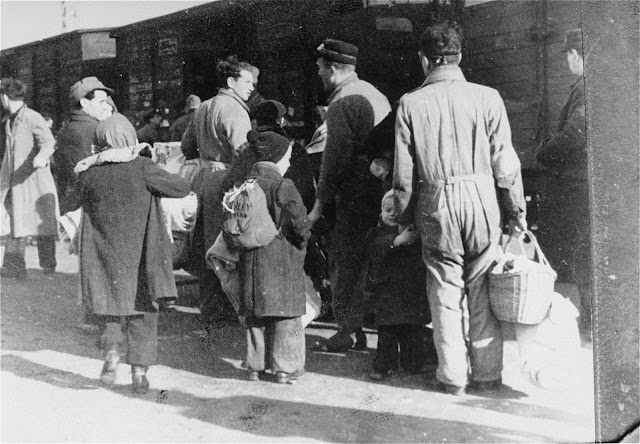
But two years after the German invasion of the Netherlands, two years after the occupation began, Westerbork was transitioned to something else altogether. The Nazi SS took the place over, and on July 15, 1942, a passenger train--eventually cattle cars--left these tracks for a place on the German/Poland border, a place called Auschwitz. More than 55,000 Dutch Jews would take that trip, most all of them never to return. 


Our family visited Westerbork in 1991. I'd taken on the job of helping a Holocaust survivor write her story, and I wanted to see for myself some of the places that were most important to her during the German Occupation, when she and her fiancé operated in great danger as members of the Dutch Resistance. One of those places, a final destination, was a camp close to the German border and far from major cities, a transit camp named Westerbork. 

Pictures are worth a thousand words, and even if the descriptions were written in the Dutch language, the experience of the place was stunning--well, chilling. No occupied country lost as high a percentage of its Jewish population during the war, as did the Netherlands. Almost 100,000 Jewish men, women, and children left Westerbork on a track to death. Pictures like this don't require description.

We must have been there in the morning because later that day, just outside of Arnhem, we stopped as planned at the Dutch National Open-Air Museum, a sprawling community all its own, full of Dutch history--barns and bridges, shops and open houses where docents, dressed in the clothing of their time, were working at tasks, like blacksmithing, long departed from everyday Holland.


We'd separated for some unknown reason--mom and daughter were off somewhere on their own, as were our son and I. Seems to me we were in some kind of general merchandise store, the kind of place that just about every burg in northwest Iowa had until the necessary horsepower came in gasoline engines. Seems to me the place looked like the Newkirk Store. 

The plump docent wore an all-encompassing apron and a beard, as I remember. His shirt looked much like what I'd seen on men at Tulip Festival. The two of us wandered slowly, didn't beg attention or conversation until he opened it up with a question that surprised me. "You're Dutch, aren't you?" he said, pointing a bit with a wave of his hand.

"Well, yes," I told him, "but we're fifth generation Dutch-American." I was amazed that he'd called me out the way he did--I don't think I was conscious of "looking" Dutch. 

"And your name?" he said.

"Skkkhhhaap," I said, trying my best to wiggle my epiglottis into creating that unique lingual marker.

"That right?" he said. "You're Jewish."

I shook my head. 

"Schaap, in Holland, is a Jewish name." 

He explained it this way. When Jewish people immigrated to the Netherlands--which they did and had done for hundreds of years, the Dutch being more permissive than other countries--they were accepted as citizens if they would jump two hurdles: first, join the Dutch Reformed Church; and second, take a Dutch name.  "In the Netherlands, Jewish people often have very simple names--like Schaap, from 'sheep,' or Van Rotterdam or Van Amsterdam."

I don't think my son had quite made it to middle school back then. He was just a kid, and I may well be creating a story that wasn't there. But when I looked at him just then, when the Dutchman in the old general store told me we were Jewish, something of the reality of the transit camp at Westerbork, something of its horror and its shame, something of all of that, I think I saw in his eyes.

Some family vacation moments are blessedly memorable. I hope that is true for him in the story in the Newkirk Store.

Wednesday, February 09, 2022

The Final Solution


It's a kind of anxiety, I suppose, something akin to unease. What is visible on the faces of these mothers and children is their troubledness, not because they fear death but because they have no idea of they ma well be on their way. They have no sense at all of what will happen. Even the faces of the children register how uneasy they are, how scared. Perhaps it's better that they didn't know.

On the far side is an imperial proclamation signed by Holy Roman Emperor Ferdinand I in 1551 that ordered all Jewish people to wear a circle on their clothing. The document on the left indicates that the document on the right was a gift to Hermann Goring, who with Reinhard Heydrich had come up with the idea of requiring all the Jews in Germany and throughout occupied Europe to wear stars on their clothing, so there could be no mistaking the truth. There was, after all, precedent, historical precedent.

If you need a story to go with the plan, you make one up or refashion it from fear that's already in the air, a story that takes advantage of a man or woman's sense of victimhood or powerlessness or lack of achievement, a story that will, at once, locate an enemy and an answer to why on earth your not getting what you deserve. For some, that story began here in a Jewish cemetery in Poland where Jewish people entered late in the night to make final plans on taking over the world. 

Imagine this. You spot this post card for sale somewhere on the street and tell yourself you really should say hello to cousin Egbert. The action of the drawing tells all, but the visage of the Jewish cross-dresser manages to convey in a single, grotesque image the total ugliness of the enemy, his (or her) danger to German patriots, his overwhelming power (look at that arm) and the malignant sexuality of, you know, those inferior beings. "Greetings," the writer might say on the other side.  

Here's the sign my Dutch cousins would have seen, a proclamation from the occupying Nazi forces making clear to the nation's Jewish citizenry that the law going presently into effect mandates their wearing a yellow star. And from the yellow star, the Nazis moved to this

and this

and this

Not so long ago. Not so far away.

Tuesday, February 08, 2022

Not so long ago. Not so far away.


Rudolph Hoss, the commandant of Auschwitz, got to thinking that Theodor Eicke, at a place called Dachau, had a stroke of genius when he decided that his camp should erect a welcome sign, Arbeit Macht Frei, which means something to the effect of "work sets you free," and might have been a half-truth that Dachau, but was never anywhere close to the truth at Auschwitz, a factory, stunningly, designed from the very first stroke of a pencil, to house an industry whose sole purpose was extermination of human beings, as if they were lice.

Why not a lie? Men and women, strong and weak, Jews and Gentiles didn't leave Auschwitz. They were gassed burned. 


You want to know how people left Auschwitz?--have a look at this drawing created by an inmate. People left Auschwitz in a column of smoke from the specially designed crematoriums, where bodies were incinerated dozens at a time. The genius of the Auschwitz method was that both the killing and the incineration were handily arranged for peak efficiency. 

Perfectly evil. 


In truth, the exhibition at Union Station in Kansas City was remarkably. You might think it impossible to overdramatize what happened at Auschwitz, but if the story was told with nothing huge photographs of naked human beings--some dead, some half-dead, and some still alive--the effect of the story would be different. We've all seen them--boxcars spilling emaciated bodies lying atop each other like cord wood. There was very little of that, which meant that throughout the museum of artifacts, photographs, videos and striking quotes (like the one above), your brain could remain engaged because your sensitivities weren't burned. 

The exhibition's subtitle carried the vital theme: "Not long ago. Not far away."

To me, among the most horrifying pictures was this one:


Every eye awaits his his every facial expression, every ear his every word. The crowd of cultists cannot get enough. Hitler, they once thought, was the Savior of the Reich, the Third Reich. He promised to take them to a station in the world Germany deserved to be. After the desolation of the First World War, the legacy of defeat, the humiliation of the Treaty of Versailles, the subjection of a once proud and powerful empire, he--Adolph Hitler--would make Germany great again. 

Last weekend, the Republican National Committee met to determine its direction, and then took one. They tossed out the two members of their party who had determined to work with the January 6 committee, and then passed a resolution that called what happened in the nation's capital "legitimate political discourse."

Legitimate political discourse.

It's impossible not to draw parallels. The riot--the insurrection--that occurred that January day now more than a year ago, to his supporters, can not be in any way attributable to Donald Trump. If you take those Nazi armbands out of the picture and superimpose the head of a man with orange hair on the man with a moustache, the picture will look a lot like the kind of rally the man with orange hair feeds on.

For me at least, the most chilling chapter of "Auschwitz: Not long ago. Not Far Away," was not the crematorium, the crowds of hairless women, not even this, a onesie from a child who, like so many others, was gassed and incinerated.


The most horrifying of the pictures were these:


intelligent, educated, thoughtful men, oohing and aahing over plans for an impressive and efficient place to kill millions of human beings; and this


German people having fun while whole families burned.


They were lied to, but their guilt lies in having accepted the lie. Their guilt lies in these artifacts:


A peephole from a crematorium, a door behind which the fires raged, and a pole, just a tool.  This is Hannah Arendt.


Not so long ago. Not so far away.

Monday, February 07, 2022

Perfectly awful


I'd like to think that just about everyone has read the stories--and seen the pictures. They're perfectly awful, of course, but just about any description falls short--say, f0r instance, the line I just used. Listen: "pictures of the Holocaust--we've all seen them--are perfectly awful.

There's even a hint of an oxymoron there, two words most often and most likely thought of as opposites: perfect and awful. The oxymoron stretches the description into something almost poetic, something more than words--in this case--something worse than the words. It takes something more than words to describe the Holocaust. If, in point of fact, a picture is worth a thousand words, it's safe to say, I believe, that even pictures of the suffering are perfectly awful. What happened in the camps was worse--always, always, always worse.

Here's a picture of words scribbled down by a Jewish man from Poland named Zalman Grodowski, who was specially chosen as a sonderkommando, a man designated, under penalty of death, to help take people to their deaths.


No matter what you say or how you say it, it's just not enough. For the last several months, Union Station, Kansas City, has hosted an exhibition of Auschwitz artifacts that curators have assembled into a comprehensive retelling of the story of Auschwitz, perhaps the most famous of the camps because it was, almost from its inception, an factory designed for one purpose and one purpose only--to kill millions of undesirables. These men, these women, these children--


and this,


women like these, who've already lost their hair--


Death itself dreamed up in a place that would seem a wonderful historical building even if it hadn't hosted the ordinary men who sat down together and designed a place of death, a "death camp" that would kill a million people,


where men who worshipped at Christian churches--Protestant and Catholic, men who listened to Bach and Brahms and Beethoven and loved their wives and children, men who waved their national flag and were more than willing to give up their lives for Deutschland, where those men sat down together over coffee and looked over plans like this, drawn up by ordinary architects and draftsman in ironed shirts and pleated pants, other men who, after work, went home and enjoyed family dinners--


Men and women whose life's mission was described and defined by a man they worshipped, a hero, one of their own who cared about their troubles, their lives, and their souls, and showed them the way to the immensity of the task they faced: 


Just in case you can't read the quote, let me make it perfectly clear, as clear as it was to the millions of Germans who determined it to be the truth:

Here in the East spiritually unbridgeable conceptions are fighting each other: German sense of honor and race, against an Asiatic mode of thinking and primitive instincts. We clearly recognize our mission to save European culture from the advancing Asiatic barbarism. This battle can only end with the destruction of one or the other.

Perfectly awful. 

Sunday, February 06, 2022

Sunday Morning Meds--Groaning


“I remembered you, O God, and I groaned;
I mused, and my spirit grew faint.” Psalm 77:3

There are times in church when I nearly lose my wife. Maybe I should say she nearly loses herself. Maybe we attend too often—twice every Sunday. Maybe we’ve attended for too long—both of us, entire lifetimes. Maybe it’s the specific congregation—a wonderful place full of many, many happy faces. I don’t know the reasons, but yesterday in church—both times—I nearly lost her. She doesn’t sing, doesn’t read along, doesn’t appear to be in it whatsoever. What she does there is not worship, really. At the end of the sermon last night, she was looking down at her hands and had been for a long, long time.

She is my wife, and I believe I understand her, although with each passing year I’m less sure of our being able to enter the corners of any of our individual secret places. But I have this advantage: she is my wife, and I know something of what she is feeling because I too experience what it is that weighs upon her.

This entire weekend has been another one of those that both of us hope never, ever to experience again. “No young man thinks he shall ever die,” Hazlitt once wrote, one of my all-time favorite aphorisms. But neither does any young man ever believe he will become the father of adult children. Trying to make it through your child’s suffering—your adult child’s suffering—is nothing you can prepare for. It’s a black hole that threatens to engorge everything.

I think it is the lot of parents to worry even more than their children, even when children create the worry—and even when the children themselves do worry. I don’t live in my kids’ skin. I don’t know what they’re feeling from moment to moment; what I’m left with is the deadly sting of those few moments when I do know, moments when what I see is poison. They may well go back to home, turn on some music or watch a flick, and walk right out of the darkness I’ve just experienced with them.

Not so, us. We spend the rest of the weekend in a midnight winter.

Our kids’ problems inflict wounds whose bleeding doesn’t stanch easily because the older one becomes, the fewer coagulants one’s insides seem to produce. Blood spatters all over, on everything. It smears the walls in the living room and pools in the bedroom. And when we go to church, we track it right into the pew.

And that’s why I say that yesterday in church I almost lost my wife.

Honestly, I know of no better way to understand what Asaph is talking about here in Psalm 57. In the night, with his hands extended, he hoped and prayed for blessing that flat out didn’t come. What he remembers is the very language of his groaning. Because he knows oodles of blessings, in their absence, when all the world seems aligned against him, those bountiful memories trigger spiritual, mental, and even physical pain that is excruciating.

Sometimes our cries and prayers seem as bootless as Asaph’s, and that realization—that God seems stone deaf—is the peculiar pain only of those who know Him. When our Lord God doesn’t pick up the phone, believers feel unspeakably alone, even in worship, maybe most alarmingly then.

“I remembered you, O God, and I groaned.”

Been there, done that.

Friday, February 04, 2022

"You Are Happy"

This poem showed up on my screen a week or so ago, courtesy of Writers' Almanac. It brought to mind the forty-year-old essay that appeared here for the last two days. Margaret Atwood, a Canadian novelist (and, I guess, poet) is on a different beach--all stones, no sand--but it's the same winter environment. Have a good look at what she sees. Read the poem slowly and you won't be surprised at all surprised by the title--or the last line.

 You Are Happy

by Margaret Atwood

The water turns
a long way down over the raw stone,
ice crusts around it

We walk separately
along the hill to the open
beach, unused
picnic tables, wind
shoving the brown waves, erosion, gravel
rasping on gravel.

In the ditch a deer
carcass, no head. Bird
running across the glaring
road against the low pink sun.

When you are this
cold you can think about
nothing but the cold, the images

hitting into your eyes
like needles, crystals, you are happy.


Thursday, February 03, 2022

Seagulls and Sovereignty - ii


In winter the beach is desolate from the sharp grass of the sand cliffs to the hem of ice chunks the lake wears until March. The sand runs smooth and true as plate glass, and the tiny footsteps my children make seem remarkable, the paths they form, poetic. In the winter the beach belongs to the wind, of course, uncovering stones as round and flat as silver dollars, rolling the soft sand in flowing drifts-"frolic architecture" Emerson called it-in elegance unmatched by anything manmade. Just the seagulls are here now-and the deer. My daughter puts two little fingers in the cloven prints they leave behind.

Just being here makes me confess hypocrisy, as if my real purpose in coming here were my children's benefit. Lake Michigan, this magnificent presence, still attracts me, still leaves me in awe, too full of the touch of its presence to explain it clearly. So while my kids write their names in the sand with the tail feather of a seagull, I let it work its mystery on me in its own inimitable, silent way, the way it always has.

It tells me things I've always known but never really taken the time to believe. Its incredible size mocks my own smallness. Its eternal rhythm reveals the transience of my own life and mocks my ambition. Filling the entire eastern horizon, its immense presence portrays what Thoreau called the "quiet desperation" of my daily living.

And yet, paradoxically, it strengthens me amid all this humiliation. I am reminded, Calvinist that I am, of the in­terdependence of the sand and the water and the gull and the deer and the sky; and within it all, my self, man, God's final creation during that first incredible week, this lake, somehow, still remembers. My children's meandering paths only emphasize the lesson, because they fit in too. I don't remember it, but there must have been a time when I, like my children, looked at all of this as just the world's greatest sandbox.

We all need our Lake Michigans. Novelist John Fowles says he feels it most in the forest, this inescapable sense of having to measure oneself and one's ambitions in the face of the eternal. I was brought up on the lake; I feel it here. When I see my father-in-law's eyes sweep up over 40 acres of soybeans and scan the horizon of Iowa farmland, I know he feels it too.

My daughter says her hands are cold, so we head back to the car. It is time, I suppose. That's when I soften enough to forgive those first Calvinist settlers who knew that the beach could grow no corn, who left the beautiful shoreline to today's "beautiful people." I can forgive because I learned from them another of those fretful paradoxes of faith: having been awed by His presence, He tells me to go back now, to leave, to return to the world of quiet desperation. It’s a command. It’s not a request. Eventually it gets hard to breathe on a mountaintop. The beach, no matter how beautiful, is as sandy as a desert. Such is the nature of retreat. It is done only in order to return uplifted, strengthened, more sure, perhaps, of who we are, what we are about, but never as an end in itself, no matter how ravishing.

Out here, facing the vast horizon of perfect blues, its strain of sky and water barely visible, I find it easy to sing, “This is my father’s world.” Back at the office, five floors up overlooking a skyline of a million people, it’s not as easy, even though it’s just as true. Having been here, I know it once more.

After the car warms, my daughter asks if we can come back again sometime.


Wednesday, February 02, 2022

Seagulls and Sovereignty - i


"Seagulls and Sovereignity" is 40 years old, written when we lived in Oostburg, Wisconsin, while I was in graduate school and Barbara was working in the bank just down the block from the house, uptown, where we lived for a couple of years. My off days were her work days, which meant I was the mom to our two kids, neither of them quite yet in school. So I took them out to the lakeshore, even in the cold of winter. This little essay appeared first in the Sunday magazine of the Milwaukee Journal all those years ago. I've been working on a memoir that uses published things to trace my life (and ours). Running this one here gives me a chance to put up Lake Michigan pictures.

~*~*~*~*~

I didn't grow up on Lake Michigan, literally. My ethnic ancestors first set claims on the Lake Michigan shoreline, and they called their first American town their own "Amsterdam," hoping, perhaps, that the name would pro­vide some clear identity and maybe a touch of security in the new country. Today there is no Amsterdam, Wiscon­sin--no town, no streets, no church. When the railroads came twenty years after its founding, my ancestors' oxen lugged Amsterdam up and away from the shoreline on long tamarack boughs, setting it carefully down a mile away, close to the new shiny rails, sure that growth was in­evitable over there, adjacent to the freshly cut path of the great steam locomotive.

They were right, of course. So today, 125 years later, the shoreline belongs to people who have made their for­tunes in Milwaukee or Chicago, people whose names once seemed foreign to the Veldbooms, the Wilterdinks, and the Eernisses, the later generations of the first settlers. In 1850, the first Dutch immigrants knew nothing at all about the real estate market, so they turned their backs on the shoreline, moving west into soggy Wisconsin marshlands, where they put to use their old-country propensity for til­ing and draining the swamps and turning it all into produc­tive farmland.

So when I say I grew up on Lake Michigan, I mean I grew up close enough to hear its continuous roar through my open bedroom window, close enough to ride my 26 inch J.C. Higgins down to the beach and go skinny-dipping, one fairly comfortable mile from the sharp steeple of the Dutch Calvinist church where we all went to catechism on Saturday mornings. 

I grew up on Lake Michigan the way some people grow up on meat and potatoes. In high school we'd pair off, snuggle up in our cars at the end of the lake roads, and "park" -a wonderful teenage euphemism, today probably thought to be some kind of archaic usage. Every spring we'd seine for smelt in chest-high waders, and in the winter I remember driving old cars down miles of frozen sand. Annually there were those few golden weeks in August when Lake Michigan would warm to a tropical 68 degrees, and everyone would go in, confident that Bermuda had nothing on southwestern Wisconsin and our own big lake.

On hot summer nights we'd barefoot the wet shore, the continuous ebb and flow of lake waves as refreshing as a quart jar of icy lemonade after twenty acres of baling hay, its peaceful lapping as firm and reassuring as Christmas in a little Dutch Calvinist town. Often, it brought out the best in us, a walk like that, for you can't talk trivia when your footsteps have been forever erased a moment after you've left them. There was something there on the beach like that. Perhaps it's that kind of mystical presence that makes me say I grew up on Lake Michigan, as if she, or he, shaped me as surely as the smooth driftwood it offers up during every season of the year.

It's that kind of mystical presence I want my children to feel when I bring them to the shoreline now, years later, a time when too much of the beach is now sentried by bright yellow "No Trespassing" signs. But we go anyway, though it's the middle of winter.


Tomorrow: finis

Tuesday, February 01, 2022

Me and the Today Show


When I think back to it, I'm a little surprised that I don't remember a time in my life when there was no television. I remember what our first one looked like--like this:


a whole lot of box and not much screen. It was black and white, of course, and it had a dozen tubes in the cabinet behind. Honestly, it seems to me that, like a naughty kid, it required a little banging around once in a while to keep it on the straight and narrow. I remember my father whacking its side, and I also remember him telling me that I shouldn't be so harsh with the old thing.

I wasn't very old then, and, as I said, when I remember it sitting there, I can't help think it was more than a little, well, progressive of them, stern Republican conservatives and very religious people as they were, to buy a set, as we called it. . ."a TV set." I don't really remember a time when there wasn't "a set" in our house. (Do people say that anymore?) And I remember the aerial: like some Dutch Reformed people, they didn't stick it in the attic where no one could see it.

Oddly enough, during my own earliest years I don't remember sitting around the set as a family and watching some of those early shows. I don't know why not. I remember Saturday night Gunsmoke, but that seems to me to have been much later. 

What I do remember and (therefore can safely judge) will never forget was Dave Garroway and the irrepressible J Fred Muggs, his sidekick monkey. It may not seem odd today and it probably wasn't then either, but that monkey stole the show for me at least, kept me glued to the set right through my morning fare of Sugar Pops--"Sugar Pops are tops," or so the ditty went, an ad I may well have seen during the Today show.

I was four years old in 1952, the date The Today Show, starring Dave Garroway, first aired, the oldest show on television. Child psychologists might dispute this, but I'm not sure I remember anything before that time, so not long ago when the Today Show celebrated its 70th anniversary, I couldn't help but remember how Garroway and that monkey buddy of his were guests at our place every last morning of my childhood--well, just weekdays: it was cartoons on Saturday. The set went dark and dumb on the Sabbath (Sunday TV would take a few more years--although not many because Lassie came on right before church on Sunday evenings).

I don't watch the Today Show anymore. Maybe I should. Our set is turned to CNN or MSNBC (yes, I know them's fighting words). I've nothing against the Today Show or NBC these days, and I'm really taken by the fact that the Today Show, so much a part of my childhood, has been a staple of American mornings for as long as it has. "Good morning," Dave Garroway said on January 14, 1952. "The very first good morning of what I hope or suspect will be a great many good mornings between you and I."

And it has been, most probably far beyond his wildest dreams.

Me? I can't dream of a breakfast (haven't had Sugar Pops for years--can you still buy them?) without the news, thanks to my dad, who, with me, sat at the kitchen bar and devoured Corn Flakes while listening to Dave Garroway talk about the news. I don't think I'm addicted to morning news, but a breakfast without them would be more difficult than a morning without breakfast.

So my heartiest congratulations to NBC for 70 years of that show, on a medium that changes as often as the weather. Congrats to the Today Show, and thanks, Dad, for Garroway and J Fred, for the set itself, and an early morning diet of headlines, for creating in me a hunger to know what's going on in this big, wide world.