Morning Thanks
Garrison Keillor once said we'd all be better off if we all started the day by giving thanks for just one thing. I'll try.
Wednesday, October 16, 2019
Netherlandish Proverbs--(ii)
I can't help it--the plain fact of the matter is that I look a ton more Dutch than Spanish. I don't wear wooden shoes, but when I walk, I klompen. So one day, by myself somewhere in the Netherlands, I was walking down Main Street among a host of others while the kind of rainy mist that's native to my country of origin was all around.
I have no idea who he was, will never know, but a man who happened to be walking beside said something about the foggy morning, and did so with an intonation I recognized as some old proverb he knew because everyone did. It never dawned on him that I didn't, so I have no idea what he said. No matter. I looked at him and smiled, as if to tell him that about the clingy mist, he'd nailed it.
The penchant for ancient wisdom in a wee package is, at least to me, quintessentially Dutch. Ben Franklin may well have been America's first proverb peddler--"a stitch in time saves nine." Poor Richard had a notebook full. But the Dutch are masters.
Wee wisdom is going on in Pieter Brueghel's Netherlandish Proverbs, a canvas full of sermons in teaspoons, more of a catechism than a masterpiece.
Try this:
I wouldn't doubt that the man's red pantlegs signify something, but what I don't know. He appears to be pulling along chunk of a trunk that may or may not have legs like a stool. By the angle of his efforts, it's a stiff job. There's a bit of Sisyphus here maybe, that poor king sentenced by Zeus to roll a boulder up a hill endlessly.
The Dutch line is easy enough, just three words: "de blok slepen," which Wikipedia translates as "to drag the block" and explains as "to work at a pointless task." It's his punishing duty to drag this beastly thing around, for what sin or crime we don't know. What seems to be implied is that his sentence is not likely to end soon.
Somewhere, however, this little witticism developed a specific usage by what Shakespeare called "cuckolding." Apparently, there's often something sexual about this man's misery. Poor guy was deceived by a lover. He is, therefore, dragging the block. Linguistically, that doesn't work in English, which is not to say it's beyond understanding. Still, I get it.
Here's another:
So I'm walking my kids' dog on one of those expanding leashes, which is likely a mistake, given my idiocy about things mechanical. Without letting me know, the dog bolts. He's just a lap dog whose most fearsome trait is his bark. But immediately I'm thinking the worst: he'll get hit by a car or he'll run off to Fort Sill. So I take off after him.
Well, that's a misrepresentation--"take off" bears no resemblance to what happened on that sidewalk. I'm 71 years old, and the fact is, I haven't run or jogged since having back surgery 20 years ago. I didn't "take off" because what I learned at that moment is that I can't run. Somewhere in the earlier chapters of my story, I left running, never was my forte' anyway, behind. What I learned at that moment is that I can't run--not that I don't run, but I can't. Literally. Fifty feet away, the dog stopped and waited for me. An act of mercy. Didn't giggle either.
Brueghel's old woman here is running, doing the impossible. She is highly conscious of those beasts at her heels and thoroughly believes they mean to make a meal of her. In the fire of her adroit fear, in her madness, she runs.
Maybe I could too with those medieval beasts salivating behind me.
Noot doet zelfs oude vrouwen rennen--"thus doth fear make old women trot." What you can do if you have to is amazing.
One more quickie. Gotta love it, but then, unlike the English, the potato-eating Dutch are un-apologetically earthy.
It's not pretty. In Dutch, the line goes like this: Paardonkeutels zijn geen vijgen, or "horseapples are not figs," which is just an blushingly Dutch turn on "you can't tell a book by its cover" or "all that glitters is not gold." Better yet, "you can't make a purse from a sow's ear," or, to return to the Dutch, "you can't put pink ribbons on wooden shoes."
That's more than enough wisdom for one morning.
________________________
All three proverbs exist in the upper right hand corner of Netherlandic Proverbs.
Tuesday, October 15, 2019
Indigenous People's Day

Because there isn't one.
That may be the best reason for an Indigenous People's Day, whether or not the new name erases what has been Columbus Day. People know so little about this nation's first nations that creating a holiday to commemorate them is altogether fitting. Me?--I prefer what South Dakota did: eschew both Columbus and the odd word indigenous, and just call yesterday "Native American Day."
Not all that long ago, a Washington Post article made humiliatingly clear how poorly American schools teach its students about slavery. Not that teaching about slavery isn't done; it simply isn't done well. One of the reasons is obvious: slavery isn't a nice story. Teaching about it, Joe Heim wrote in that story, "means acknowledging and exploring slavery’s depravity. It means telling the personal stories of enslaved people, the physical and psychological cruelty they endured, the sexual violence inflicted upon them, the separation of husbands and wives, parents and children."
And that's not something fun to do, especially right before the pep rally. Who on earth wants to teach "ugly stuff"? Bring on World War II, and and how we finally dispatched Hitler and Hirohito, or the Great War, when we came to Europe's rescue. The Civil War, despite hundreds of thousands of dead, isn't bad either, given the fact that, hallelujah! it freed the slaves.
For kids who are white or red, there's no easy way to teach Native American history either. A Navajo once told me he dropped out of college after taking an interim course in Native American history. He quit school altogether because he was so angry that what he'd learned in that single, short class was a saga he had never, ever heard in school before even though he'd grown up on a reservation.
There's good reason to drop Columbus Day from the calendar and Columbus himself from the pantheon of American heroes, starting with the word discovery. "Before it became the New World," says Charles Mann in a 2002 essay in the Atlantic, "the Western Hemisphere was vastly more populous and sophisticated than has been thought." There were thousands, millions, for whom the word discovery is not only silly but a slam. Columbus didn't need to find them or to verify their existence, and he certainly didn't need to treat them as despicably as he did.
Columbus Day, Yoni Applebaum argues just last week in the Atlantic, is, oddly enough, a victim of its own success. Applebaum traces the history of the holiday back to a time in American culture when "swarthy" Catholic Italians were swarming into WASP-held America, upsetting the powerful, who felt the immigrants to be a grade or two less than human. Columbus Day originated as a means to celebrate a people who were also despised, save for their strong backs and their cheap labor at jobs in which white folks had no interest.
I'm all for "Native American Day," but it's also good to remember that its predecessor on the calendar of national holidays actually had origins in seeking to recognize yet another forgotten people.
Is there a pattern here? Probably. Should we try to understand it? Yes.
Not all that long ago, a Washington Post article made humiliatingly clear how poorly American schools teach its students about slavery. Not that teaching about slavery isn't done; it simply isn't done well. One of the reasons is obvious: slavery isn't a nice story. Teaching about it, Joe Heim wrote in that story, "means acknowledging and exploring slavery’s depravity. It means telling the personal stories of enslaved people, the physical and psychological cruelty they endured, the sexual violence inflicted upon them, the separation of husbands and wives, parents and children."
And that's not something fun to do, especially right before the pep rally. Who on earth wants to teach "ugly stuff"? Bring on World War II, and and how we finally dispatched Hitler and Hirohito, or the Great War, when we came to Europe's rescue. The Civil War, despite hundreds of thousands of dead, isn't bad either, given the fact that, hallelujah! it freed the slaves.
For kids who are white or red, there's no easy way to teach Native American history either. A Navajo once told me he dropped out of college after taking an interim course in Native American history. He quit school altogether because he was so angry that what he'd learned in that single, short class was a saga he had never, ever heard in school before even though he'd grown up on a reservation.
There's good reason to drop Columbus Day from the calendar and Columbus himself from the pantheon of American heroes, starting with the word discovery. "Before it became the New World," says Charles Mann in a 2002 essay in the Atlantic, "the Western Hemisphere was vastly more populous and sophisticated than has been thought." There were thousands, millions, for whom the word discovery is not only silly but a slam. Columbus didn't need to find them or to verify their existence, and he certainly didn't need to treat them as despicably as he did.
Columbus Day, Yoni Applebaum argues just last week in the Atlantic, is, oddly enough, a victim of its own success. Applebaum traces the history of the holiday back to a time in American culture when "swarthy" Catholic Italians were swarming into WASP-held America, upsetting the powerful, who felt the immigrants to be a grade or two less than human. Columbus Day originated as a means to celebrate a people who were also despised, save for their strong backs and their cheap labor at jobs in which white folks had no interest.
I'm all for "Native American Day," but it's also good to remember that its predecessor on the calendar of national holidays actually had origins in seeking to recognize yet another forgotten people.
Is there a pattern here? Probably. Should we try to understand it? Yes.
But try teaching that to the guy in the MAGA cap.
Monday, October 14, 2019
Morning Thanks--Last night's performance
I know it's awkward of me to say it, but I have had far more than my share of successes as a performer in my three-score-and-ten. After helping Diet Eman tell her story in print (Things We Couldn't Say), I created a readers theater presentation out of all that courage and perseverance, a presentation that toured widely in 1995, fifty years after the liberation of the camps in World War II.
After writing Our Family Album, a book about the Christian Reformed Church, I thought I could do the same thing--and did, bringing that story to the stage, the story of the denomination of which I've been a part ever since I was born--and before, if I calculate time by one of the CRC's staid old doctrines, the doctrine of "the covenant."
I created a show for the 50th anniversary of Dordt College (now University) that also toured widely and featured videoed stories of eight specially chosen alums. I've read my own stories time and time again, throughout the U.S. and Canada.
If my eyes and heart can be trusted, then I'll hazard this judgement: a ton of those readings and performances were greatly successful. If I sound like I'm tooting my own horn, I guess I am. I'm sorry. At 71 years old, I don't think it's a sin to do a little self-reflection.
I say all of that for a reason. Last night before a crowd in our church, five readers and I staged an unique performance that, if my instincts can be trusted, was wonderfully received (emphasis on wonder).
A friend of mine from Vermont told me that I'd like Benjamin Myers' book of poems, Black Sunday, a series of sonnets (all all things!) that tell stories of the Dust Bowl, right there in "no man's land," a triangle of horrors cut from Texas, Oklahoma, and Kansas, where that terrible Sabbath day will never be forgotten.
I took Myers's book of poems from the package and read it, cover to cover, the only time in my life I've ever done that with any book. That recommendation was true. The stories Myers tells are heartfelt alive, brittle with the kind of electrical charge that arose from all that dust. To me, remembrances of the people who speak in that book were beautiful, but dark--very dark, as was the time. Many thousands left--Steinbeck tells their stories.
I sent out a few emails to people I know to tell them I thought Black Sunday was an amazing work, powerfully moving, dark as a dust cloud but never quite hopeless against the wide Great Plains sky, then decided to try it, to put it up on stage for people to hear and see.
We planted an old hymn right in the middle of the performance, a hymn begun by a school teacher, who simply starts, wearily, to sing the first quiet verse of "Leaning on the Everylasting Arms." For a moment, she's all by herself, singing quietly, thoughtfully, to no one but herself. She's trying to raise some hope. On the chorus the rest of us on stage joined her, in a testimony that's also inescapably a lament.
We'd recruited a pair of wonderful singers. When they joined in, the crowd began to understand that they too could help, all of it a capella. Something happened just then: somewhere in the back, people stood to sing with her, with us. Slowly, the rest of the crowd got to their feet as well. No one asked them to rise, no one gave any sign that we wanted them on their feet. No one up front ever thought they would, but on their own they did--they got to their feet as if helping the schoolteacher with the courage to face the deprivations of her life in "no man's land."
That moment was almost heavenly. To me at least it signified that those who attended were on a perfect pitch with the emotional heart of the poems the cast were reading. The crowd became a part of the story. I've experienced far more than my share of beautiful moments in dramatic performances, but this one was extraordinary, and pure blessing.
On the way out, as the cast walked through the crowd, a boy, a little boy, looked at the schoolteacher, and gave her a thumbs up as if to say he'd loved it. I've had standing ovations that weren't as precious.
We live in a culture that doesn't really value history much. The great American Dream cares not a lick for yesterday. When people lose those yesterdays, we call the condition senility. Black Sunday is a chapter in our history we forget at our jeopardy.
The great value of history, someone said, is that it tells us what we've done and therefore what we are.
This morning I'm thankful for Benjamin Myers wonderful book, for our attempt to put it on stage, and for the blessings which understanding ourselves affords.
_________________________
Listen to a Small Wonder from KWIT, public radio in Sioux City, Iowa, a short essay about the Dust Bowl and Benjamin Myers's book.
Sunday, October 13, 2019
Reading Mother Teresa--Purity
. . . I consider everything a loss
because of the surpassing worth of knowing Christ Jesus my Lord,
for whose sake I have lost all things.
I consider them garbage, that I may gain Christ. . . .
Philippians 3:8
Fine and pure as summer dew
Her soft warm tears begin to flow,
Sealing and sanctifying now
Her painful sacrifice. (17)
Just before the epic battle that would forever change Native American life on the Great Plains, the Battle at Greasy Grass, or Little Big Horn, Sitting Bull, a Lakota medicine man, performed a Sun Dance, then cut chunks of his own flesh from his arms and legs as an act of devotion to the divine, or the sacred, Wakan Tanka. Bloodied and weakened, he then saw a vision of cavalrymen falling from the sky. That vision, historians say, both red and white, strengthened Native resolve for the battle which that was to come.
Barbaric. Heathenish--sure. But somehow, to a religious person, understandable. What Sitting Bull did that day was a sacrifice. He gave bloodily of himself to his god, humbled himself, hurt himself in contrition and submission to his own image of the divine.
Mother Teresa was little more than a child, when, tears in her eyes, she wrote a self-reflective poem on her trip to India, a poem that describes her mood on board that ship. I believe her when she says she cried. I believe her tears. She had to be anxious about the world she was entering and what was to come. She was little more than a college freshman; and, away from home for the first time, I’ve seen them cry in torrents.
What’s difficult for me to understand is that she considered the way she had pledged herself to God and his love to be such an immense sacrifice. If she truly valued what she might have become had she not chosen to take her orders, being on that ship and on her way to a whole new life would have been more difficult, and much less filled with the sweet promise that she was soon to become, after all, “the little bride of Christ”?
Yet, here, in the last lines of that little poem, she says her tears, “pure as the summer dew,” flowed from her “painful sacrifice.”
I don’t think Mother Teresa ever pulled out some kind of poetic license to wrench out half-truths or hyperbole. I can see her there on the deck of that ship, little more than a kid, handkerchief in hand, dabbing at her eyes.
What I don’t understand is her sacrifice.
But then, I just returned from the gym, where I work out lest my weight balloon, as it certainly could. Our house is comfy and warm. Sometime this week, I’m getting a new easy chair. Tuesdays and Wednesdays are tough teaching days for me, but I’m sure I’ll come out whole on the other side by the time by the weekend. I haven’t cut out any chunks of my flesh as of late, haven’t worn the hooks in a Sun Dance, haven’t denied myself anything to speak of, haven’t even fasted. I just don’t think I’ve done much suffering.
With so much of her storied life still in front of her, so much suffering yet to be discovered and endured, so much love yet to be given away, it’s difficult for me to understand how tears could possibly be wrenched from what this young lady, still a child, thought of as her significant sacrifice in following Jesus.
But then, maybe that’s my fault. Not long ago, somewhere I remember, we sang the old hymn “I Surrender All.” Really? I do?
Maybe I don’t recognize her sacrifice because I haven’t a clue about my own.
Maybe.
Friday, October 11, 2019
Small Wonders--The Todd House

Religious visions were everywhere in the years preceding the Civil War. Boom towns out west here may have been hell holes for a time, but they were also peopled by starry-eyed believers who claimed their marching orders came from on high.
Tabor, Iowa, sits on a bluff far above the Missouri, the highest point of Fremont County. The place is not in terrific shape today; but Tabor has an epic past, created when fiery abolitionist Congregationalists set up camp here, just across the river from Nebraska.
The Reverend John Todd House, in town, was a stop on the Underground Railroad in the 1850s, often a port of entry to runaway slaves who weren’t free until they could be protected from slave-holders and vigilante northerners looking to make a buck from substantial bounties. There was money to be made: slaves were property, after all.
In the 1850s, slavery was under attack, and Rev. Todd was a soldier in God’s army.
Truth is, he got into trouble before there even was a Tabor. A discussion about slavery aboard the steamer he came up on became heated. Once other passengers detected an abolitionist, they wanted his scalp. "Shoot him," someone yelled. "Kill him." One idiot told him if it was his choice, he’d straight-up trade the pastor for a mongrel dog and shoot the dog. Todd says he learned later that man was "a minister of the gospel from Missouri."
Both Iowa Congregationalists and Iowa Quakers thought the institution of slavery an abomination. What separated the two faith communities was a commitment to violence. The Quakers said no. Rev. John Todd and his Congregationalists said yes and became a prototype for an abolitionist preacher in Marilynne Robinson’s Gilead.
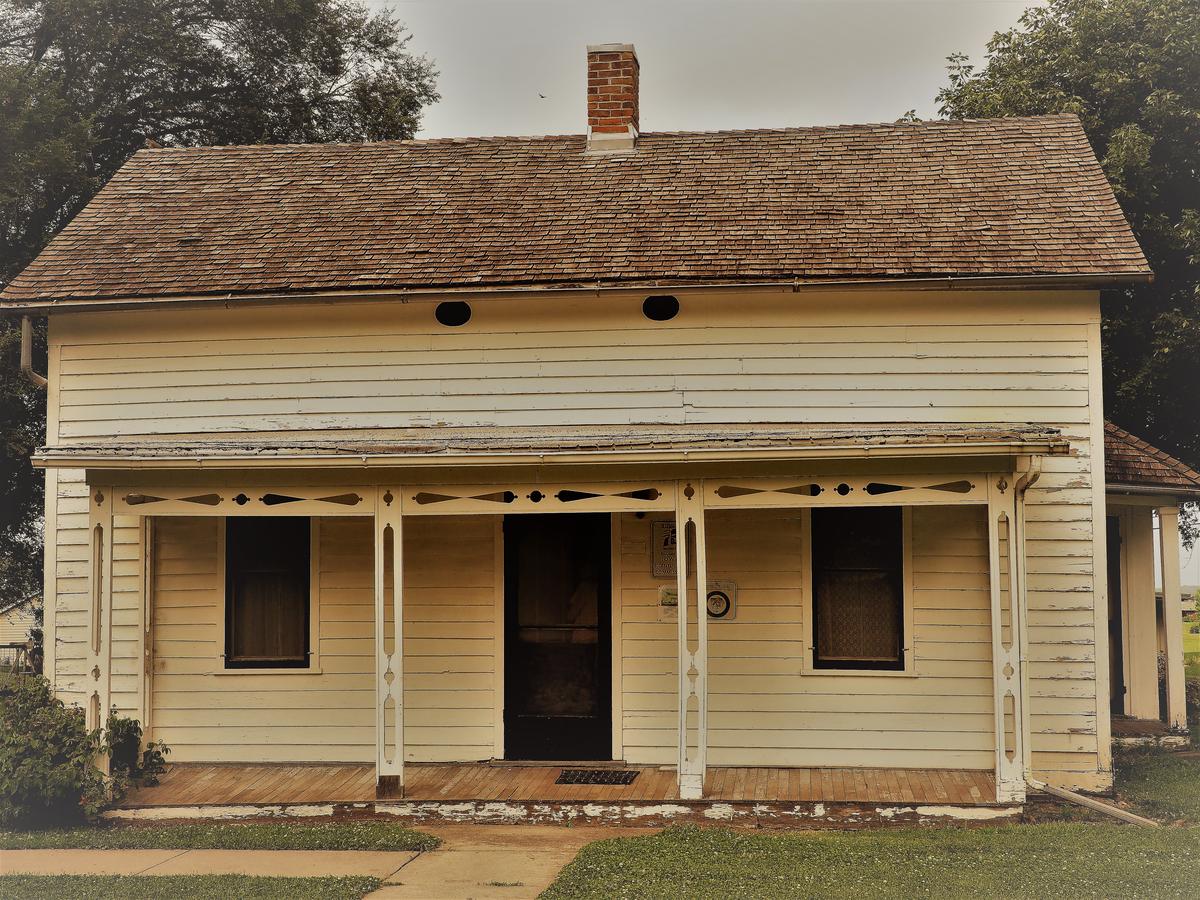
The manse of the Reverend John Todd sits right on the square in Tabor--don’t expect a palace. But the old house still has an tiny door leading down to a dank basement. John Todd was no more than a shim over five and a half feet tall, so what’s downstairs is more his size, a cave really, not inviting.
But if you stop by, don’t not go downstairs. At one point in time that basement was an armory full of guns for the war he thought about to begin in "Bleeding Kansas."
What's there today? Nothing. No cement floor, just dirt, a humming dehumidifier, random stones, bricks. That cellar was was never meant to be lived in. It was a place to hide when the prairie sky turned foreboding.
At the request of none other than fiery John Brown, who stayed right there in Tabor, Pastor Todd stocked his house full of guns because he simply could not abide the sin of slavery. Slaves, he and his friend John Brown claimed, had a more righteous reason for rebellion than did patriot colonists a century before.
In his own memoir of that era, Todd described himself and what happened this way:
The parson had one brass canon on his haymow, and another on wheels in his wagon shed. He had also boxes of clothing, boxes of ammunition, boxes of muskets, boxes of sabres, and twenty boxes of Sharps rifles stowed away in the cellar all winter.
The preacher took up arms. His eyes had seen the glory.
You'll have to get off the beaten track to find Tabor, and you’ll have to call ahead to to get in the house. Not many Americans stop there anymore, if they ever did.
But the basement still beckons, and the memory of that time and place and the war it begat somehow seems more real when you stand beneath ancient beams on a dirt floor, where once a preacher readied himself for a war that God meant to happen, a war to free the slaves.
Thursday, October 10, 2019
Brueghel's Netherlandish Proverbs--i
Things change, right? Sure, but sometimes not as much as you think.
Pieter Breughel the Elder, whose religious preferences in 16th century Holland have never been determined beyond a reasonable doubt (was he Catholic or Protestant or neither?) created a marvelous canvas overwhelmed with wisdom in the shape of aphorisms, delightful little proverbs, tidbits of artful wisdom his audience not only understood but used in everyday speech. Interpretation would be helped greatly if we were ourselves 16th century Dutch ordinaries, not unlike the kleine leude he breathed to life in this old country landscape, but you'd be surprised by how many proverbs evoked here still have currency.
Brueghel's vision is just plain fun--and not just in a 16th century sense. A ton of the these easily transportable Dutch proverbs are still with us, which suggests--and proves--that we've not really changed--human beings being what we are, with or without smart phones.
Center-left foreground for instance, you'll find this idiot.
What's he up to? With or without that toad-stabber in his right hand, he's being a block head, ramming his head against the wall. And that idea is what's behind the figure--the guy's banging his head against a wall.
"'Course I know what that's like," you say. We can't see the guy's face--maybe you're the subject. I am.
Moralists get old fast normally because they can't help telling other people how to live. But Brueghel's moralism in this incredible painting is a joy. It's fun. In truth, it seems, he rather likes this dummies, finds them, well, something akin to normal.
Try this image, upper left--set in the side of the house:
Hint: the thing is upside down.
Get it? Today's political mess captured here in just one of a world of images, and Brueghel never heard of Trump.
They're a ball, really, a joy. Brueghel's visions of hell have tormented believers for centuries. His interpretations of the Seven Deadlies are complex and memorable. But this single work--Netherlandish Proverbs--is just plain fun, in part because we're in it, always have been and always will be.
More to come. Stay tuned.
Wednesday, October 09, 2019
At the Fur-Trappers Museum
Painting on display in the Fur Trappers Museum, outside of Chadron, NE. Haunting beauty featuring a time all but forgotten, when the world, out here, was held and run by fur companies and their men, who may well have gotten along with the native populations better than any of the settlers who followed them west.
What all the fuss was about. Hard to believe that a furry fad in Europe--beaver hats--prompted new world corporations to travel thousands of miles in rugged, unmapped North American territory in search of these fat, furry creatures.
Tomorrow night--snow, they say. I'm sneezing badly this morning because the dust in the air that rises from hundreds of bean fields being harvested by machines with giant hungers. Got to get 'em in before a drenching, before the seasons change because it won't be long, as everyone knows, and the cold will be upon us. How on earth did natives and those fur-trappers, miles from shelter, ever make it in all that bone-chilling cold. Rabbit mittens, for starters. . .
. . .for starters, because the world of the wilderness wasn't always this beneficent. Look at the smoke from the fire, not even a breeze. I can't imagine that there weren't moments of sheer awe, however, and that's what's celebrated in this painting in the Fur Traders Museum.
Medieval torture machines. Actually, traps. Big ones, to be sure, but the tools of the trade. No, the whole enterprise isn't pretty. Yes, there's suffering. I almost hate to admit it, but the truth is some of the mornings on the river, back when I was a boy, some of those mornings rank with experiences as rich as anything in my childhood. Our traps were a tenth as large, but they looked just as painful--and were. But I loved it.
The truth is, of course, fur is beautiful--and that isn't its only attribute. It keeps the beaver warm and doesn't do a half-bad job on human beings.
When beaver hats went out of style, the fur-trading enterprise looked for new quarry--and found it quickly in the 50 million buffalo that made most of the region went of the Mississippi their home. They were everywhere. Just about ever small-town museum anywhere close to the Missouri River has a buffalo coat. They became so popular that when we killed them all off--or most of them--fur companies created fake buffalo robes, like this one--phony baloney.
I know--doesn't have much to do with fur trapping, but I couldn't help snapping this picture because this war bonnet looked so beautiful. Maybe it's just me. Still, the fact of the matter is that this little-known era of American history may well have been the best times of Euro- and Native American relations. Jedediah Smith and his cohorts knew that needed the Lakota and the Arikara, the Omaha and Yankton Sioux, not only to gather furs themselves, but also to help them navigate what was once all wilderness. There is a history of fierce fights--remember Hugh Glass!--but there is also a fleeting pax Americana that ended only when our numbers got overwhelming and people like my own great-grandparents moved west to land they believed they could have without cost.
About that, they were wrong.
Tuesday, October 08, 2019
An Extraordinary Orange City-ian
Rick Peppers stands alone in Orange City.
Mornings, likely as not he's at the Dutch Bakery for coffee and a donut, with a table full who retirees who daily make short work of the most vexing world's troubles. They tolerate the few Democrats among 'em, but most are Trumpers, as is he.
Rick Peppers has been retired for years. Soon enough he's scheduled to go under the knife in Sioux Falls to get a valve or two replaced. Two days, he says he'll be there; likely as not, he's right. But he'll be back--you can't hold a good man down.
Rick Peppers didn't grow up in Orange City, never spent a day here until he needed a place to come home to, some place not next door to, but in the neighborhood of family members who live in northwest Iowa. Don't be mistaken--Rick Peppers is an Iowan, born and reared in Exira, even though he wasn't always thrilled to call Exira home. Problem was, he says, when he was a kid he had the bad luck to follow a gifted big brother who could do no wrong.
So Rick rebelled, did some teenage silliness, went drinking one night before ramming the cop's car, then took off, left town, but came back and made peace with a loving father who was happy to see his rebel kid in one piece. Still, Rick Peppers got tired of the place, didn't bother with a diploma, and hitched up with the Navy to see the world.
Eventually, he got himself hitched to a good Iowa girl, moved to Omaha, but got weary of shoveling snow. He told his wife soon as he could find himself a job someplace warm, they were going off to a place where he'd never have to pick up a shovel again. With a job in some warm climate, he told her, for once they'd put Omaha and Exira in the rear view mirror.
You're saying there may well be other retired men like Rick Peppers in Orange City. He's not so different. People get tired of the places they were born. In the rural Midwest most kids eventually leave. Could be a rule of thumb. Rick Peppers isn't so different, just a little more contrary maybe.
There's more to the story. Rick and his wife moved to Nevada, where he took the first job he was offered--in the mines just outside of Las Vegas, Blue Diamond mine, to be specific, one of those out-of-the-way places where the corporation ran an entire village for workers, a neighborhood of workers Rick and his wife found, well, homey. On the job, he learned what a "mucker" was when he became one. Soon enough, he says he figured out what Tennessee Ernie Ford was talking about in a song he'd always loved, "Sixteen Tons."
In all likelihood, Rick is the only guy around that bakery coffee table who worked the mines, but that's not how it is he stands alone.
Blue Diamond Mine was just down the road from Vegas, as in "Las Vegas," a place some call "The City of Lost Wages," the entertainment capital of the world. When Blue Diamond management undercut the workers, when the boss handed him a broom and told him to start over, Rick Peppers left that little company town and took the quickest trip he could to Sin City.
Now Rick Peppers isn't the only Orange City-ite to hit Vegas, I'm sure, but he's likely the only one who spent a couple decades working security at Caesar's Palace--you heard that right: Caesars Palace. He's the only one who watched when the powers-that-be became the state regulators and not the mob toughs--a bad move, he'll tell you, by the way. He's the only one at the Dutch Bakery who was appointed bodyguard for Ann Margaret (ask him to show you his lovely autographed portrait). Rick Peppers stands alone in Orange City. He's the only guy in that coffee bunch who once upon a time got on the good side of Frank Sinatra;'the only man or woman whose job it was to keep gadzillions of Caesars's Palace dollars in locked boxes where those millions were supposed to be.
In Vegas, Rick Peppers lived with high rollers he knew by name, the mega-wealthy who could lose hundreds of thousands in a couple of hours, then come back to the Palace's Twenty-One Pit the next day or week and start over again. Rick Peppers found a home among dealers and shills and sharks and the Sergeants whose job it was to keep the Palace running clean, as clean as you can in Sin City.
"I was fortunate to live in the time that I did," he says, in his own personal memoir of the years he spent at Caesar's Palace. "If I had a chance to live my life over, I would not choose any other time or place than the one I lived through." The truth is, Rick Peppers is the only guy around that coffee table who will tell you he loved his many years at Caesar's Place, right there in Sin City.
"I thank God for the life that I've had, and I ask his forgiveness for all my transgressions." That's how he ends the story of his life, An Ordinary Man in an Extraordinary Place at an Extraordinary Time. Read it for yourself.
You can find it on Amazon, even a Kindle edition. Better yet, ask him. He's got a few. He'll sell you one. Most mornings he's at the bakery for coffee. Ask for the man from Sin City.
Monday, October 07, 2019
Morning Thanks--Sunday walk on a farm pond
Nothing really to commend the place. A farm pond, little more; wind--loads of it; and just a touch of fall. Some lucky folks, yesterday, hundreds of miles away, stood beside Niagara or looked up or down from the Tetons. Here, just outside of town, it was just me, an azure sky, and few dancing milkweeds around a farm pond.
Unremitting rains have kept the world emerald, but here and there a few broken yellows suggested the cruelty of passing seasons.
The sun poured down on the open fields of grass, but no one stood still in reverence because wind laid siege to everything. Wind was the whole Sabbath story.
Sometimes beauty parades before us; we don't need to look to find it, sit in wonder because we simply can't stand. I'll bet the red rocks of New Mexico were stunning yesterday, the woods up north exploding with color. Me?--I spent an hour or so in wind, walking around a farm pond amid wildly dancing prairie grasses doing everything they could simply to stand.
But I'm not complaining, not at all, not with Mary Oliver in my ear.
Instructions for living a life:
Pay attention.
Be astonished.
Tell about it.*
Here and there, a milkweed pod, like a Lakota chief, bravely facing the wind.
And I have become the child of the clouds, and of hope.
I have become the friend of the enemy, whoever that is.
I have become older and, cherishing what I have learned,
I have become younger.**
Also, Mary Oliver.
For whom, this morning, I'm thankful.
___________________________
*"Sometimes"
**"To Begin with, the Sweet Grass"
Sunday, October 06, 2019
Reading Mother Teresa--"Saving Souls"
![]() |
| Hieronymus Bosch, from Descent into Hell |
“You snakes! You brood of vipers!
How will you escape being condemned to hell?” Matthew 23:33
“From the age of 5½ years, – when I first received Him [in Holy Communion] – the love for souls has been within. – It grew with the years – until I came to India – with the hope of saving many souls.” (from Come Be My Light)
For reasons which that I don’t understand myself, when it comes to the fires of hell, I have, since childhood, become significantly less fearful. What’s more, I’m probably a good deal more generous about who might or might not go there – and why. I am, without question, far more theologically liberal today, maybe even something of a backslider, especially when it comes to hell. My guess is that, for the most part, I’m not alone.
Mother’s Teresa’s white-hot, childhood passion for “saving many souls” probably arises from a cosmos she saw clearly before her at that age, a cosmos I think I know too, because when I was a kid I saw just two roads leading toward eternity – one wide, one narrow, both clearly and vividly mapped leading to two diametrically opposed ends.
I think I knew exactly how to travel down the road to either destination, and it wasn’t all that difficult. In my kid’s mind, salvation had very little to do with the mysteries and miracles of grace, and much more to do with toeing the line in every which way – “oh, be careful little eyes what you see.” The “straight-and-narrow” was, for me at least, wholly as understandable, the signage as unmistakable, as it is on the interstate to hell.
And hell, for me, was as real as, say, Milwaukee.
If you love people, as Mother Teresa did, you want to save them, at all cost, from the nightmarish visions of Hieronymus Bosch or whatever horror one’s mind creates down there at the luminous end of that diabolical road, the wide one. I understand that. She says she was 5½ when she partook of her first communion, just 5½ when those lifelong passions took root. She was a child. She saw things as a child.
Me? – when I became a man, I think I put away those childish things.
Or did I?
Christ’s admonitions about babes in arms, about children, about kids, about the dire necessity of simple, untrammeled childhood faith – hHe was kidding about that, right? Throughout his ministry, he was given to hyperbole, after all – like rich men passing through a needle’s eye. How nonsensical is that? – it’s poetry, not hard-and-fast truth.
Isn’t it?
Besides, what she’s talking about here isn’t Hieronymus Bosch. What she’s talking about is saving souls, her love for them, a full dose of which I think even this learned professor could use.
I’m not as sure as she was at that age, or at this. Nor am I as sure of what “saving souls” really means.
Oddly enough, that having been said, I honestly don’t think we’re that much different.
Saturday, October 05, 2019
Memorial--a story (conclusion)
On Memorial Day, on the holiday, Wiley was out in the field, rotary-hoeing in the sixty north of the house, roaring along in fourth gear, kicking up dust behind him, smashing the hard edge of soil into pieces around the straight lines edge where his father had always of corn, when he said years came to ar ago an immigrant church stood, long before his time or his father's, on a flat spot at the very corner of his land. Every year he'd kick up something in the dirt, maybe a brick, hard and square in the soft ground, maybe a square chunk of wood, blackened by rot.
And that's where Carolynne saw him late that morning, standing beside the tractor in his coveralls, the cab door swung open. He was looking down at something he held in his hand. Cheryl, all decked out in her band uniform sat beside her in the front seat. She was driving the kids back from the holiday parade, the boys in the back seat in their scout uniforms.
That's when she saw him out there by himself.
"What's Dad doing, Mom?" Danny asked.
She couldn't see exactly what he was holding, but if she could have, she would have seen him scraping the dirt off a jagged piece of porcelain from some old church plate, a scrap of white he'd unearthed from the ground, some remnant of a church that once upon a time stood out there full of huddled immigrants, a people with hope years and years ago.
From the rounded shape of his shoulders, from the way he held that something in his hands, and from the way his head was bowed over it, she could see that her husband was dreaming about something again, out there in the field, alone, the tractor's noise almost lost beneath what it was he was hearing in his soul.
"What's Dad doing, Mom?" Danny asked.
She couldn't see exactly what he was holding, but if she could have, she would have seen him scraping the dirt off a jagged piece of porcelain from some old church plate, a scrap of white he'd unearthed from the ground, some remnant of a church that once upon a time stood out there full of huddled immigrants, a people with hope years and years ago.
From the rounded shape of his shoulders, from the way he held that something in his hands, and from the way his head was bowed over it, she could see that her husband was dreaming about something again, out there in the field, alone, the tractor's noise almost lost beneath what it was he was hearing in his soul.
She knew he was thinking about something she might never fully get from him--or give him either, something he'd felt once long ago on a Saigon sidewalk, and maybe now, here again, on broken field, something he needed to find for himself, forgiveness and then comfort, in the words of an old Psalm that long ago would never leave his soul behind.
That was her prayer as she turned in the driveway.
________________________
Even though a heart condition kept me from being drafted in 1970, I am a child of the Vietnam era. I knew vets, some of whom had trouble speaking to their fathers, who were also vets--but of an earlier war. A good friend told me that he'd once gone to the funeral of a neighbor, a WWII-era vet, where he'd spoken to a neighbor who told him he and the deceased had been close while the two of them spent some significant time in Europe during the war. The two of them had remained friends even though they weren't that close when they'd returned. That man told him that vets never lost those friendships. My friend told me how angry he grew at that moment because their experiences were so painfully different.
What prompted me to write "Memorial" was the source of that conflict--how Vietnam was a whole different thing than WWII. That idea brought me into what we now call PTSD--Wiley's.
But the story reached out for another protagonist. With the revelation she feels as she sees her husband out in the field, Carolynne heart is beginning to process the stories Wiley had finally told her, no matter how horrible. She's gained this sense at least--that she may somehow be a comfort to her husband the veteran because now some knows some of it. Now, maybe, she can begin to understand.
"Memorial" must be 30 years old or so. It appeared in a magazine and in the collection of stories I titled Still Life.
Friday, October 04, 2019
Memorial, a story (v)
“I remember this one Sunday morning in Saigon,” he told her. "I sat on a park bench in the middle of town and all I wanted to think about was you back here right then in church. I thought about your arm," he said, amazed that it came back so effortlessly out of nowhere, as if it had suddenly been unearthed. "Can you imagine that, Lynnie?--your husband sitting there thinking about your arm, just your arm?"
She held her cup of coffee in both hands.
“I could feel it, really. I could feel your arm in my fingers. I swear it.” He held his hands out in front of him, rubbing his own fingers. “Crazy, isn’t it? Can you imagine your husband somewhere a thousand miles away getting off on your arm—how soft it was?”
She pressed her lips together tightly in a smile.
“I sat there feeling your arm in my fingers and at the same time I was repeating the words of the 23rd Psalm—‘The Lord is my shepherd,’ like church. ‘I shall not want. He maketh me to lie down in green pastures.’ All of that. I kept going over it, trying to force it into my soul almost.” He looked up at her. “That’s really dumb, isn’t it?”
“Like meditation,” she said.
“I suppose—Carolynne Folkert’s arm—”
“My arm?—”
“Yeah,” he said, “your arm and the 23rd Psalm in the middle of Saigon on a Sunday.” He brought his hands up to his eyes and laughed. “I’m sorry,” he said.
“Why?”
“I remember I could feel things top in me, all the nerves just quit, everything shut down when I’d think about you. My nerves went soft as fur, and all the time I was trying to repeat the words of the Psalm. It made things quiet.”
“He restoreth my soul,” she said.
She was something of yours from another world you knew existed only because you had this vision memory, he thought. He didn’t have anyone else, only her. “God, I loved you a lot,” he said.
“More?” she said, smiling.
"I said things in those letters that I guess I don't say anymore," he told her. "I remember how I could pour it into that pen--you know, writing. I couldn't do that anymore." She held one hand up beneath her chin as he talked, and her eyes suddenly seemed dream-like, almost the way he would have imagined her back then, twenty years ago. "Listen," he said, "it wasn't just your arm I thought about over there, I'll tell you that much. I thought about the rest of you too--every sweet inch, baby."
“It was all so different, wasn’t it?” she asked. "I mean, from what we are today--better, almost." She brought down her arm and stretched it out toward him across the table. "Here," she said, "hold me now, like then."
He put one hand on her wrist and the other over her elbow, pinched softly, then spread his fingers and ran them lightly over her skin, stopping intermittently to squeeze. Dime blue veins ran up from her wrist and disappeared into her flesh. The bones on the back of her hands rose from her skin like tight wires, but all around him the streets filled with little people begging him to buy, bicycles pedaled all over through the constant Sunday morning chatter of an almost language he'd almost learned to hate.
“Like this?” Carolynne said. “Is that what you mean?”
If he pressed her flesh just soft enough he could really feel her there in his hand. "'The Lord is my Shepherd," he said again, "I sha 11 not want. ' "
He heard her breathing thicken. "I used to cry," she said, "because I worried so. I never told you how much."
"We got hit on patrol somewhere once," he told her, "and the radio guy went down just on the other side of the hill, the box was squawking--I could hear it, the buzz, the garbled noise." He kept his left hand on her arm, raised his right hand to his eyes. "When I tried to get up, they kept shooting, and I was scared. I knew the radio guy was down, but I couldn't move, Lynnie. I couldn't move. I was the damn medic."
She put her hands over his.
"Four hours I listened to that squawking. He was dead."
"You never told me," she said.
"It was the crying that made me sick last winter," he told her. “It was Lewie Van Dam’s crying out there in the cemetery that did it.
“You never cried?” she said.
I cried so hard I don’t have a drop in me,” he said. “All night I cried. You see me cry now, Lynnie?” he asked. “You ever see me wet with tears?”
“You’re too strong—”
"Strength, hell," he said. “I'm too scared. " She pinched his fingers. "I buried my parents, Lynnie, both of them. Don't you dare say I didn't have occasion.
She reached up and took his arms in both her hands. "You couldn't tell me that?" she said. "In all those letters, in all these years?"
"Some people can go on and on," he told her. He pulled himself back and stood. "I got chores to do.” He nodded as if to assent to something, then walked out and down the stairs.
___________________
Tomorrow: the conclusion
Thursday, October 03, 2019
Memorial, a story (iv)
When Wiley got home, the smell of coffee made the air rich inside the house. The kids stayed outside in the sun.
"Anybody else out there?" Carolynne said with her back to him.
"Couple dozen people at least," he said.
"Talk to anyone?"
He remembered so clearly how he'd tried to tell her everything in those letters, how what he'd written seemed even then like holy scripture, how he'd put everything in.
"Boys behave?" she asked.
"Lewie Van Dam was out there," Wiley said, swinging his jacket up over the back of a chair. "I ran into him again.”
She turned to him and grabbed the towel off her shoulder, then started drying her hands. "What'd he say?"
He waited before sitting, stood there at the table with his hands on the two points of the chair. "He said he wanted me to march tomorrow,” he told her, “for the holiday, for the Legion. You know.”
“Again?”
“He doesn’t understand. He’s so way back. He doesn’t know anything.”
“Know anything?” she asked.
“It’s all behind me,” he said. “I tell myself I got you and the kids and I got this farm and all of that’s history and there’s no sense celebrating anything that couldn’t be celebrated then.”
“All of what?”
“All of that time over there.”
She kept at him with her eyes. “What’d you tell him?” she said.
He pulled out the chair just as she pushed coffee over the table toward him. “I told him no. I told him I wasn’t going to walk in his stupid parade.” He looked down at his hands and saw his fingers shake.
“You’re jealous of him, Wiley,” she said. “Down deep, you’re really jealous of him and Henry, aren’t you?”
He crossed his legs and slapped at the dirt on his knees from when he’d knelt out there at his parents’ grave.
“He gets you upset somehow because it wasn’t the same,” she said. “Is that what’s bothering you, Wiley?”
“I was out there with a hundred thousand guys and none of them cared like they did—none of them.” He looked around out the windows, away from her. “There was this one time,” he said. “We were coming back from Phu Tai on the log bird when we came up on this SPC that just got hit.” He took a long sip from the coffee. “The chopper got called down for the wounded. They told us to get out the bodies. The thing was incinerated. The guys inside were burned to the seat frames. We had to scrape them out and put what we had there into body bags.”
Carolynne sat with her cup up to her lips.
“Three days later I saw the names on a casualty sheet. I mean, it surprised me that all had names—you hear what I’m saying? They had names and places they were born, and I was almost surprised.” He stopped for a moment, forcing her to look at him. “I never had a Hank Minnard, Carolynne, if that’s what you want to know.”
“Nobody?” she said.
“Some lived and some died, but we were all short-timers. You put your monts in and got back to the world. That’s all. None of his holding hands shit.”
“What did you have?” she said.
“Nothing,” he said. “We didn’t have nothingat all like that. All I had was a sense of getting myself out—and you. Maybe all I had was letters—your letters and what’s back home. Nothing else.”
“You had me?”
He looked at her hair, lighter now, less kept, cut shorter, and at her eyes, the way lines from the corners spread into the edges of her temple—at the spots in her skin where he once imagined her so perfect, his wife now, a mother. She was part of him now, part of a whole different story, nothing close to what she was back then, the dream he had over there, the image of Carolynne.
_________________
Tomorrow: More important talk, more stories.
Wednesday, October 02, 2019
Memorial, a story (iii)
In late May the sun stays up all day long and air warms up the ground so you can smell life stirring. In the shadow of three old pines out front of the cemetery, Wiley sat on his knees setting out Memorial Day geraniums at his parents' grave, a job that fell to him in '83, when they buried his mother out there beside his father.
He dug out the holes and dropped in the geraniums, threw a little water over them, and looked around for the kids, who he shouldn't have brought along but he did anyway because his father had always taken him out there too, the day before the holiday. Half a cemetery away, they were riding graves as if they were ponies, playing leap-frog, row to row, even Danny, the eighth grader, who looked up every once in a while to check his father, make sure that he could get away with what he somehow already understood was a kind of sacrilege.
He jammed the empty pots into the box, along with the watering jug, and stuck it under his arm, then stalked the kids, It was purely by accident that he ran into Lew Van Dam, who, like half the town, was out there putting in flowers.
"I don't suppose I could twist your arm into marching on Monday?" Lew asked from all fours. It wasn't the first time that he'd tried to recruit Wiley into marching with the Legion.
"I don't even have a uniform," Wiley told him.
"I can get you a cap is all you need," he said.
Wiley tried to call the kids.
"Look at this here," Lew said, pointing with his trowel.
And it wasn't until that moment that Wiley realized he was standing at the grave of Henry Minnard, no stone yet, only an engraved brass marker stabbed into young grass growing on the mound like fine hair. "I told his wife I'd take care of this for her," Lew said, pointing to the marker and the new flowers. "She still don't have her feet on the ground yet. They only had each other.”
"I'd think you had enough work out here just with your own family," Wiley said.
"Hank is family," Lewie said, sitting. "Listen, you don't have to join the Legion to march along. It's just the numbers, you know--we keep getting smaller."
Wiley looked back at his parents' grave. "It's your parade, Lew," he said. "I told you that before. You and Henry. It belongs to you guys. It's your war."
Lewie packed dirt around the plant. “That’s crap,” he said. "It's for all of them out here," he said, pointing around at the stones with flags. "Look at 'em all." Then he stared up at Wiley, like his own father might have. "The trouble with you Vietnam guys is it's all you can think about is how bad you had it. You think you're the only ones who had it bad." He jammed the trowel back in the dirt and wiped the sweat from his temples with his jacket cuff.
“I got to get my kids,” Wiley said.
"Whole cemetery is named after your relative--Henry Lammers, the Great War. You knew that, didn't you? 1918--killed in France in a trench, in the mud."
His grandma’s only brother, he remembered. Somewhere his father had a picture of a doughboy surrounded by his mother father, a yellowed picture full of pride. Somewhere thtat picture was buried in his parents’ things, somewhere.
Lie squirmed around until he got too his knees. “Look,” he said, “Hank never had no ides—you know that.” He pointed down at the marker. “My son Fred was born when we were somewhere way the hell out in France. I remember the letter. There was this lull,”he said. “The Krauts were already pulling back, and all they left behind was some stragglers to slow us down. Not a whole lot to do. That’s when I got the letter.” He leaned back and sat, one hand behind him.
“We got the most beautiful boy you’ve ever seen,’” he said, raising his hand as if he were reading the letter. “She wrote me right from the hospital, and I swear I smelled it.” He held his fingers to his nose. “So Hank here says that it’d be wonderful to see them together, Tillie nursing little Freddy. ‘Imagine that,’ Hank says, ‘Tillie in all that white bedding, sitting up and nursing that new child.’ He knew what I was feeling, just like that boy was his—like we had one mind. You know what I’m saying, dammit, you know. You been to war,” He pointed at the flag beside the gravesite. “It’s part of me in there,” he said. “You wait till you lose buddies.”
Couldn’t stop talking, Wiley thought. Just couldn’t shuttup, had to go on and on.
“I was with him when he died, you know,” Lewie said. “Tillie come right out to the field to pick me up. She told me that Marge had called from the hospital. Those women knew what it was between us." He cupped a match in his fingers and lit a cigarette.
"He went fast, you know. I tried to talk about times in France, but when he went it was so quiet in that room, you could hear dust settle." He looked around the graveyard. "I sat there holding his hand," he said, "and just like that it was over. Nothing said. Just silence."
Wiley watched the kids climb the steel fence by the pines.
"But that's the way it should have been, " Lew said. "Back there in France, all around us there was war, and we used to hear it all night long, the bombs. But always there was this silence between us--the big-mouth wops from New Jersey and all them city guys in the motor pool, and us two hick farm boys, with monkey wrenches, and we never had to say a thing. Both of us just knew just what it was we were dreaming, see? You know vJhat I'm saying. He put a hand down to his knee and pulled himself to his feet. "I don't have to explain to you.”
Wiley felt his hands shiver as the words tipped out. “I don’t understand a wword you’re saying,” he told him. “You go on and on and on like I know, but I don’t.
Lewie slapped off the grass clippings. “You’re lying,” he said.
“You don’t have a clue, Lewis,” Wiley told him. “We’re talking about a whole different world.”
Lewie dropped his cigarette a yard or so off the soft dirt of Hank’s grave, then stepped it out. “Maybe it was,” he said. “You should know—you were there.” He kept his foot down. “But you still know what it’s what it's like--better than somebody who never went--"
"I don't know," Wiley said. "I never had all that good buddy stuff. It wasn't the same."
Lewie let it sit there for a minute, and then he pulled himself up to his feet and brushed off his knees. "Maybe that's true, but you know what it is to have dreams," he said, pointing his finger like an old preacher. "You know what it is to be in the middle of all that and still dream about the smell of good land. Dammit, you know--just like he did." And he pointed to the grave.
________________________
Tomorrow: A difficult conversation with Carolynne.
Tuesday, October 01, 2019
Memorial, a story--(ii)
_________________________
The kids were still in school when he and Carolynne got home, so he told her how Lewie had cried out there in the cold, made a spectacle of himself, and what he’d said on the way home about the two of them and the war.
“What’d you tell him, honey?” she asked him.
He scratched at his fingernails. “He’s the guy did all the talking,” Wiley told her. “I didn’t have time to get in a word.”
"You didn't tell him anything?"
"I didn't have a thing to say."
He could tell by the way Carolynn put down her coffee spoon that somehow she'd wished it were different.
"Then, it's good that you could be there to listen," she said. "Probably he needed somebody to say all of that to--somebody like you, who'd been through it." She looked up at him almost sadly. "You know what I mean," she said, begging him with her eyes like she could, asking him to talk.
"Of course, I know what you mean," he said, looking out over straight lines of corn stubble poking through the snow on the field west of the house.
"Hank must have really been a buddy," she said. "But it's a funny thing because you never saw them together that much--not the couples, I mean."
He was thinking how it might be come spring with all the snow, how the yard would be full of mud.
"I suppose you get close to a man like that in the service," she said, "going through it together."
He got up from the table and took out a cigarette from the pack he kept up by the bills above the refrigerator. He didn't smoke much anymore, not in the house anyway, not with the kids harping constantly.
"You have someone like that from Vietnam, Wiley?" Carolynne said, "--somebody?"
He lit the cigarette, pulled the ashtray from behind the envelopes, but let it sit up there out of the way.
"I suppose you get close to a man like that in the service," she said, "going through it together."
He got up from the table and took out a cigarette from the pack he kept up by the bills above the refrigerator. He didn't smoke much anymore, not in the house anyway, not with the kids harping constantly.
"You have someone like that from Vietnam, Wiley?" Carolynne said, "--somebody?"
He lit the cigarette, pulled the ashtray from behind the envelopes, but let it sit up there out of the way.
She picked up the scissors and cut a coupon out of the paper. "You had buddies, didn't you?"
"There's guys I wouldn't mind talking to sometime," he said, "but I wouldn't go out of my way to see them and I don't think they'd do any more for me.
“Nobody?” she said. “Really?”
Faces he remembered, and the names that went with them came up like magic in his mind, one after another. Hibbard would be bald as a buzzard now, and Flannary always wanted to sell cars in Little Rock, where everybody talked just like him, he said.
"Maybe," Wiley said. "I just don't think about them much."
“What do you remember?" she said.
Pronster was going to go to college for the women. Meredith said he wouldn't go back to Columbus for nothing. Alaska, he said. He wanted to be a wilderness man, coonskin cap. All Wiley really remembered was the farm, coming home to Iowa. "You know," he said, "nobody has time to sit out on a porch and watch the crops grow--not in farming nowadays. It's a cut-throat business now.”
She looked at him strangely, the scissors in her hand.
"It's something," he said. "It's just one of them hundreds of things Lewie said coming back." He didn't want to explain. "Just never mind."
Carolynne turned the pages and looked up and down the columns. "Did they have the whole army rigmarole out there? Tillie said Henry had asked to have the whole thing--shooting the rifles and everything," she said.
“Too cold,” he said, “thank the Lord.”
“I guess it comes with being in the service—did you know that?” she asked. "All that has to happen is that somebody has to ask for it. You don’t pay a thing. You just have to ask for it.”
He knew the kids would smell the smoke when they came in, so he doused the cigarette. “Carolynn,” he said, “if you love me, don’t order up any of that junk when they put me in the ground.”
“Don’t even talk that way—”
“I mean it.”
She waited to speak, and then, “I just wondered,” she said.
“Promise me,” he told her.
“Wiley,” she asked, “why is that so important? Why do you have to forget so hard?
There was too much to say, he told himself, too much to try to explain, too much to remember. “I was mostly behind things. I didn’t have it so bad,” he told her.
“Then why aren’t you telling me?”
“Nothing. It’s twenty years ago,” he said. “And it gripes me no end when guys can’t forget it, as if that’s all that ever was was Vietnam. It gripes me no end, Lynn. Shoot, I was there and everything, and it’s nothing to hang your hat on.”
She sat there waiting for him to go on.
"There's guys I wouldn't mind talking to sometime," he said, "but I wouldn't go out of my way to see them and I don't think they'd do any more for me.
“Nobody?” she said. “Really?”
Faces he remembered, and the names that went with them came up like magic in his mind, one after another. Hibbard would be bald as a buzzard now, and Flannary always wanted to sell cars in Little Rock, where everybody talked just like him, he said.
"Maybe," Wiley said. "I just don't think about them much."
“What do you remember?" she said.
Pronster was going to go to college for the women. Meredith said he wouldn't go back to Columbus for nothing. Alaska, he said. He wanted to be a wilderness man, coonskin cap. All Wiley really remembered was the farm, coming home to Iowa. "You know," he said, "nobody has time to sit out on a porch and watch the crops grow--not in farming nowadays. It's a cut-throat business now.”
She looked at him strangely, the scissors in her hand.
"It's something," he said. "It's just one of them hundreds of things Lewie said coming back." He didn't want to explain. "Just never mind."
Carolynne turned the pages and looked up and down the columns. "Did they have the whole army rigmarole out there? Tillie said Henry had asked to have the whole thing--shooting the rifles and everything," she said.
“Too cold,” he said, “thank the Lord.”
“I guess it comes with being in the service—did you know that?” she asked. "All that has to happen is that somebody has to ask for it. You don’t pay a thing. You just have to ask for it.”
He knew the kids would smell the smoke when they came in, so he doused the cigarette. “Carolynn,” he said, “if you love me, don’t order up any of that junk when they put me in the ground.”
“Don’t even talk that way—”
“I mean it.”
She waited to speak, and then, “I just wondered,” she said.
“Promise me,” he told her.
“Wiley,” she asked, “why is that so important? Why do you have to forget so hard?
There was too much to say, he told himself, too much to try to explain, too much to remember. “I was mostly behind things. I didn’t have it so bad,” he told her.
“Then why aren’t you telling me?”
“Nothing. It’s twenty years ago,” he said. “And it gripes me no end when guys can’t forget it, as if that’s all that ever was was Vietnam. It gripes me no end, Lynn. Shoot, I was there and everything, and it’s nothing to hang your hat on.”
She sat there waiting for him to go on.
Outside, he could finish that smoke, he thought. In the barn, he had to nail up some pens for his sows. He pushed open the folding door to the back hall and raised his eyebrows at her, then shrugged his shoulders before going down the stairs to get dressed for the barn.
___________________
Tomorrow: At the cemetery for Memorial Day
Subscribe to:
Posts (Atom)