Morning Thanks
Garrison Keillor once said we'd all be better off if we all started the day by giving thanks for just one thing. I'll try.
Thursday, June 13, 2019
Morning Thanks--The Alton llama
I don't know why they get an extra l, but they do--and, well, I think they earn it quite frankly. I'm told gelding llamas are the ones most committed to mission, or were thought to be until unbred females were put to the test--with great success. All the way around, the unattached or attach-able, are just plain less randy, I guess.
Not every llama is wired for guardianship it seems, but those who are become beloved to the flock, like this one, on watch, so to speak. It's somehow rich to think of these noble beasts as eunuchs and spinsters, the chosen few.
Even though some few dead-as-a-door-nail coyotes would, if they could, disagree, generally, the book says, llamas are not killers. They've been blessed with a variety of defensive weapons capable of keeping fox or coyotes at bay. They spit--for one thing, a behavior that must be as repulsive to predators as it is to humans. Their number one weapon however, or so people say, is not their hooves or their bite but the screeching they emit when at their protective best, a double-barreled weapon that shoos coyotes away and keeps sheep on their toes (well, hooves).
For the record, guanacos and alpacas--all South American--may apply for an opening because they too have proved themselves useful, even invaluable, in the pasture, where, like their llama cousins, their not just hired guns. Sweet llamas--and there are many--really love their flocks and bond better, in fact, if they get acquainted with moms-to-be before the kids arrive. Look at that picture--the only quadruped on watch is the llama, the rest of the gang is buried in emerald, belly-deep pasture.
I'd suppose most people would drive right by, but if you're just south of Alton and your name means "sheep," you can't help but love this gracious godfather or mother, a warm-hearted shepherd who, true to the genes, is keeping watch over the flock by night--well, evening anyway.
Long, long ago, I had an English prof who couldn't get through a swimming scene in a short story or novel without claiming what we were really reading was a symbolic baptism. More to the point, the guy--we loved him, by the way--wanted to call just about any giving character a Christ-figure. As you have likely observed, I've been aching to do that; but then, as I told you, my name is Schaap, which has to be at least part of the reason I found this good-shepherd scene so sweet.
And why, this morning, my morning thanks are for this guy--or girl. The Creator of Heaven and Earth sometimes does things with nature I'd rather he wouldn't--three backyard floods in the last year.
But you just can't help taking special note of the righteousness of a good guard llama like this one, just on the other side of town, who I might just call a savior at least. If all these woolly guys were my sheep, I dare says I'd quite easily go that far.
Wednesday, June 12, 2019
William Styron's gift of darkness
William Styron's first novel, Lie Down in Darkness, is about suicide. I've not read it and probably wouldn't. I'm sure it's written powerfully because everything Styron ever wrote was written powerfully, but at this time in my life spending a couple of days pouring over a book that features the darkness is not particularly compelling.
At one time, I did read his memoir about depression, his depression--Darkness Visible: A Memoir of Madness, which wasn't at all pleasant, but moving and memorable, what a memoir should be. Being young is a heady advantage when it comes to appreciating writing that's all about darkness, a subject Styron used his immense literary power to create and to examine throughout his life.
Strangely enough, he wasn't afraid to go where few writers dared. The Confessions of Nat Turner examined slavery through the eyes of a Black man. Styron was white. That he could go, with authority and power, into African-American experience and consciousness the way he did is a measure of the sheer power of his work. The novel is convincing despite the fact that it's a white guy creating the voice of a black man. Very, very few can do that convincingly.
He did it again in with Sophie's Choice, a novel about the holocaust, thought to be the province of Jewish writers alone, not a Gentile like Styron. In 1995, I taught a "special topics" class in the literature of the Holocaust, fifty years after the whole world discovered the stark evil Hitler's hate had designed and created. It may well have been the best classroom experience of my entire teaching career. Community members showed up for a host of specials like local vets who had, half a century earlier, stumbled unknowingly into concentration camps, survivors from near and far, WWII historians. The class met at night, seven to nine, during a year in which the country was remembering not to forget World War II.
Every week, a book. The Assault, a Dutch novel, documents the aftermath in liberated Holland, where the war continued between the resistance and the collaborators long after the Nazis had left; Elie Wiesel's Night, my own Things We Couldn't Say, short stories by a Polish survivor whose unpronounceable name I couldn't spell and can't remember, a collection of fables written by Hassidic Jews, The Diary of Anne Frank, holocaust cartoons in Maus I, and more.
But it was the worst of times too, at least in my soul. Personally, I hit a wall sometime towards the end. With maybe a month left to go, I began to feel as if the Creator of Heaven and Earth had put a governor in me, a thick iron door that swung closed after some predetermined amount of lit documenting holocaust horror. I simply could no longer read the very material I had required. I did--I didn't quit, didn't drop out of my own class; but I couldn't go on. I'd suffered through so much horror, if only as a reader, that I hit a wall.
Back then, in literary circles, there was much talk about the futility of literature of the holocaust. Some survivors angrily claimed nothing on paper, nothing anyone remembered or imagined, could come anywhere close to the reality of suffering undergone by so many millions. Some claimed all holocaust literature failed.
That may be true, but Styron's Sophie's Choice left its mark on me. It's a memorable, powerful story that I will never read again.
But it was the worst of times too, at least in my soul. Personally, I hit a wall sometime towards the end. With maybe a month left to go, I began to feel as if the Creator of Heaven and Earth had put a governor in me, a thick iron door that swung closed after some predetermined amount of lit documenting holocaust horror. I simply could no longer read the very material I had required. I did--I didn't quit, didn't drop out of my own class; but I couldn't go on. I'd suffered through so much horror, if only as a reader, that I hit a wall.
Even today, amid all those searing stories, Styron's Sophie's Choice preserves the most abhorrent moment: a young mother, under penalty of the death of her entire family, forced to choose which of her two children would live and which would not. Sophie's Choice is set after the war, but that moment in Auschwitz is what Sophie, a Polish Catholic, can put behind her, Styron suggests, only by ending her life. Styron's novel was best because, in unforgettable ways, it was worse than all the others.
Back then, in literary circles, there was much talk about the futility of literature of the holocaust. Some survivors angrily claimed nothing on paper, nothing anyone remembered or imagined, could come anywhere close to the reality of suffering undergone by so many millions. Some claimed all holocaust literature failed.
That may be true, but Styron's Sophie's Choice left its mark on me. It's a memorable, powerful story that I will never read again.
Just about everything Styron wrote is dark and manic, as was his life. That having been said, for all the dark grimness of his life and work, our world is a far better place for the stories he told.
Today is Anne Frank's birthday. Yesterday, it was William Styron's. He would have been 94 years old.
Tuesday, June 11, 2019
And the rest of the field (2)
Got to finish up.
There were, famously, nineteen candidates, each of them given five minutes. Period. When five minutes were up, music played softly, then louder, then loudest. End of speech.
Think of these pictures as vacation postcards vacation--DoubleTree Inn, Cedar Rapids, Iowa, a big place filled to the brim. Many of the attendees carried in signs and posters. Cory Booker's people--there were a ton of them--had posters with lights on 'em. When he came up to the rostrum, the place was full of flashing billboards.
I didn't know what to make of this candidate, a captivating presence, which is, I suppose, a "Me Too"-era way of saying a very good-looking female. She was selling love as the answer to all of our problems, which is, of course, a great idea and much in demand, given the schoolyard bully in the White House. I mean, sure, love is the answer, right? But who's going to fix the bridges? If the Gov of Love has a plan, she's waiting to announce it.
Must not lie. How can I say this delicately?--because I didn't say it about the men. . .There were no shortage of good-looking candidates, some of them female (does that pass muster?). Yesterday I put up a New York congressperson (right word?) Gillibrand, then, just now, the Gov of Love, and now a comely Hawaiian named with the memorable first name of Tulsi.
Senator Michael Bennett, from Colorado (there are two Coloradans) may well be a great guy, bright, a strong leader--all of that; but I'd say he may well be the candidate most likely not to make the next cut. Well, let me qualify that--male candidate. But the entire world was wrong about Trump last time around, so don't bury him or anyone else quite yet.
Then there's another Rocky Mountain entry--this one the Governor of Montana, who had me wondering how good he could be, having won his last election with ease while Trump took the state overwhelmingly. A lot of Montana folk had to split tickets.
Then again, some candidates need no introduction.
Lots of folks are astounded how "Pocahontas" is rallying. No candidate has been so derided by Mr. Marmalade than she has, but she's moving up dramatically by talking specifics.
This isn't vintage Kamala. I came home with a Kamala t-shirt, not because I think she's the best candidate (I'm nowhere near a judgment on that one), but because she laughs well. This isn't a good picture--I'd have caught her more wholesomely if you'd see one of her hearty smiles. She can light the place up.
Another governor, Gov. Inslee, of Washington, is putting climate change at the pole position in his race. More power to him.
And then there's the guy with the totally unprounceable name, the least likely to succeed who is, at this moment, succeeding beyond anyone's expectations despite the fact that he's the only openly gay candidate in the bunch and the least politically experienced as the mayor of a lowly Midwestern city (with a great university). It's amazing, really, that I don't even have to tell you his name. Already, this early in the race, he's that well known, a phenomenon.
He's a little man who's a war vet. He's gay, but utters religious truth with an unmistakable authenticity. Not only that, he plays a mean blues keyboard, did so at a picnic his followers set up a couple blocks south of the DoubleTree.
Lots of talent, lots of good talk. Nineteen candidates for the office of President of these United States, each of them given five minutes (no more!) to shivver the timbers. And they did, all of them.
No matter. The highlight of the Iowa Democratic Hall of Fame Dinner was the delegation from Sioux County, praised and honored for doing what no one believed they could, building a local Democratic party in a county where not long ago, people said, the local Democrats were so few and far between they met in a phone booth. No more.
Monday, June 10, 2019
Some shots from the Hall of Fame Dinner
Never have I been so close to so many personalities who would, yet that day, be somewhere on national news. Some might well have considered it a meat market, but the Iowa Democrats Hall of Fame Dinner--which wasn't really a dinner--featuared 19 or the 22 or so declared candidates for the Democratic nomination, all of them more than ready to take on the Marmalade Beast. We shall see.
All of them--Amy (the neighbor) to Beto--save one, the leader and former VP, whose granddaughter was graduating or something.
Now that I've heard him, I sort of get what all the fuss is about. He's an attractive candidate.
Which is not to say that some lesser-knowns weren't. You may have heard about this Asian guy candidate, he said, who's going to give everybody a thousand dollars," this guy said. "Well, it's true." Fascinating theory from a guy who claimed he was the opposite of Trump--a person of color who loves math. He was terrific.
Then again, some need no introduction. Bernie made his entrance from a march through town surrounded by McDonalds workers looking for a raise.
I shook hands with Cory Booker (and Amy). Booker's the stemwinder, the orator.
Delaney did well, but he's not going to win anything. Then again, he's the only bald one in the bunch.
I thought Tim Ryan was terrific--not as radical as some Dems might like, but convincing.
Gillibrand is like a foot shorter than her fellow New Yorker, DeBlasio, who, for some reasons, is no one's favorite.
But the stars of the show were a trio from the neighborhood, the Sioux County Dems, who won a spot in the Iowa Democratic Hall of Fame for buckin' the odds in the reddest county of the reddest corner of the state of Iowa, for getting licked but coming back fighting, for growing, for raising up a crop of new members in a place where people might believe hadn't seen rain since Roosevelt.
When the three of them came off the stage, they did so to a standing ovation.
Friday, June 07, 2019
Still Life*
I'm getting a pizza, driving into town like I do several times a day, when I glance to the right and see something I never did before, a cocktail of images that add up to something gorgeous, if I can get it in a camera. So I pull over.
I don't think Joyce Kilmer had a cottonwood in mind when he made his outrageous claim about poems and trees. Cottonwoods are quintessentially gnarly. They're oversized, an awkward scramble of branches, perpetually disfigured--all of them--by the battle they wage all year long with prairie winds. They're not beautiful, but they are an unmistakable presence. They're native, and buffalo loved them because that shaggy bark made for a great back rub. Years ago, right here, trappers found knee deep buffalo fur beneath big ones like these.
When cottonwoods this size shed their cotton, we get winter, sans temps. Endless whiffs of airy whiteness float like feathers, fill the air and the garage. And, yes, people sneeze. But in the right light, they bestow something almost manna-like. Like this.
Now the Alton pond is kind of sad really. By November it was pea green. Right now, it's chocolate after all the flooding, but I'm dissing the word chocolate when I use it that way because the pond is just plain dirty, muddy and muddied, and I can't imagine it holds anything but fat old carp.
But when the sun sets--the sun we haven't seen for a week--Walden has nothing on Alton Pond.
So what pulled me out of the car on my way to get pizza was big trunky cottonwoods, wispy cotton, a brassy sunset, and a little pond that was going nowhere. Mix 'em sweetly and what you get isn't bad. I wanted to see if I could catch the concoction, all that worthless beauty. This was the best I could do.
Not bad for ten minutes on the corner at Alton. Just another late afternoon, but I got some of it, some of it at least. And all of it got me.
If you're wondering, we didn't care much for the pizza.
_______________________
*First published here June 11, 2013.
Thursday, June 06, 2019
All about June 6, 1944
I didn't know him--couldn't have. He was killed four years before I was born. For years I wouldn't have known his story any more fully than I might have known the stories of any other veteran who didn't return from Europe or the South Pacific, any of 16 million Americans who served our country in World War II.
I knew my dad spent the war years aboard a tugboat, pushing destroyers hither and yon in the South Pacific. Eventually I heard my step-father talk about his long trek from Normandy to Berlin in the motor pool, where he and his gearhead buddies repaired everything that should have moved and couldn't--jeeps and tanks and dozens of deuce-and-a-halfs. Those two were the only WWII stories I knew in even modest detail.
Gerrit Ter Horst's story slowly came into focus years later. Ter Horst was an Orange City boy, a farm kid who'd be 100 years old on September 4 of this year. He went to Christian School and Northwestern Academy, where he graduated in 1935. In telling the community the news of his death, the newspaper makes claims Orange City-ites would want to hear: "He was faithful as a church member, a member of C. E. and the Sunday School of the First Reformed Church."
On January 23, 1943, in Virginia, Pvt. Ter Horst began his first fourteen weeks of military training, along with a buddy named Ken Jacobs. The two stayed together for more than a year. From Virginia, Gerrit went to a Replacement Depot in Pennsylvania, and then New York. In late May he and literally millions of other GIs, including my father-in-law, set sail for Europe, the war zone. In the entire time he served, Gerrit Ter Horst was never furloughed, never saw again the beloved he'd left behind.
His stone in the Orange City cemetery carries the date of his death as June 6, 1944, D-day, 75 years ago today.
Pvt. Ter Horst--one of the letters calls him "Gerry"--served in the Combat Engineer Corps. From this point on, the story I can tell is based on lore passed along through the years.
Somewhere on the English shore, Gerry likely spent the night of July 5 wide awake, conscious of something huge in the wind, something far bigger than anything he could have imagined. The skies were so full of planes you could walk on them.
Sometime during that night, he may have been one of the troops who saw General Eisenhower come through the lines. In all likelihood, surrounded by buddies, some of them he couldn't have known, all of them friends, buddies, he was likely as ready as he could ever be, his ample gear in perfect condition. He had to be scared. Everyone was. His imagination probably wasn't broad enough to conceive the scale of Operation Overlord. No one could.
I'm guessing Gerrit Ter Horst knew his mission: to lay in whatever explosive devices he could and thereby destroy the iron works Nazis had set into the shoreline just off the beach. Get himself out of the landing craft and take out whatever mines or barriers he could find, quickly and efficiently, to make the invasion possible.
Hundreds of landing craft rolled up to the Normandy shore that day, thousands of GIs looked to secure a toehold on beaches heavily fortified by German armaments. Many in that very first wave never made it to sand, dozens--maybe hundreds--drowned. Those who stumbled and sloshed to the beach faced withering machine gun fire that shredded the front. The U. S. Army suffered 2500 casualties that morning on Omaha Beach, all of it 75 years ago today.
Pvt. Gerrit Ter Horst was one of those who didn't make it to shore, one of those who knew the invasion only from the water. The story goes that he no more than stepped out of the landing craft and caught the bullet or bullets that killed him. That he never accomplished his mission doesn't make him any less a great hero.
I have a stake here, telling this story. One of the beloved Gerry Ter Horst left behind was the woman to whom he was pledged to marry, a woman that newspaper story names as Bertha Visser, the 1940 Tulip Queen. On June 6, 1944, I'm sure it was impossible for her to visualize her future without Pvt. Ter Horst, without Gerry.
But a telegram from the Army ended that dream long before it could have come true. I have no idea how Bertha Visser endured that sadness or dealt with what had to be her own immense grief. That she may not have been alone in her deep sadness didn't mean that what she'd suffered wasn't devastating to heart, soul, mind, and strength.
Just a few years later she married my father-in-law and had a daughter, who became my wife. Bertha Visser Van Gelder was my mother-in-law.
When she was alive, I couldn't help thinking it would be inappropriate to ask her how she dealt with that horrific loss. Did the man she married fill what must have been her grievous emptiness? Did his presence send the shadows away? How long did it take to forget? Did the sadness ever leave? How did you find comfort?-- all questions I never asked.
What I know is that one day a young woman once betrothed to a man who died in the shallow water off the Normandy beach took some time before she walked downtown Orange City, stepped into a jewelry store, then lifted her hand to the jeweler. It was time, finally, to remove that diamond from her finger.
So she did.
I like to think it was the jeweler who thought it a good idea for her to exchange that ring for a beautiful desk clock she could set anywhere in the house, one of those nautical clocks that chimes at any hour if you so choose. Whether or not he did, when she left the store, that clock was in both her hands.
That clock now is ours today. It doesn't chime; it's not plugged in. But it has a very special longer and sadder story than anything else among our most treasured possessions.
Even though he never had a day of furlough, even though she hadn't seen him for a year and a half, even though she likely never forgot the day the telegram came or what she was doing or how short her breath must have come, all these many years later, I like to think the story that nautical clock still tells is only somewhat about D-Day or war or death itself.
More to the point, I'd like my mother-in-law's grandchildren, and theirs after them, to know that old, otherwise indistinguishable nautical clock is really all about life, even very much about their own.
Wednesday, June 05, 2019
Grumpy old men and David Brooks
I've long had a question about this sanctification business. A friend of mine used to say he wasn't sure there was such a thing because just about every old man he'd known got more cantankerous through the years, not less. If sanctification was meant to be something akin to "the gradual, gracious work of the Spirit in us bring us to conformity to Christ," then how is it, he used to say, smirking, that most old guys got more grouchy with the years?
He was being facetious, but there was some truth in what he was seeing and saying: old farts grew owly more often than not. I can feel it in me.
My old friend's perception, it seems, was skewed because statistics show each generation of Americans tend to grow more "progressive" through time. That is certain among my people, who, a generation ago, would not have walked into Wal-Mart on a Sabbath afternoon, as I did last Sunday, only to run into several church members, none of whom, it seemed, bore a nickel's worth of guilt for said transgression.
David Brooks, in yesterday's New York Times, says Republicans--especially Trumpites--tend to forget that, and tend to look away from what's happening all around us as we speak: a younger generation, Generation Z, simply doesn't gauge the social issues separating us in the ways their parents do, even though they get along with their parents, often royally. On gay marriage, they see no reason why it's wrong. On immigration, they believe that a racial and ethnic mix doesn't divide but enhances our lives. On gun control, they don't begin to get Wayne LaPierre. About climate change, they couldn't be more sure.
Brooks, a conservative by nature and personal history but a classic no-Trumper, says the present Republican Party, Trump's party, is woefully and willfully blind to what is happening all around us. The world is changing, most visibly in racial character. White folks will soon become a minority that nothing, save genocide, is going to change. A program of racial exclusiveness, as Trump seems bent on using, is doomed, Brooks says. "These days the Republican Party looks like a direct reaction against this ethos — against immigration, against diversity, against pluralism," he says. "Moreover, conservative thought seems to be getting less relevant to the America that is coming into being."
Hard as it might be for old farts to get less grouchy, he says we all need to face the fact that the world beneath our feet and all around us is clearly and demonstrably changing. "A better multiculturalism would be optimistic," he says; "we need to believe that we can communicate across difference; the American creed is the right recipe for a thick and respectful pluralism; American structures are basically sound and can be realistically reformed." That's not Trump, and it's not, at present, Republican.
Besides, what Brooks suggests strikes me as better definition of what the catechism claimed "the process of sanctification" was meant to be.
Tuesday, June 04, 2019
Small Wonder(s) -- The haunted house at Mariazell
You ought to be here.You would say with me, "Let us remain, for it is pleasant here and very appropriate for the erection of a little convent." Yes, God is good, and infinitely good to us, the most unworthy of his children who trustingly rest under the shadow of his wings.Thus wrote Mother Gertrude on April 7, 1883, to Mother Johanna, explaining in no uncertain terms that the idea of moving their Benedictine convent from Maryville, MO, to Mariazell, an Austrian Catholic immigrant colony in South Dakota, a colony just then coming up in the prairie grass, was not simply a good idea, but a divine blessing. The Homestead Act made acquiring good land possible in the flourishing counties of a brand new state. And new residents meant real-wage jobs were there for the asking in brand new rural schools. Those jobs would bring money to build a community--a new convent for the Sisters of the Sacred Heart. It all seemed so great a blessing--"Yes, God is good."
Getting to the place required directions.
From Maryville take the train to Council Bluffs. The same evening leave there from the Union Station on the Sioux City train for St. Paul, Union Station. The next morning with the Hastings and Dakota Train go to Aberdeen, where you arrive the following midnight. In Aberdeen take the omnibus to the Sherman House where Reverend Haire lodges and he will advise them as to the rest. But, if he should not be at home, they [the sisters] should go the next morning down to Redfield where they can get directions in the store of Mr. Sherfine how to reach Mariazell twelve miles to the west.Got it? 'T'would be easier, sure, to use the GPS, but, alas, no towers could be found in 1883.
Do not be deceived--Mariazell was not "nowhere." When one of its citizens--a man part C of C and part real estate salesman--used to ride the train, he'd quiz passengers cold turkey: "You're German maybe?" he say, and "Are ya' Catholic too?" If the answer was yes on both counts, he'd put on a hard sell to get them to step off at the train at Mariazell. Occasionally, he'd win.
Community by community, a new world was rising, a world Mother Gertrude felt in her very soul: "It is not for nothing that this is called this is called 'new world.' Everything proceeds here quickly and with vigor." Once upon a time,there was growing community "appropriate for the erection of a little convent."
Wasn't posh. For mass, those homesteading sisters used their bed linens for altar cloths spread over the kitchen table. For some time, in fact, Mother Gertrude's description--". . .for it is pleasant here"--seemed a siren song. Poverty was ever closer than wood for their stoves. For the sisters, all of whom had only recently immigrated from Switzerland, trudging though prairie grass collecting buffalo chips for fuel was, well, humbling, even to mission-minded sisters who claimed to glory in their spiritual humiliation.
However, in just two years, 1885, the convent at Zell, South Dakota, grew into a edifice unlike any anywhere around, a two-story dormitory-looking frame building, the "motherhouse," with gables and a bell tower and fine front porch. From the moment it was finished, it was clearly an institution. Dreams had come to life.
But as such, its lifetime was but a few years. Bishop Martin Marty wanted the sisters to consider moving their motherhouse to Yankton, where a fine building could be had. He needed teachers. The sisterhood departed.
There's no reason to go see the old convent really, even though, surprisingly, it's still there. Today, the old convent still stands powerfully against the wide-open prairie all around. It's beaten and run-down, its downstairs windows long gone, it's front door boarded, masked as if to keep it from speaking. The lawn is long gone. Old trucks sit thoughtlessly in front and to the north side. A Big Wheel toys with the junk out front.
Some consider the whole place haunted. Look it up on-line. There's good reason to think so: there's still nothing like it all around, but a dark old cemetery on what was once undoubtedly the property, a life-size Jesus hanging from the cross. It's a wicked combo really--desertion, consecration, emptiness, death. Why people might think that on some late nights it moans is understandable. They may be right.
But the old convent is not scary because of who or what might haunt it, what ghoulish things may swoop down from its second story and walk among us. There were dreams here: "Let us remain, for it is pleasant." There was divine sanction: "God is good and infinitely good for us."
Once it was blessed, but what's left today is nothing--and that's as humbling as picking buffalo chips off the prairie to keep warm.
Humility is a virtue, the sisters would say. After all, it has its own beatitude. But it's hard, very hard, don't you think?
On Saturday, I couldn't help thinking that the spirits that wander about beside the graveyard at Zell, that step out of boarded door in that massive old monastery is humility, the sense that we aren't what we dream to be, maybe the only religious principle the sisters left behind.
Monday, June 03, 2019
Morning Thanks--A bit of grace on the road
I can't help thinking we're all a little goofy, every last man or woman who can't pass up a museum--or the people who run them. So I wasn't surprised when I met the guy who finally shuffled out of the back. I don't think he was sleeping, but his huge unshaven face had a Rip Van Winkle look, as if he'd just been a century away.
I'd stopped at a little rural museum because it was there, not because I'd intended to. Surprisingly well-kept, it was along the road I'd been traveling. I have trouble passing those things because, even though they're just another kind of cemetery, stories live in those places and I'm always shopping.
Retirees who staff 'em are nearly always a little oddball. Unlike the masses, they find their joy in what once was. This guy wore huge glasses low on his nose, glasses that exaggerated his eyes, giving him an owly look. Just what shape of humanoid will wander out of the back room of most small-town museums is anybody's guess.
He appreciated my stopping by--I may have been the only visitor that morning. He seemed knowledgeable, showed me local maps, talked about buckskin explorers. He was all right with the fact that someone had come in off the street, but he didn't act as if I'd saved him from loneliness or backroom suicidal thoughts. Beefy, tall, he was shaped like a old wood stove. I can't guess where he needed to go to buy belts.
I spent ten minutes with him, told him about the newly discovered Missouri River Trail. About that he was interested, asked questions I couldn't answer. He was a character, just one of a host of rumpled geezers of both genders who likely read far too darn many books.
Fort Sisseton, just down the road, was hosting a festival on Saturday morning, and I figured I'd stop by. As much as I like history, I've never been particularly taken by re-enactors, who dress up like Jedediah Smith or Stonewall Jackson as if the West needs still to be won.
The fort was a long ways off the beaten path, but I like that. Hundreds of people, a thousand maybe, were already there--more on the way. Parking lot attendants on horseback pointed me where to leave the car.
It was still early, but the morning, bright and cool, was joyfully inviting. Some of the fort's buildings were open for inspection. A blacksmith and a carpenter were doing their things, more than willing to show and tell. Hefty women in aprons and long dresses had coffee going on metal stilts just outside floor-less canvas tents. Some were mending things or making soap or throw rugs.
I watched an officer in a Union uniform aboard a big, handsome horse, pull out his sword and slice a pumpkin at full gallop. An old hairy hippy in frilly blouse and leather vest strummed a guitar and sang about doleful wide-open spaces. Children begged daddies to buy wooden swords and rabbit pelts. Gunfire--even cannon fire--shook the whole neighborhood every few minutes. It was something akin to Tulip Festival, with guns. Cost me five bucks, but the whole event was worth my time.
A big open-air tent set up near the entrance had rows of benches all the way across, full of people. On my way back to the car, I shuffled into the front pew. A projector threw a video up on an old-fashioned movie screen spread wide and tall. The image was barely visible in the sunny morning, but the very first face I saw when I sat down was the rumpled docent in the owly glasses back at the little museum. There he was, front and center, talking knowledgeably about dying small towns where, I'm sure, most of the hundreds sitting beneath that open-air tent lived or once had.
Blew me away. I couldn't help but smile. There he was--the expert, the authority being interviewed on an as yet un-aired PBS documentary on the death of small towns, the same guy I couldn't help giggle about once I got back in the car. Good for him, I thought. Good for him. Sounded like he knew very well what he was talking about.
And then yesterday, our pastor chose a passage from John 17, a prayer Jesus offers, asking that the Father bless the world as he himself has been blessed: "I have made you known to them, and will continue to make you known in order that the love you have for me may be in them and that I myself may be in them.”
And then, our pastor made the outrageous claim that, if he's understanding this passage right, our meeting others, even and maybe especially others we don't know, we'll be meeting Jesus.
I couldn't help remembering the rumpled, unshaven guy who had suddenly appeared on that yet-to-be released video in the open-air tent. I couldn't help but think about what a blessing I'd been given to share a little more than just plain history with the guy in the owly glasses that Saturday morning, a meeting for which, this morning, I'm happily thankful.
Sunday, June 02, 2019
Sunday Morning Meds--The Sun
“For the LORD God is a sun. . .” Psalm 84:11
It’s difficult, at least for me, to think of the sun as an inanimate object—like a stone or brick. It gives us life, after all. Without the sun, there’d be no energy to run this computer, no warmth in which to breath, no light with which to see. Without the sun, we wouldn’t be here. “Let there be light,” God said so many years ago no one remembers. Suddenly a new world was animated.
One of the most pleasing landscapes I took this year is a shot no one else would find lovely. I was out on some public land south of a county park. It was mid-April. My fingers were stiff with cold. I’d been trying to frame a bush on a landscape shot that just wasn’t working, in part because the sky—which can be so bold here—was, that morning, wispy and pale. There wasn’t much backdrop to shoot against.
Dawn was behind me by a half hour, so I quit and started walking back to the car by way of a rutted lane between a stand of poplars, a country path occasionally traveled by deer hunters, I’d guess. As far as I could see in any direction, nothing but open land. The sun was rising gently, already flattening shadows. The air was moist.
That stand of trees was the closest thing you’ll find to a woods on the open plains, probably an old homestead. But trees take a beating out here. They’re not at all native. Farmers still plant them for windbreaks; but deciduous trees, like most of us, soon start looking as if they’ve battled too many incessant prairie seasons.
Try to imagine a little lane through trees littered with dead branches, some broken off, splayed over the road, others hanging precariously by a thrusting stump of twisted wood, as they had been—some of them—for years. Many are bleached and gray.
The floor is brush, last year’s mantle of brome grass, plus whatever else held its shape through winter. If my beard gets too long, it looks like what I was walking on—a scroungy, colorless mess.
I was walking east, into the sun, when I noticed the haze of emerald from what probably were, not a week before, jagged, skeletal branches. The morning light caught those tiny poplar leaves just right and turned them into a glittering song. And then I looked down, and there beneath the old whiskery brome grass, nothing less than jade was emerging from the dusky land.
If you sat and watched that old road all year, I suppose you could pinpoint the exact moment that spring came to the grove. I swear I had to be close.
And it’s all the sun, its warmth penetrating the earth, igniting chemical equations.
I took some pictures. What you see is no gaudy dawn, no out of this world landscape, no fiery sky. What you see is a shoddy old path through a stand of trees barely capable of holding its own through another gusty spring.
But spring it was, and the whole place was and all things were being transformed.
If photography is an art whose materials are time and light, then I swear I caught a masterpiece right there on a dingy landscape in the middle of nowhere. With the morning sun in my face, I told myself that all things were starting anew, one more time.
“For the Lord God is a sun,” the psalmist says, and a whole lot more.
Friday, May 31, 2019
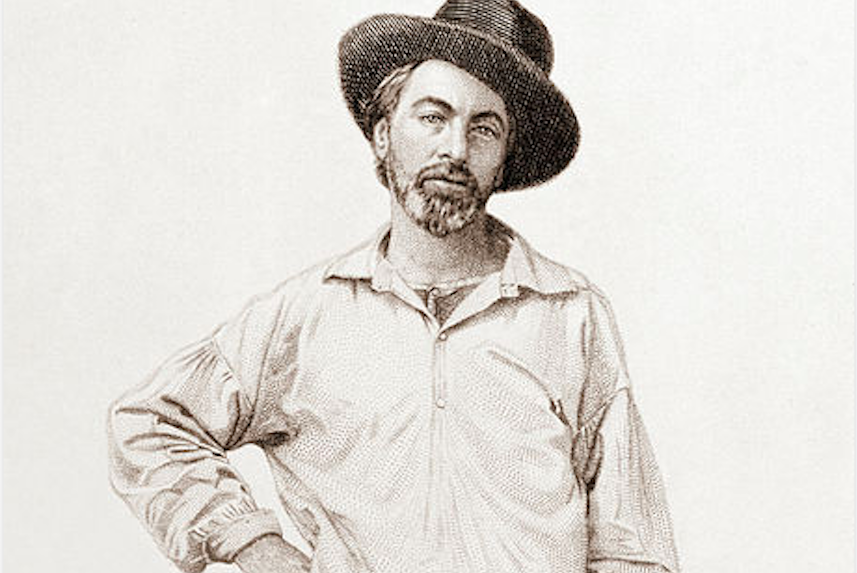
Morning Thanks--Walt Whitman
![]() |
| Whitman, the pose he loved |
Take a deep breath. This single sentence ambles along for a decade or so.
For years past, thousands of people in New York, in Brooklyn, in Boston, in New Orleans, and latterly in Washington, have seen, even as I saw two hours ago, tallying, one might say, the streets of our American cities, and fit to have for his background and accessories their streaming populations and ample and rich façades, a man of striking masculine beauty—a poet—powerful and venerable in appearance; large, calm, superbly formed; oftenest clad in the careless, rough, and always picturesque costume of the common people; resembling, and generally taken by strangers for some great mechanic or stevedore, or seaman, or grand laborer of one kind or another; and passing slowly in this guise, with nonchalant and haughty step along the pavement, with the sunlight and shadows falling around him.Supposedly, it's from the pen of a man named William Douglas O'Connor, who is defending the American poet Walt Whitman, the character described in that book-length sentence. There lies a tale.
Whitman, who shook my timbers when I took American Literature in my sophomore year in college, was, well, "an outfit," as my mother-in-law used to say about those who wandered substantively from the norm. And Whitman did every way.
The atmosphere is not a perfume, it has no taste of the distillation, it is odorless,Dozens of such lines (from "Song of Myself") weren't standard poetic fare in 1865. Shoot, they're hardly standard today. I doubt they've ever been printed on a Hallmark Card, despite the fact that most every kid who's ever taken American Lit had to read them, as I did, at one time or another--and as I assigned them to be read for forty classroom years.
It is for my mouth forever, I am in love with it,
I will go to the bank by the wood and become undisguised and naked,
I am mad for it to be in contact with me.
Such weird swagger was sacrilege to some--to Willa Cather, for instance, half a century later, in fact. Yet today, I'm guessing some parents would rather that Whitman be politely passed over during classroom discussion. How many people you know howl about how much he enjoys the scent of his own armpits.
It's understandable why a senator, from Iowa no less, and Mr. James Harlan, would go ballistic when he discovered that unrighteous Walt Whitman was working for the government of the United States, a low-level clerk in the Department of the Interior to be sure, but just the same--that hedonist on the government payroll? Say it ain't so, Sen. Harlan screamed. Something has to be done.
And something was. Didn't take long and Sen. James Harlan, he of the Tall Corn State, had Walt Whitman fired.
That's when William Douglas O'Connor--he of that long gracious sentence above--came to the poet's defense, both in words--
He has given his thought, his life, to this beautiful ambition, and, still young, he has grown gray in its service. He has never married; like Giordano Bruno, he has made Thought in the service of his fellow-creatures his bella donna, his best beloved, his bride. His patriotism is boundless. It is no intellectual sentiment; it is a personal passion.--as well as in action, getting Whitman yet another low-level position in the office of the Attorney General. "The Good Gray Poet," a long essay O'Connor penned, slowly altered the view of Walt Whitman held by thousands of Americans.
(A secret? There are those who think O'Connor never touched a pen to paper. There are those who believe the man who wrote all that puffery was named Whitman. Hey, mum's the word.)
And Whitman? --I can't imagine he changed a bit, eccentric, yet personable, outrageous yet oddly reverent about the whole idea, the promise of democracy, of America. Whether you like him or even understand him, Leaves in Grass is in every last American Lit anthology, and deservedly so.
About James Harlan I don't know much. I'll look him up.
And Whitman? --I can't imagine he changed a bit, eccentric, yet personable, outrageous yet oddly reverent about the whole idea, the promise of democracy, of America. Whether you like him or even understand him, Leaves in Grass is in every last American Lit anthology, and deservedly so.
About James Harlan I don't know much. I'll look him up.
Give him this at least--the Senator from the Tall Corn State at least made the history books--a footnote maybe, but he's there, 150 years later, still in the wardrobe of a prune.
Today is Whitman's birthday.
Just sayin'.
Subscribe to:
Posts (Atom)