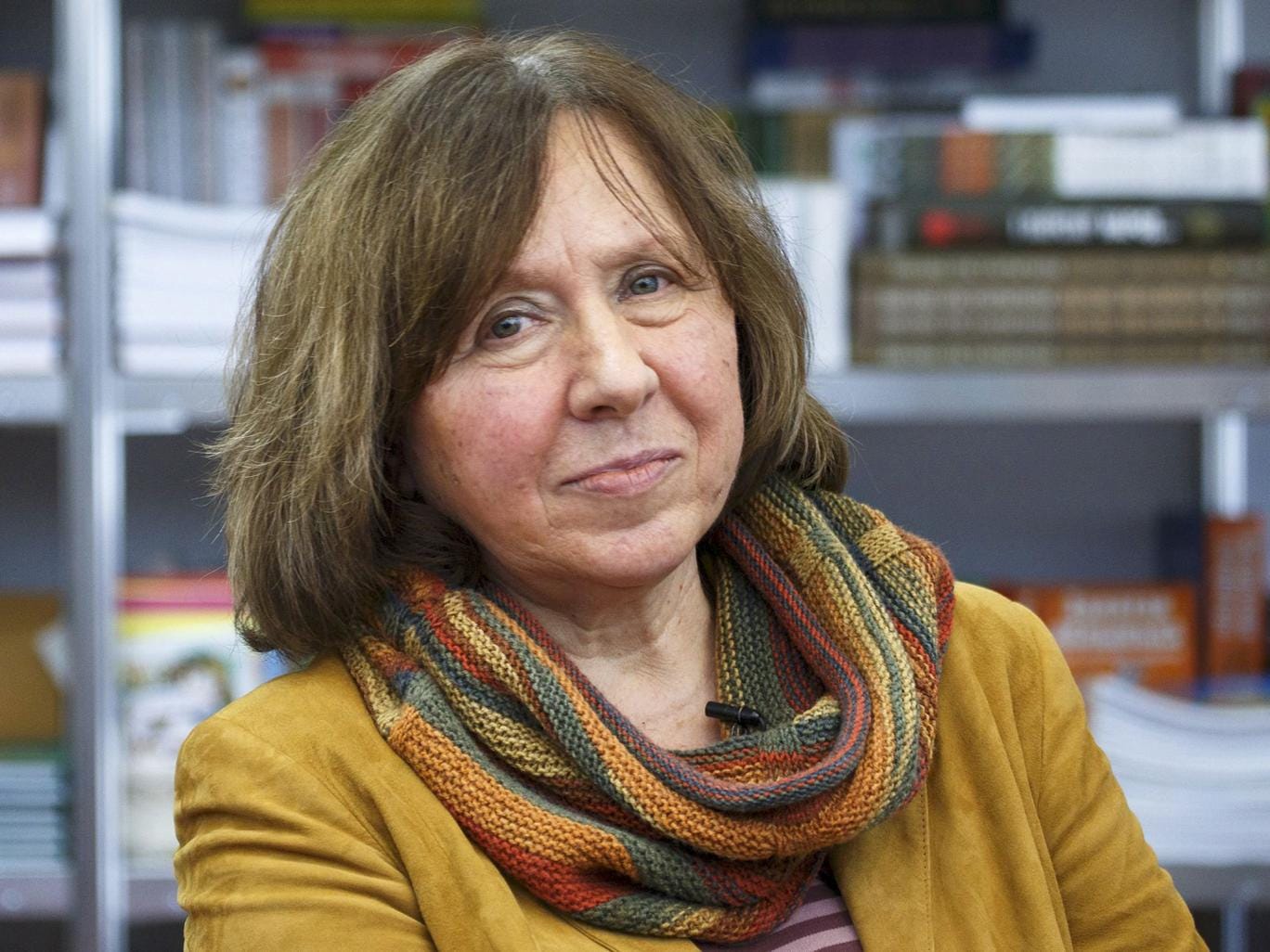
I'm searching life for observations, nuances, details. Because my interest in life is not the event as such, not war as such, not Chernobyl as such, not suicide as such. What I am interested in is what happens to the human being, what happens to it in of our time. How does man behave and react. How much of the biological man is in him, how much of the man of his time, how much man of the man.If you're wondering who Svetlana Alexievich is, you're not alone. Most recognized for a book she did on the Chernobyl, Voices from Chernobyl, she is primarily a journalist, and her work consists of interviews done with hundreds, even thousands of people, interviews she uses to define world events as massive as the Second World War (The Unwomanly Face of War).
Last week, she was awarded the 2015 Nobel Prize for Literature.
Most recently, she published a collection of interviews over an even broader subject--our mutual humanity. Most of us--me included--know her only by what we have been able to read about her since the award. Her webpage is greatly helpful.
Most recently, she published a collection of interviews over an even broader subject--our mutual humanity. Most of us--me included--know her only by what we have been able to read about her since the award. Her webpage is greatly helpful.
What's in this latest work of hers, The Wonderful Deer of the Eternal Hunt? What will we find in the interviews she includes? Here's what she says:
That's what Svetlana Alexievich knows, and that's what Svetlana Alexievich does. She may not be an imaginative writer, but she certainly tells stories that define us, that are us. I'm anxious to read some myself.
That everything turns into memories. That each life is interesting in its own way. That without death you can't understand life. That love plunges us into the depths of our own selves. That human beings are neither saints nor satans but somewhere in between. That our knowledge is powerless. That in love people look for the same things as in war and crime. That each one of us conceals both men and women. That we live among shadows, among the impossible and the unrealized. That in love you may disappear as in death. That the real life and death of the body is inaccessible to us. That Christ was also a man. That you can die from love during the war. That everyone may recall what he/she would like to conceal. That all creatures in this world love one another - flowers, trees, butterflies, worms, birds. That no modern technology can free us from the need to love, feel and suffer.
There's more, more of the same. Her own summary of Wonderful Deer ends by describing the stories her subjects tell as being basically "about people's desire and failure to find happiness."
That she was chosen is quite unusual. If you're wondering whether the Nobel Prize for Literature has ever been given to a journalist, you're not alone.
That she was chosen is quite unusual. If you're wondering whether the Nobel Prize for Literature has ever been given to a journalist, you're not alone.
The answer is no. This is new.
I wish--I really do--that I could read The Wonderful Deer of the Eternal Hunt because it sounds magnificent, although I'm more than a little wary of reading nothing but "failure to find happiness." Still, in my own life of interviewing people for writing projects (Crossing Over, On the Trail of the Spirit, Rehoboth, Our Family Album), I can't begin to describe how much I've learned by simply listening to the stories of people's lives.
One of the most dramatic and powerful moments I experienced in the last couple of years happened when four Christian men deeply involved in a difficult racial decision on Chicago's west side talked about that experience forty years ago--remembered and cried, not because they believed they were wrong in ruling what they did, but because the decision was back then and remains today so harrowing, so impossible.
Once upon a time in a long interview, I asked a Laotian woman whether she liked working in a packing plant. I knew very well that lots of white Iowans would have done anything not to have to spend their days wielding a knife on a hanging hog carcass. She looked up at the translator who was with me and shook her head. She didn't understand the question.
I repeated it. "Ask her if she likes her job at the plant," I told the translator. "Not everyone would."
She looked at him as if he was the idiot in the room, then gave him an answer she seemed to say was self-evident.
Once upon a time in a long interview, I asked a Laotian woman whether she liked working in a packing plant. I knew very well that lots of white Iowans would have done anything not to have to spend their days wielding a knife on a hanging hog carcass. She looked up at the translator who was with me and shook her head. She didn't understand the question.
I repeated it. "Ask her if she likes her job at the plant," I told the translator. "Not everyone would."
She looked at him as if he was the idiot in the room, then gave him an answer she seemed to say was self-evident.
He listened, then looked at me. "She says back home she had to do all of the butchering."
At that moment, I was embarrassed. I was a Joe American, a cultural blind man. At the packing plant, dressed well in a protective smock, she made just one or two cuts on the pork that came up the line. In Laos, she had to butcher the whole animal. The packing plant was a dream come true.
When you listen to people, it's remarkable how much you can learn. When you ask them to tell their stories, what results is whole libraries of incredible narratives.
At that moment, I was embarrassed. I was a Joe American, a cultural blind man. At the packing plant, dressed well in a protective smock, she made just one or two cuts on the pork that came up the line. In Laos, she had to butcher the whole animal. The packing plant was a dream come true.
When you listen to people, it's remarkable how much you can learn. When you ask them to tell their stories, what results is whole libraries of incredible narratives.
That's what Svetlana Alexievich knows, and that's what Svetlana Alexievich does. She may not be an imaginative writer, but she certainly tells stories that define us, that are us. I'm anxious to read some myself.
jordan pas cher, louboutin pas cher, louis vuitton outlet, polo ralph lauren outlet online, tiffany and co, longchamp outlet, christian louboutin outlet, louis vuitton, ray ban sunglasses, air max, uggs on sale, nike free, oakley sunglasses, louis vuitton outlet, replica watches, jordan shoes, longchamp pas cher, ray ban sunglasses, michael kors pas cher, tiffany jewelry, oakley sunglasses wholesale, longchamp outlet, christian louboutin shoes, louis vuitton outlet, nike outlet, christian louboutin uk, nike air max, gucci handbags, tory burch outlet, nike air max, ugg boots, oakley sunglasses, cheap oakley sunglasses, prada handbags, polo ralph lauren, replica watches, nike free run, ugg boots, prada outlet, polo outlet, burberry pas cher, louis vuitton, ray ban sunglasses, sac longchamp pas cher, chanel handbags, longchamp outlet, nike roshe, oakley sunglasses
ReplyDeletesac vanessa bruno, michael kors, ralph lauren uk, kate spade, nike blazer pas cher, burberry handbags, lululemon canada, nike tn, coach purses, north face, coach outlet, vans pas cher, abercrombie and fitch uk, uggs outlet, sac hermes, timberland pas cher, coach outlet store online, converse pas cher, replica handbags, hogan outlet, hollister pas cher, guess pas cher, mulberry uk, nike air max uk, michael kors outlet online, uggs outlet, nike air max, nike air force, true religion jeans, burberry outlet, ray ban pas cher, north face uk, michael kors outlet, michael kors, ray ban uk, oakley pas cher, new balance, michael kors outlet, nike air max uk, michael kors outlet online, polo lacoste, true religion outlet, michael kors outlet, michael kors outlet online, true religion outlet, michael kors outlet online, nike roshe run uk, hollister uk
ReplyDeleteherve leger, lululemon, reebok outlet, ferragamo shoes, wedding dresses, louboutin, longchamp uk, gucci, converse outlet, new balance shoes, mont blanc pens, nike air max, celine handbags, nike roshe run, hollister, nike trainers uk, p90x workout, beats by dre, mcm handbags, converse, nfl jerseys, instyler, nike air max, ralph lauren, valentino shoes, hollister, ghd hair, giuseppe zanotti outlet, abercrombie and fitch, vans, iphone cases, nike huaraches, baseball bats, vans outlet, hermes belt, chi flat iron, hollister clothing, babyliss, asics running shoes, oakley, soccer shoes, north face outlet, ray ban, mac cosmetics, timberland boots, bottega veneta, jimmy choo outlet, soccer jerseys, north face outlet, insanity workout
ReplyDeletecanada goose jackets, canada goose outlet, louis vuitton, ugg pas cher, hollister, doudoune moncler, ugg, ugg,uggs,uggs canada, moncler, louis vuitton, pandora jewelry, replica watches, moncler outlet, moncler uk, barbour, juicy couture outlet, barbour uk, lancel, canada goose, juicy couture outlet, swarovski crystal, pandora charms, louis vuitton, marc jacobs, moncler outlet, moncler, louis vuitton, swarovski, pandora uk, karen millen uk, canada goose outlet, ugg,ugg australia,ugg italia, moncler, ugg uk, montre pas cher, toms shoes, moncler, supra shoes, links of london, canada goose uk, wedding dresses, canada goose, canada goose, thomas sabo, canada goose outlet, louis vuitton, pandora jewelry, coach outlet
ReplyDelete